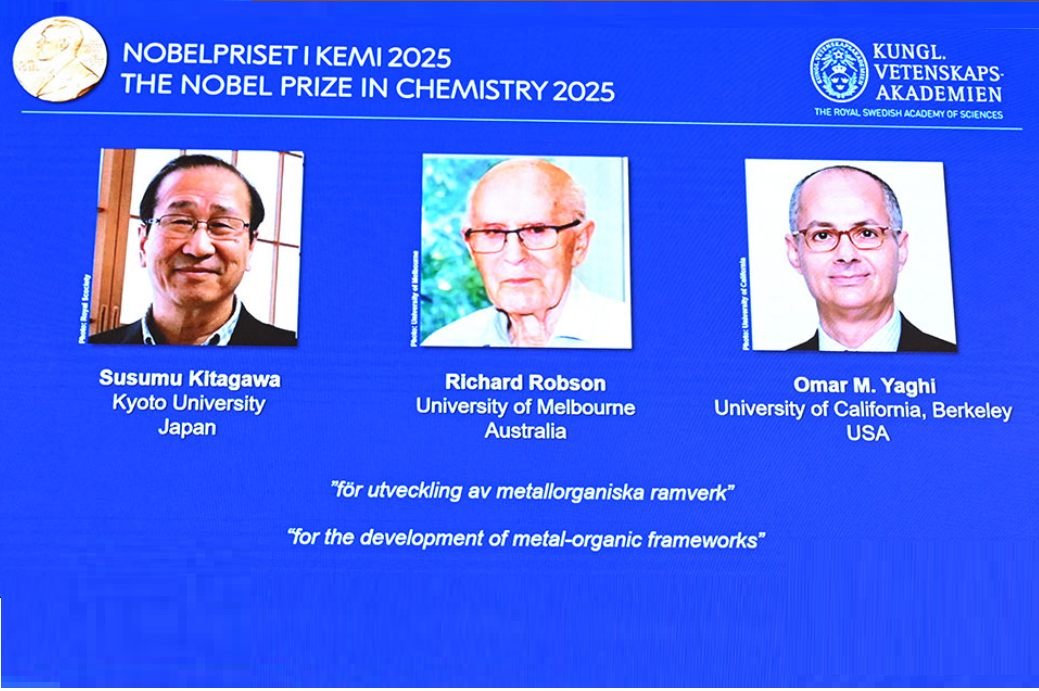
The 2025 Nobel Prize in Chemistry has been awarded to three pioneering scientists for developing metal–organic frameworks (MOFs)—ingeniously designed “molecular cages” made from metal atoms connected by organic linkers. These crystalline structures, resembling molecular Swiss cheese, have revolutionized materials science by offering a way to capture, store, and separate gases with exceptional precision. Science.
Nobel Laureates:
-
Susumu Kitagawa – Kyoto University (Japan)
-
Richard Robson – University of Melbourne (Australia)
-
Omar Yaghi – University of California, Berkeley (USA)
As early as the 18th century, chemists knew about Prussian Blue—a pigment with the unusual ability to trap water molecules within its structure. The modern counterparts of this compound are metal–organic frameworks, which the three laureates transformed into a powerful new class of materials.
Richard Robson first laid the groundwork in the 1980s by linking copper ions with nitrile groups to form open, cage-like crystalline networks. Although his materials were fragile, they proved that stable, porous molecular solids could exist—a visionary step that inspired a generation of chemists.
Susumu Kitagawa advanced this idea in the 1990s, creating robust three-dimensional frameworks that could absorb and release gases such as methane and oxygen without disintegrating. His pioneering work proved that MOFs could be made both stable and reusable, opening the door to practical applications in gas storage and separation.
The field’s true transformation came in 1999 with Omar Yaghi, who introduced MOF-5, a cubic structure with enormous internal surface area—just a few grams of it can cover a football field. By varying the length of organic linkers and exposing metal sites, Yaghi demonstrated that MOFs could be custom-built for specific functions. His philosophy—“If you think it, you can make it”—has since guided the synthesis of tens of thousands of new MOFs.
Today, metal–organic frameworks are being developed for clean energy storage, carbon dioxide capture, water harvesting, and catalysis. They can trap greenhouse gases, extract fresh water from desert air, and even act as filters for pollutants. As one researcher observed, “These materials are not only highly porous—they’re endlessly designable.”
Together, Kitagawa, Robson, and Yaghi have created a new frontier in chemistry. Their molecular architectures are helping humanity rethink how we use air, energy, and resources.