
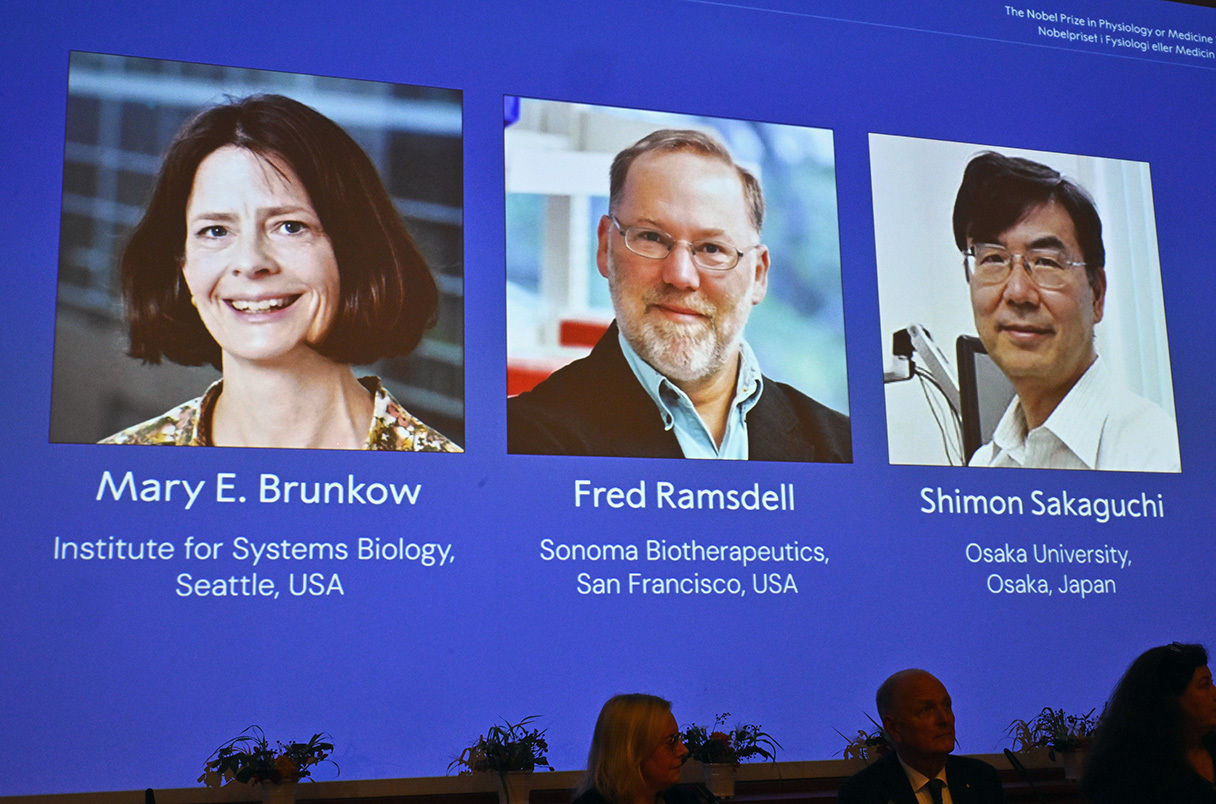
The Nobel Prize in Physiology or Medicine in 2025.
This year’s Nobel Prize in Physiology or Medicine has been awarded to three researchers for uncovering how the immune system tells the difference between the body’s own cells and invading threats. “Their pioneering research uncovered one of the immune system’s most critical regulatory mechanisms,” says Carola Vinuesa, a senior group leader studying autoimmunity at the Francis Crick Institute. “The recognition of their work is richly deserved.”
Shimon Sakaguchi (University of Osaka),
Mary Brunkow (Institute for Systems Biology, Seattle), and
Fred Ramsdell (Sonoma Biotherapeutics, San Francisco).
Their collective research revealed vital mechanisms that prevent the immune system from attacking the body’s own tissues—failures of which lead to autoimmune diseases—and has inspired new experimental therapies for cancer and immune disorders. Science
Their pioneering work unveiled one of immunology’s key control systems. As Carola Vinuesa of the Francis Crick Institute remarked, “Their research uncovered one of the immune system’s most critical regulatory mechanisms. The recognition of their work is richly deserved.”
The immune system relies on T cells to detect and destroy foreign invaders. However, some T cells mistakenly recognize the body’s own cells as enemies. Normally, these self-reactive cells are removed during development in the thymus—a process called central tolerance. In the 1990s, Sakaguchi discovered there was a second layer of protection: certain regulatory T cells (Tregs) expressing a protein called CD25 that suppress autoimmune reactions. His findings, first published in 1995, established Tregs as essential “peacekeepers” maintaining peripheral tolerance in the immune system.
At the same time, Brunkow and Ramsdell were studying scurfy mice, which suffer from severe autoimmune disease. Through meticulous genetic mapping, they identified a mutation on the X chromosome in a gene they named Foxp3—a transcription factor crucial for Treg development. The human equivalent, FOXP3, was later linked to the rare autoimmune syndrome IPEX, which causes severe inflammation in boys.
Later collaboration between these research lines confirmed that Foxp3 is the master regulator of Tregs, capable of transforming ordinary T cells into suppressive ones. These discoveries have since revolutionized immunology and laid the foundation for more than 200 clinical trials exploring how Tregs can be harnessed to treat diseases ranging from autoimmune disorders to cancer.
In some therapies, patients are given interleukin-2, a natural growth factor for Tregs, to enhance their protective effects. Conversely, in cancer research, scientists aim to reduce Treg activity to allow the immune system to better attack tumors.
Colleagues around the world have hailed the Nobel Committee’s decision. Holm Uhlig of Oxford called the announcement “amazing news,” while Thomas Boehm of the Max Planck Institute praised the recognition of Brunkow’s long-overlooked contributions.
Reflecting on the honor, Sakaguchi said he was “surprised and grateful,” emphasizing that the award celebrates the collaborative spirit of scientists worldwide. “I was never working alone,” he said. “This prize represents all those who contributed to this research.”
As Vinuesa noted, the 2025 Nobel highlights the power of basic science: “Discoveries made through curiosity-driven research decades ago are now shaping transformative medical treatments. Supporting such science is essential to fuel the breakthroughs of tomorrow.”