
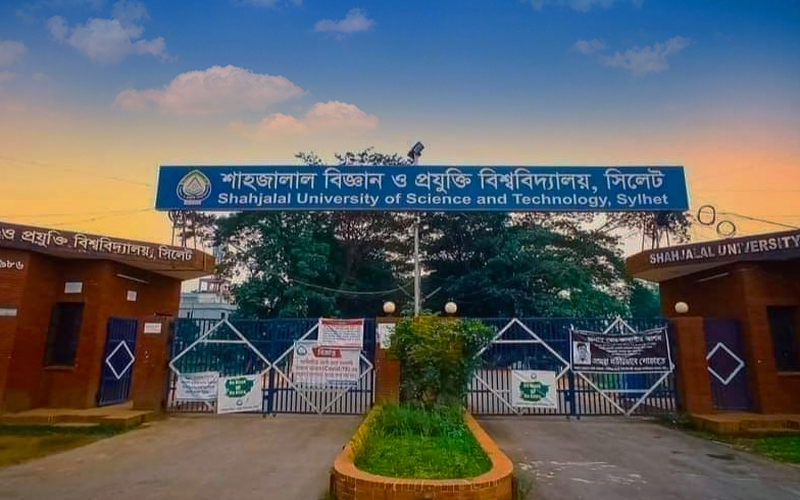
In 2025, Shahjalal University of Science and Technology (SUST) produced 398 Web of Science–indexed publications, demonstrating strong research activity and growing global collaboration. The majority of outputs are research articles (85.18%), followed by review articles (8.54%), indicating a primary focus on original research. The leading research areas include Environmental Sciences (11.3%), Multidisciplinary Sciences (9.0%), Food Science & Technology (7.79%), and Public Environmental & Occupational Health (7.79%), highlighting the university’s strong engagement in environmental, health, and sustainability-related topics. In terms of publishing platforms, Elsevier (32.9%), Springer Nature (15.6%), and Wiley (11.1%) dominate as major publishers of SUST research. International collaboration is notable, particularly with the USA (22.36%), Saudi Arabia (10.80%), Australia (10.30%), India (9.05%), and Canada (8.79%). Leading contributors include Syed Toukir Ahmed Noor, Mohammad A. Hasnat, and Ajit Ghosh, among others. The dataset also reflects strong accessibility with 250 open-access publications, along with 7 highly cited papers and 2 hot papers, indicating increasing global visibility and research impact. Web of Science
The areas of research publication categories in the TreeMap:
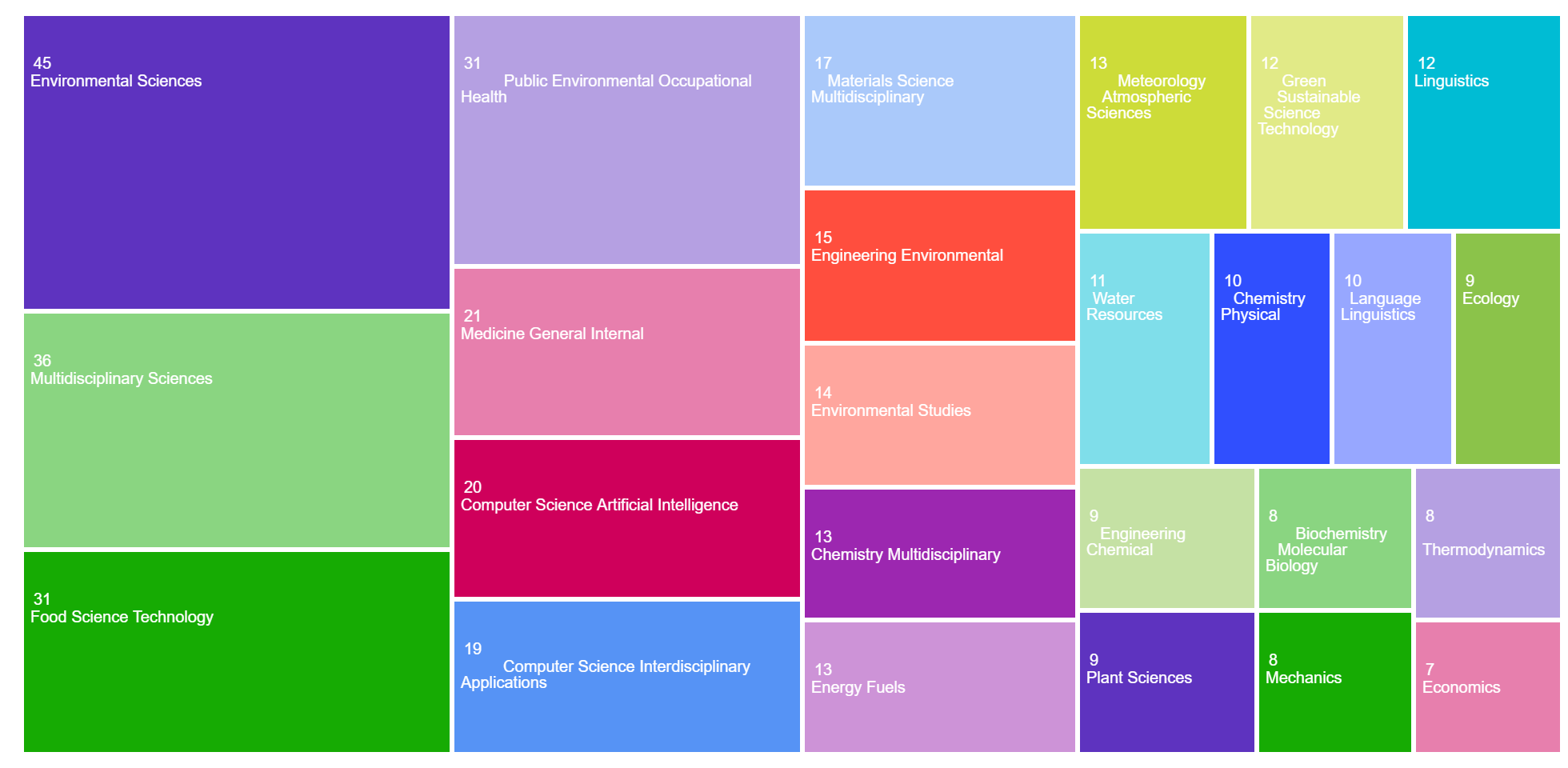
Research contributions in the field:
| Categories | Record Count | % of 398 |
|---|---|---|
| Environmental Sciences | 45 | 11.307% |
| Multidisciplinary Sciences | 36 | 9.045% |
| Food Science Technology | 31 | 7.789% |
| Public Environmental Occupational Health | 31 | 7.789% |
| Medicine General Internal | 21 | 5.276% |
| Computer Science Artificial Intelligence | 20 | 5.025% |
| Computer Science Interdisciplinary Applications | 19 | 4.774% |
| Materials Science Multidisciplinary | 17 | 4.271% |
| Engineering Environmental | 15 | 3.769% |
| Environmental Studies | 14 | 3.518% |
| Chemistry Multidisciplinary | 13 | 3.266% |
| Energy Fuels | 13 | 3.266% |
| Meteorology Atmospheric Sciences | 13 | 3.266% |
| Green Sustainable Science Technology | 12 | 3.015% |
| Linguistics | 12 | 3.015% |
| Water Resources | 11 | 2.764% |
| Chemistry Physical | 10 | 2.513% |
| Language Linguistics | 10 | 2.513% |
| Ecology | 9 | 2.261% |
| Engineering Chemical | 9 | 2.261% |
| Plant Sciences | 9 | 2.261% |
| Biochemistry Molecular Biology | 8 | 2.010% |
| Mechanics | 8 | 2.010% |
| Thermodynamics | 8 | 2.010% |
| Economics | 7 | 1.759% |
Research areas:
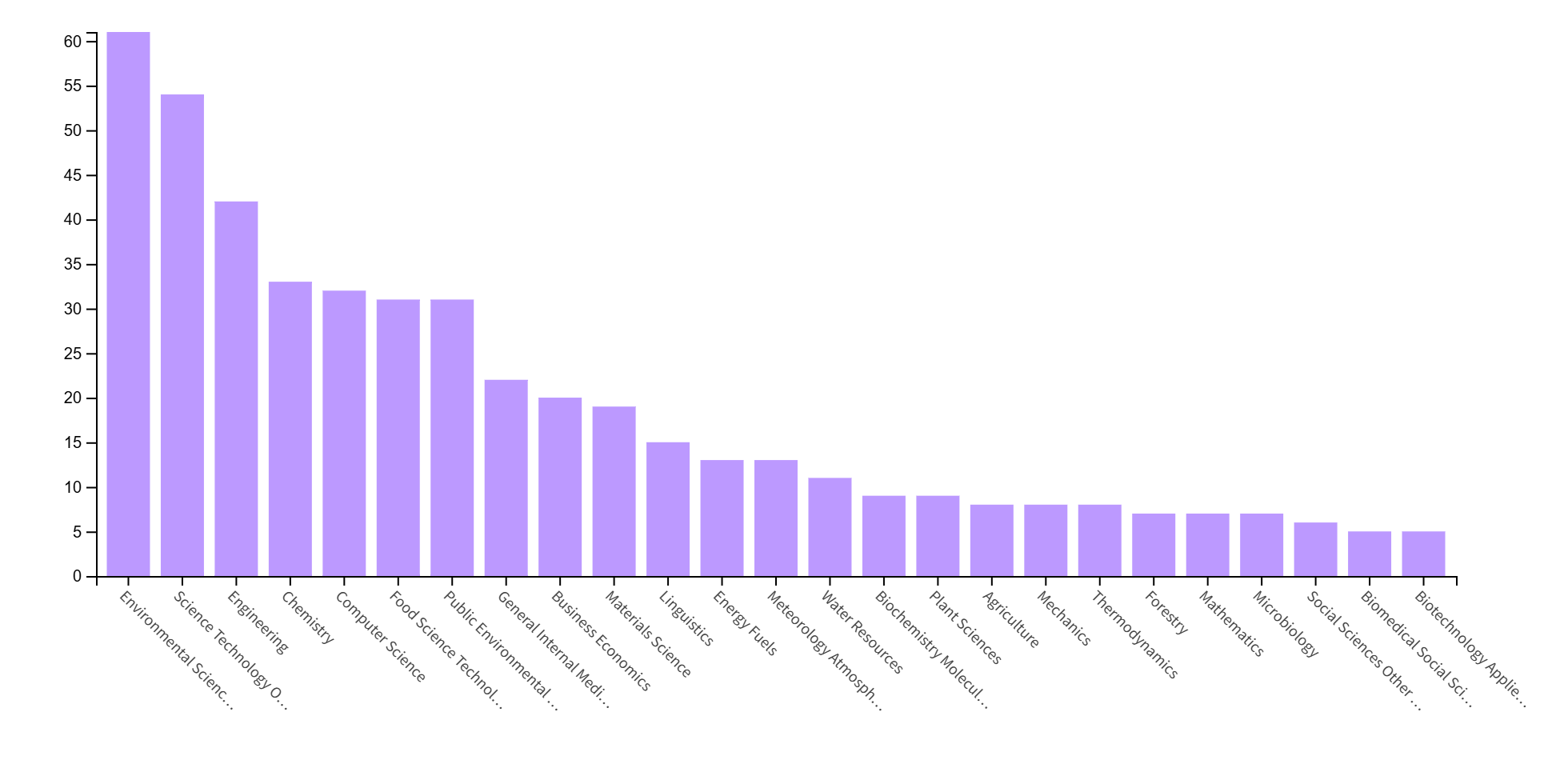
Types of published documents:
| Types | Record Count | % of 398 |
|---|---|---|
| Article | 339 | 85.176% |
| Review Article | 34 | 8.543% |
| Proceeding Paper | 16 | 4.020% |
| Early Access | 9 | 2.261% |
| Editorial Material | 3 | 0.754% |
| Correction | 2 | 0.503% |
| Letter | 2 | 0.503% |
| Meeting Abstract | 2 | 0.503% |
Authors’ infographic (Top 25):
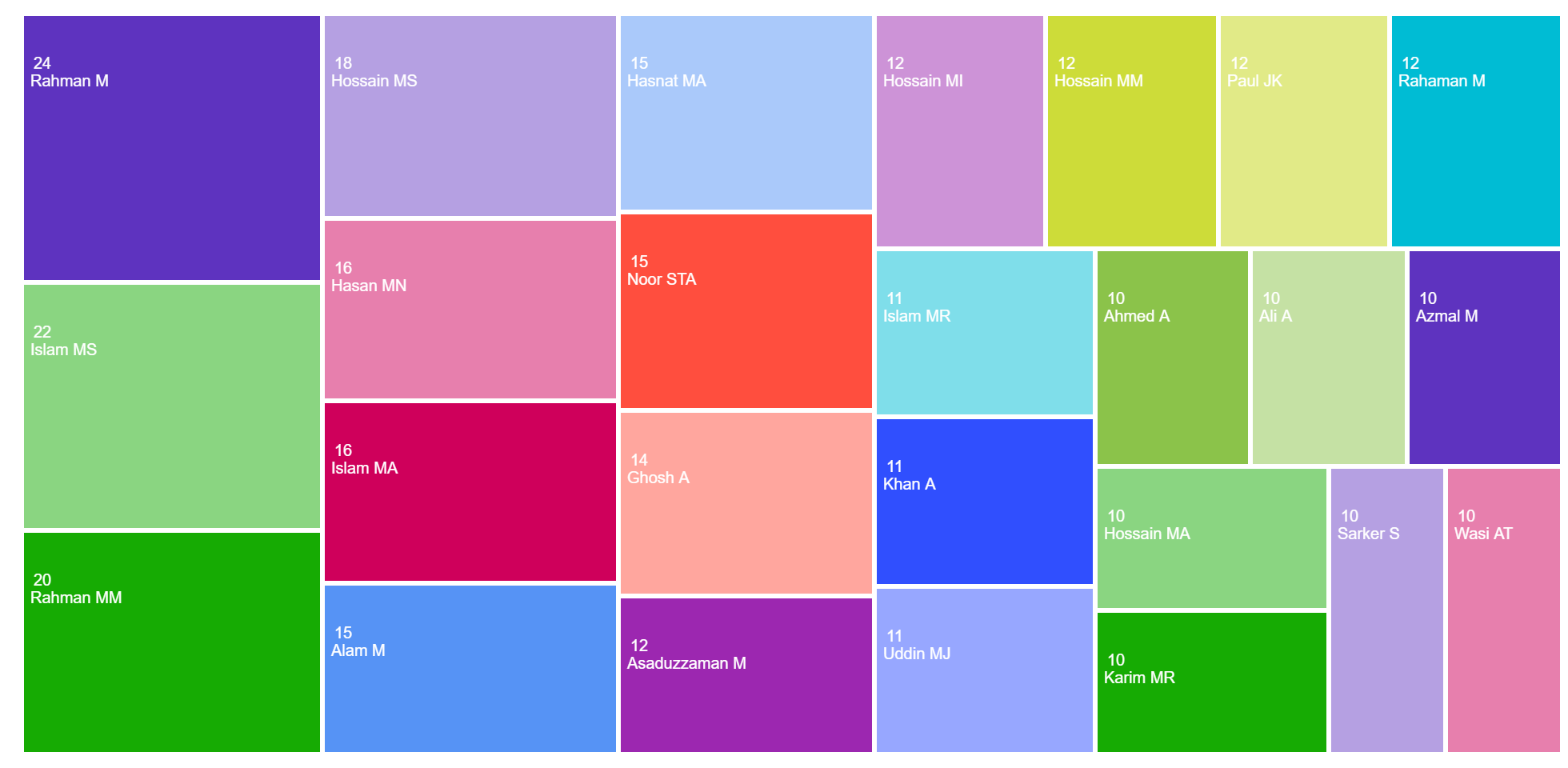
Researcher profiles (Top 25):
| Researchers | Record Count | % of 398 |
|---|---|---|
| Noor, Syed Toukir Ahmed | 15 | 3.769% |
| Hasnat, Mohammad A | 14 | 3.518% |
| Ghosh, Ajit | 13 | 3.266% |
| Paul, Jibon Kumar | 12 | 3.015% |
| Hasan, Mohammad Nayeem | 11 | 2.764% |
| Azmal, Mahir | 10 | 2.513% |
| ROUT, Himanshu Sekhar | 9 | 2.261% |
| Chattu, Vijay Kumar | 9 | 2.261% |
| Bhaskar, Sonu | 9 | 2.261% |
| Kulimbet, Mukhtar | 9 | 2.261% |
| Yon, Dong Keon | 9 | 2.261% |
| Mokdad, Ali H. | 9 | 2.261% |
| Lahariya, Chandrakant | 9 | 2.261% |
| Swain, Chandan Kumar | 9 | 2.261% |
| Saeed, Umar | 9 | 2.261% |
| Nargus, Shumaila | 9 | 2.261% |
| Uddin, Md. Jamal | 9 | 2.261% |
| Joseph, Nitin | 9 | 2.261% |
| Wasi, Azmine Toushik | 9 | 2.261% |
| Alam, Mahabub | 9 | 2.261% |
| Sethi, Yashendra | 9 | 2.261% |
| Menezes, Ritesh G | 8 | 2.010% |
| Siddig, Emmanuel Edwar | 8 | 2.010% |
| Mohamed, Nouh S. | 8 | 2.010% |
| Hosen, Mohammad J | 8 | 2.010% |
Research-affiliated institutes:
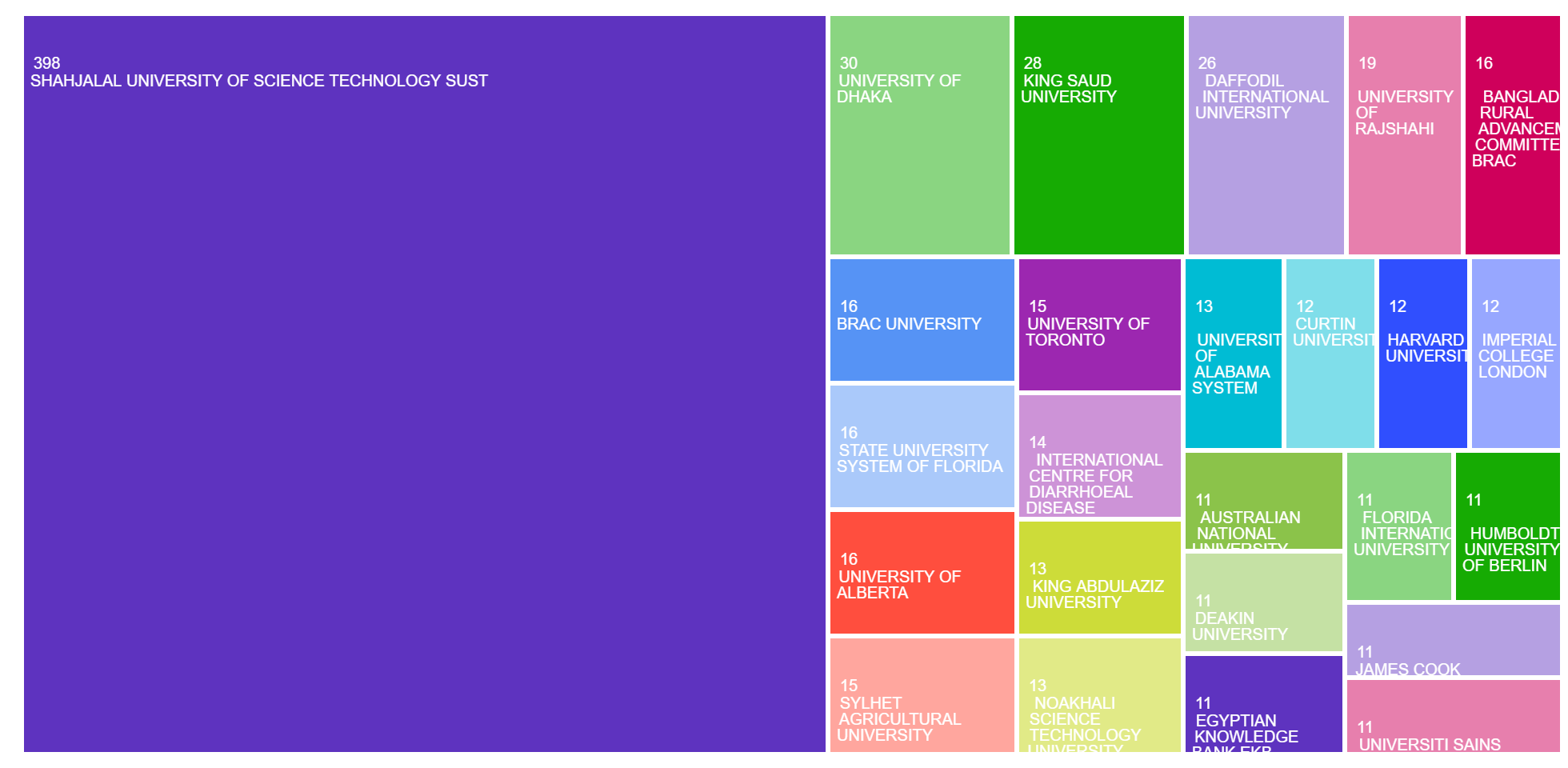
Research collaboration countries:
| Countries/Regions | Record Count | % of 398 |
|---|---|---|
| BANGLADESH | 398 | 100.000% |
| USA | 89 | 22.362% |
| SAUDI ARABIA | 43 | 10.804% |
| AUSTRALIA | 41 | 10.302% |
| INDIA | 36 | 9.045% |
| CANADA | 35 | 8.794% |
| JAPAN | 32 | 8.040% |
| MALAYSIA | 32 | 8.040% |
| ENGLAND | 28 | 7.035% |
| GERMANY | 25 | 6.281% |
| PEOPLES R CHINA | 25 | 6.281% |
| SOUTH KOREA | 24 | 6.030% |
| ITALY | 19 | 4.774% |
| NORWAY | 18 | 4.523% |
| BELGIUM | 15 | 3.769% |
| PAKISTAN | 15 | 3.769% |
| SPAIN | 15 | 3.769% |
| BRAZIL | 14 | 3.518% |
| GHANA | 14 | 3.518% |
| MEXICO | 14 | 3.518% |
| PORTUGAL | 14 | 3.518% |
| SWEDEN | 14 | 3.518% |
| INDONESIA | 13 | 3.266% |
| NETHERLANDS | 13 | 3.266% |
| TURKIYE | 13 | 3.266% |
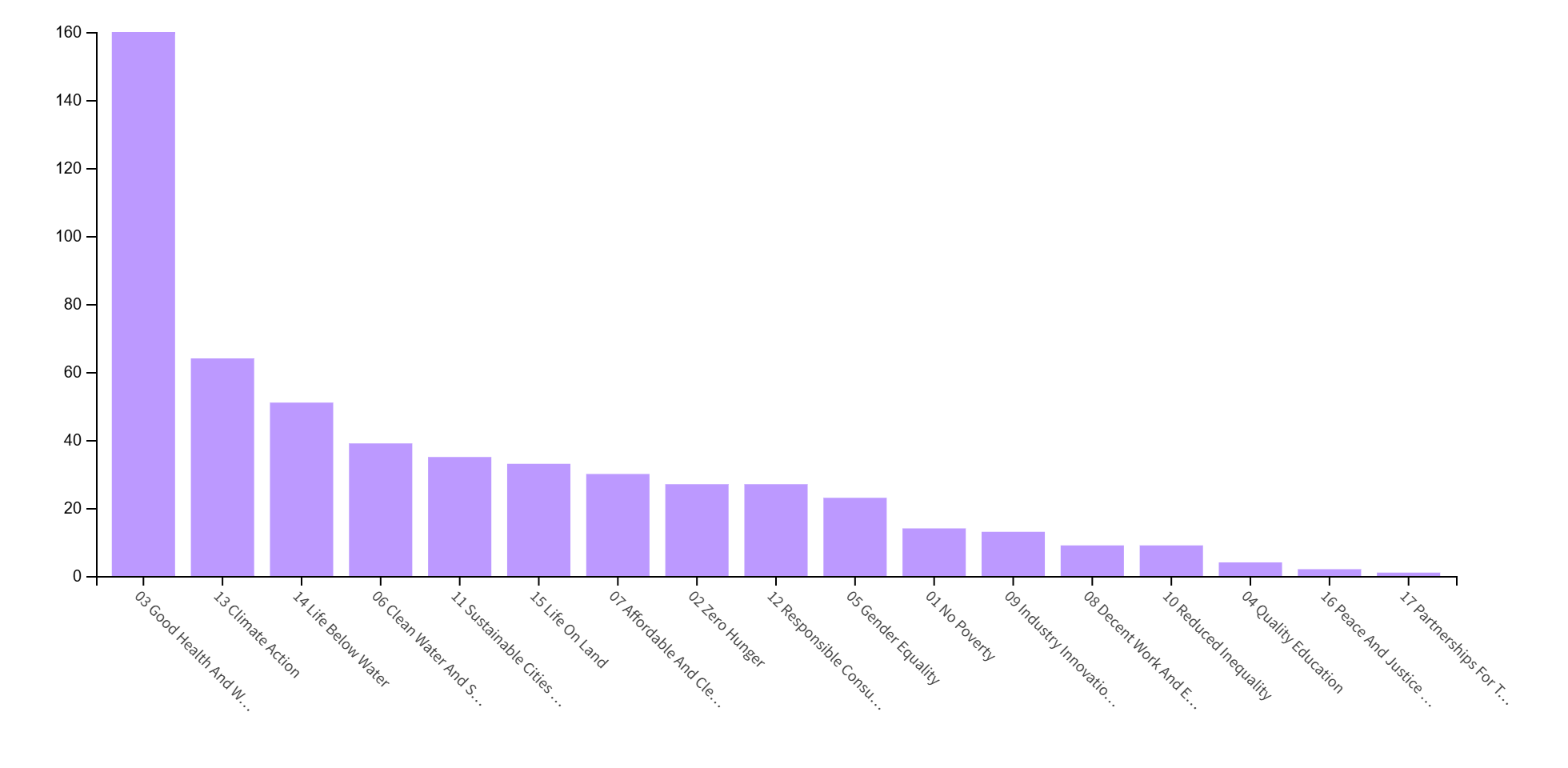
Sustainable Development Goals:
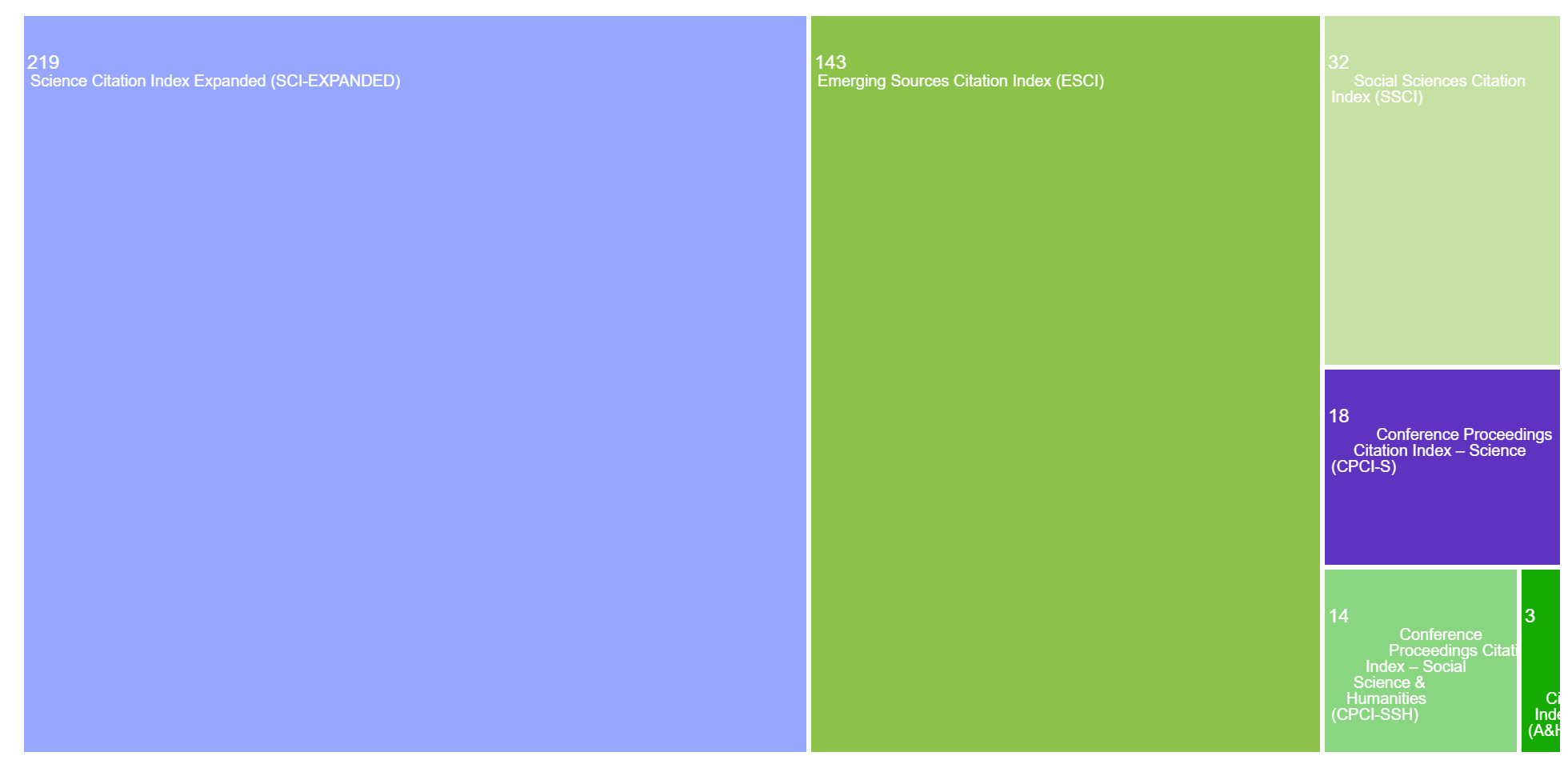
Web of Science Index:
Research highlights of SUST:
| Types | Results |
|---|---|
| Highly Cited Papers | 7 |
| Hot Papers | 2 |
| Review Article | 34 |
| Early Access | 9 |
| Open Access | 250 |
| Enriched Cited References | 198 |
| Open publisher-invited reviews | 1 |
Citation Index:
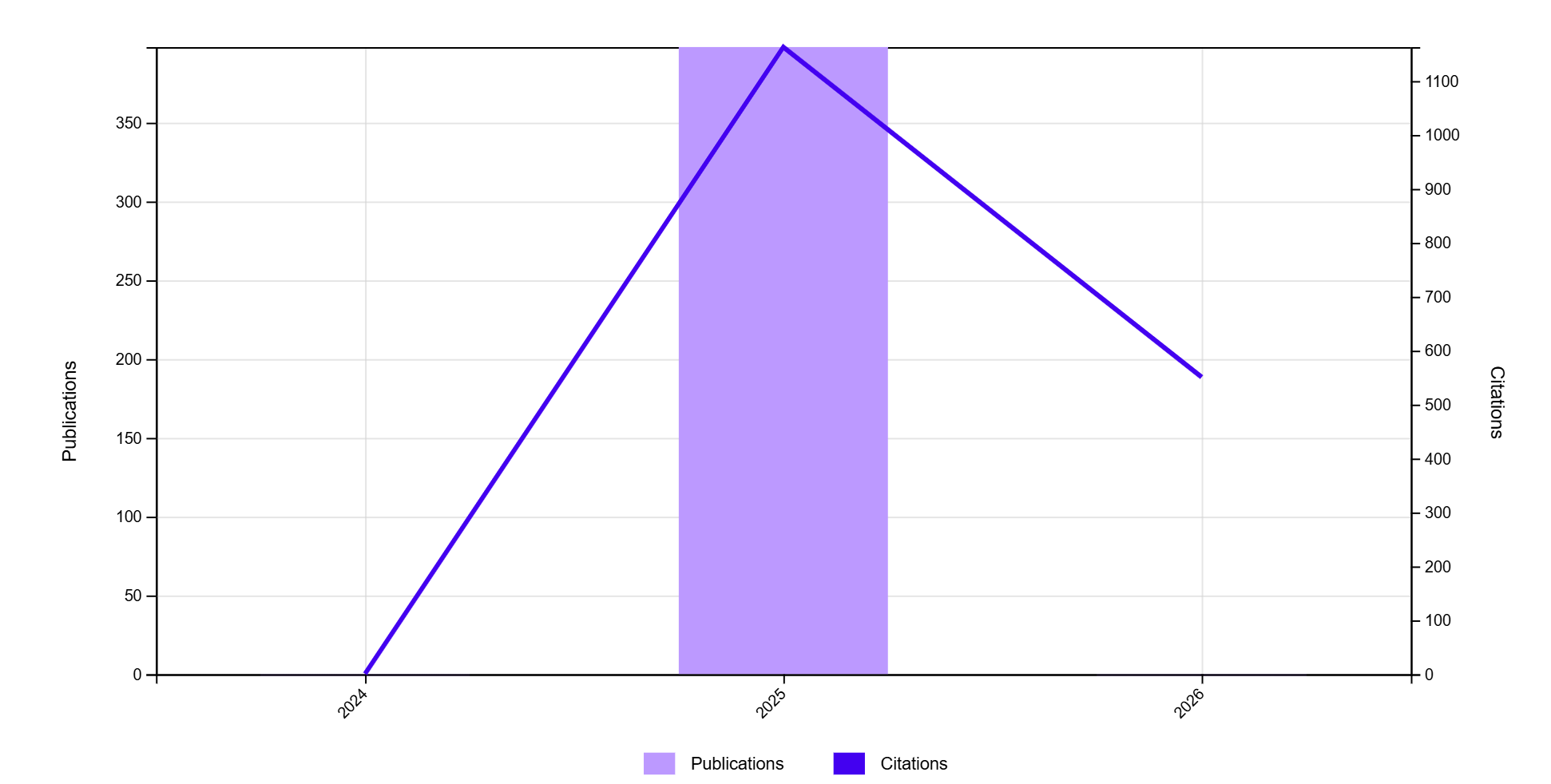
Publishers:
| Publishers | Record Count | % of 398 |
|---|---|---|
| Elsevier | 131 | 32.915% |
| Springer Nature | 62 | 15.578% |
| Wiley | 44 | 11.055% |
| Mdpi | 18 | 4.523% |
| Public Library Science | 18 | 4.523% |
| NATURE PORTFOLIO | 16 | 4.020% |
| Taylor & Francis | 15 | 3.769% |
| Assoc Computational Linguistics-Acl | 14 | 3.518% |
| Amer Chemical Soc | 8 | 2.010% |
| Frontiers Media Sa | 5 | 1.256% |
| SPRINGER INT PUBL AG | 5 | 1.256% |
| Sage | 5 | 1.256% |
| Royal Soc Chemistry | 4 | 1.005% |
| Amer Inst Mathematical Sciences-Aims | 3 | 0.754% |
| Cambridge Univ Press | 3 | 0.754% |
| Emerald Group Publishing | 3 | 0.754% |
| AIP Publishing | 2 | 0.503% |
| Amer Soc Microbiology | 2 | 0.503% |
| Bmj Publishing Group | 2 | 0.503% |
| Iwa Publishing | 2 | 0.503% |
| Keai Publishing Ltd | 2 | 0.503% |
| Wolters Kluwer Medknow Publications | 2 | 0.503% |
| Acoustical Soc Japan | 1 | 0.251% |
| Aesthetics Media Services-Aesthetixms | 1 | 0.251% |
| Amer Assoc Advancement Science | 1 | 0.251% |
Funding Agencies:
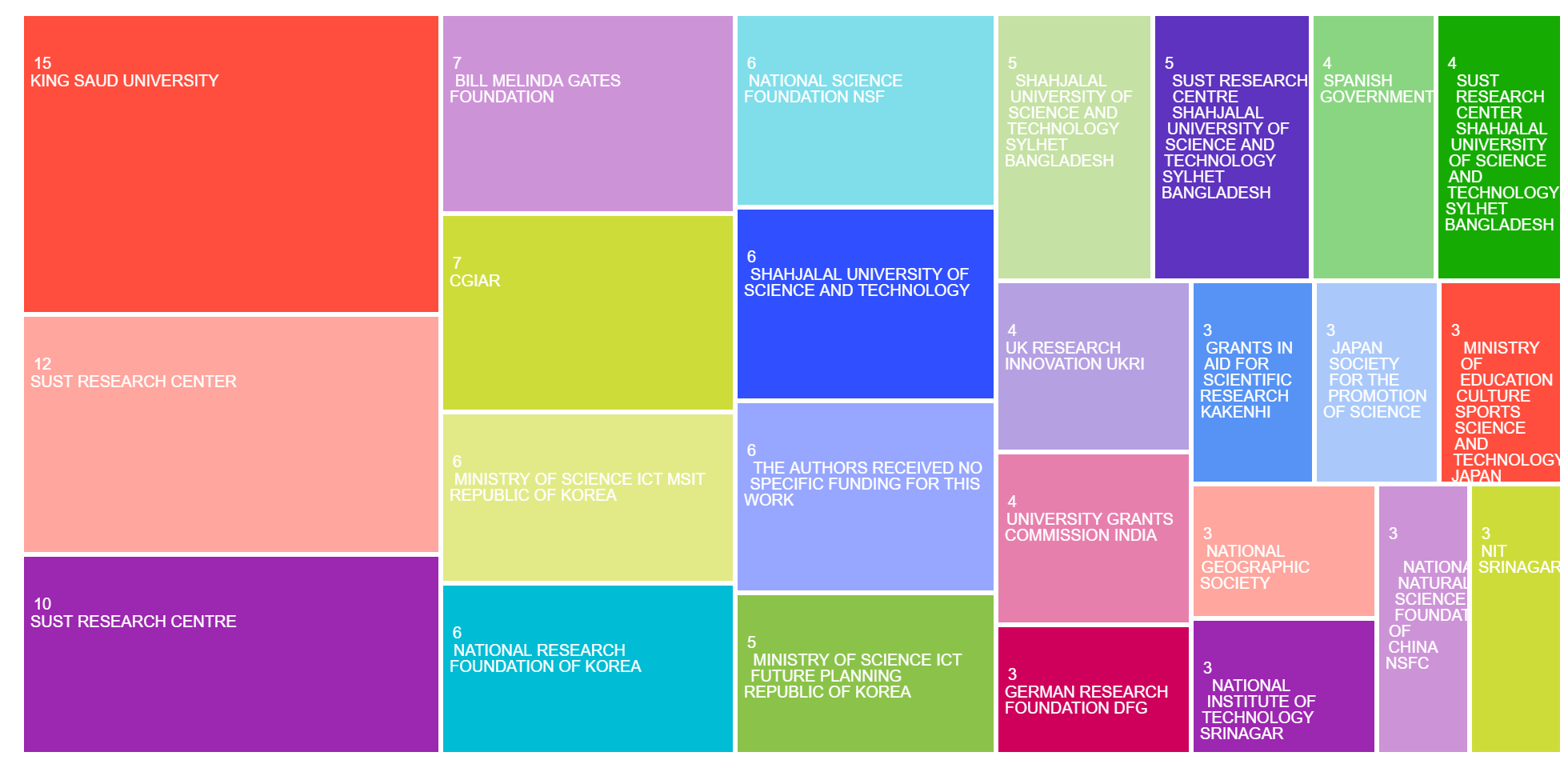
Observations:
-
Environmental and sustainability-related fields dominate SUST’s research output, suggesting a strategic focus on environmental and public health challenges.
-
Elsevier, Springer Nature, and Wiley together publish nearly 60% of the papers, showing a strong concentration in major international publishers.
-
International collaboration is significant, especially with the USA and several developed research nations, indicating strong global research connectivity.
Questions:
-
How can SUST further increase the number of highly cited and hot papers to strengthen global research impact?
-
Are there institutional strategies to diversify research fields, especially in emerging areas like advanced AI, biotechnology, or quantum technologies?
-
What mechanisms are in place to expand collaborations with top global universities and research institutes?
Overall, the 2025 publication profile shows that SUST is steadily strengthening its international research presence, with strong output in environmental and interdisciplinary sciences and growing collaborations with global research communities.