
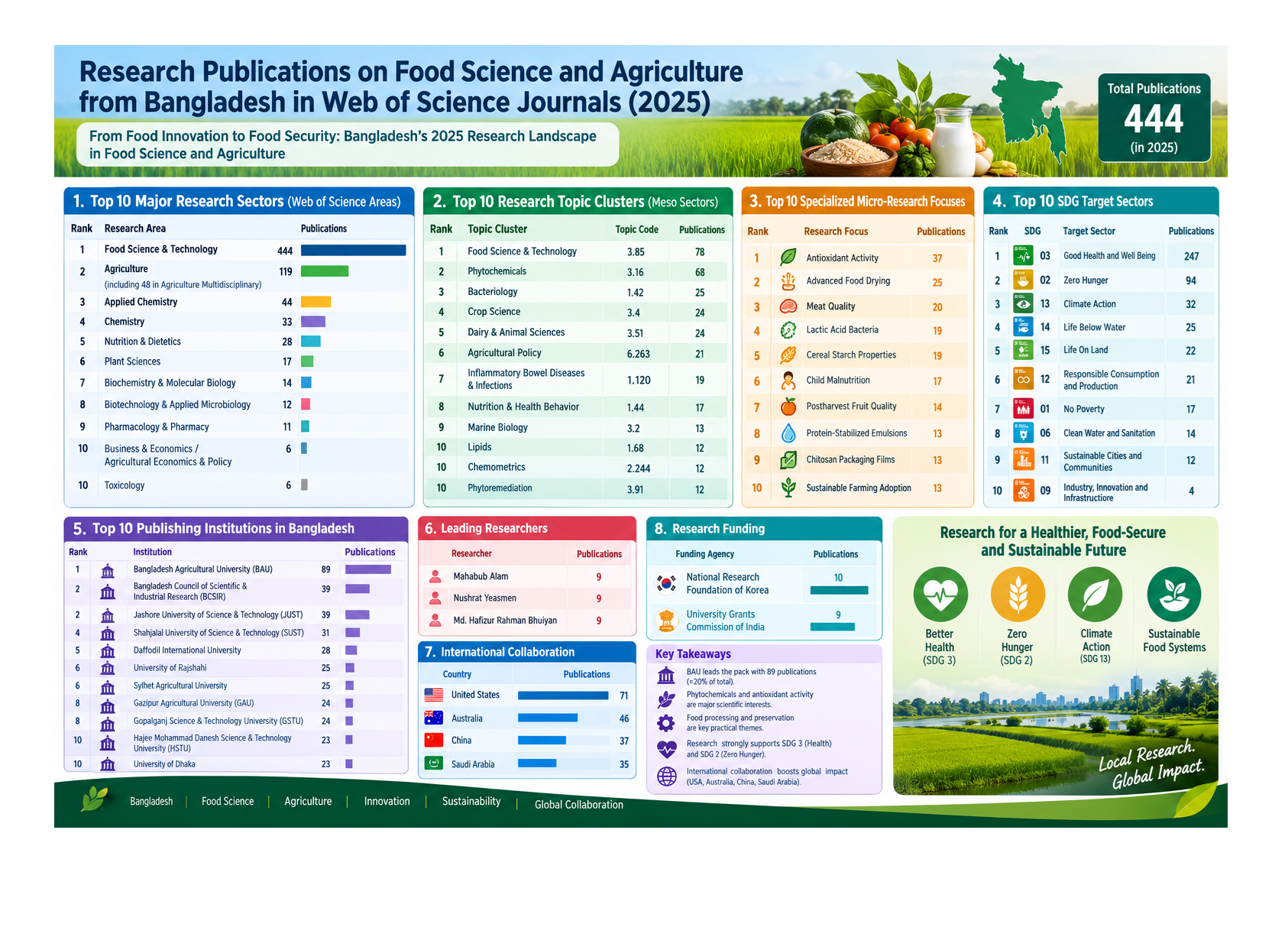
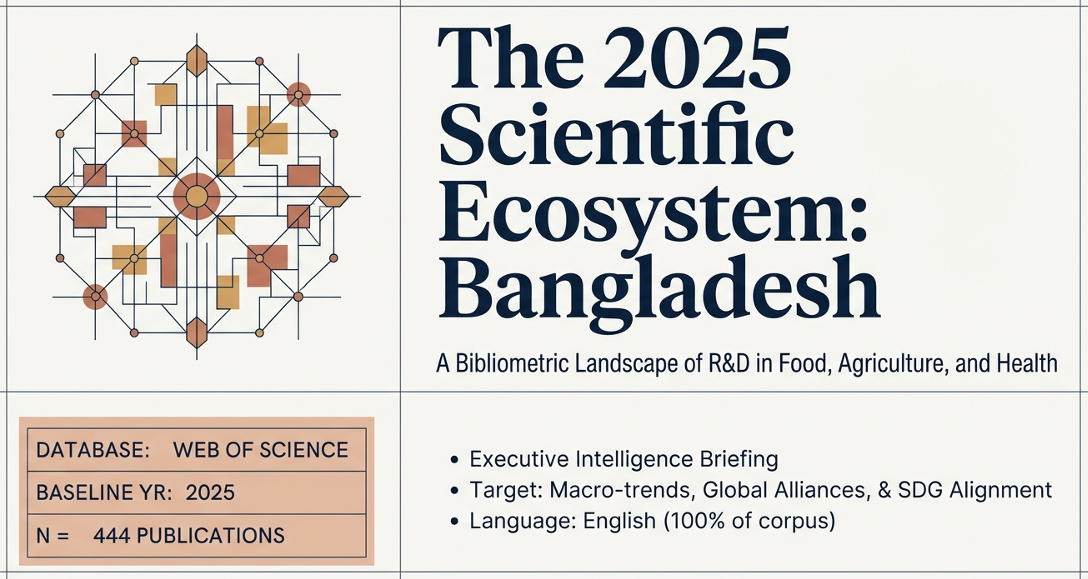
Food science and agriculture research published by Bangladeshi researchers in Web of Science-indexed journals in 2025 was characterized by strong attention to food technology, phytochemicals, agricultural production, nutrition, food safety, and sustainability. A total of 444 publication documents were recorded in the dataset. The research portfolio extended beyond conventional food science, incorporating agriculture, chemistry, nutrition, plant sciences, biotechnology, microbiology, pharmacology, economics, and toxicology. The distribution of research topics indicates that considerable emphasis was placed on the development of healthier and more sustainable food systems. Particular attention was given to antioxidant activity, advanced food drying, meat quality, lactic acid bacteria, cereal starch properties, postharvest fruit quality, protein-stabilized emulsions, chitosan-based packaging, and sustainable farming adoption. The strong representation of SDG 3 (Good Health and Well-Being) and SDG 2 (Zero Hunger) further indicates the health and food-security orientation of this research portfolio. Web of Science
Major Research Areas
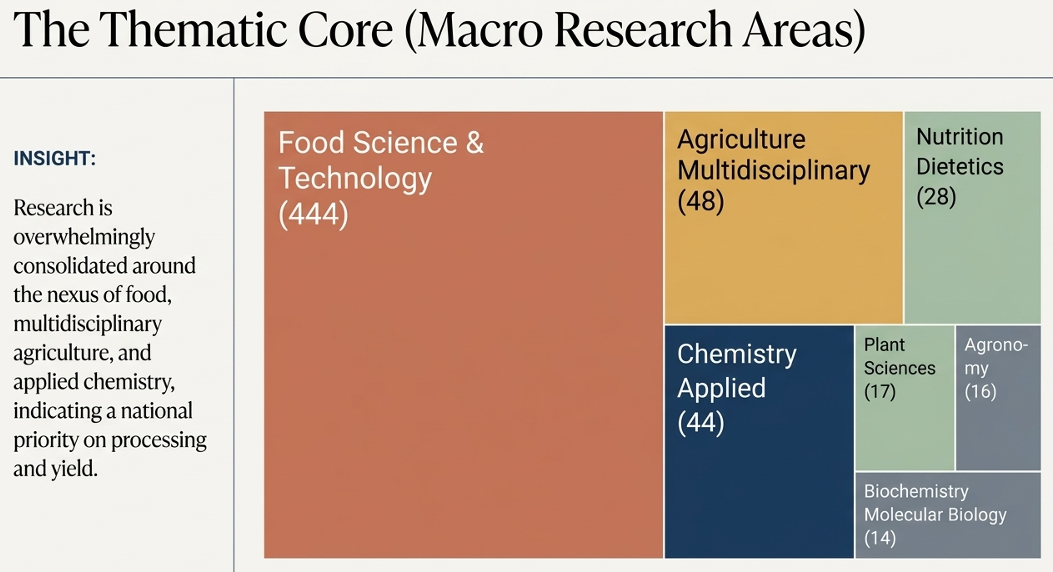
Although Food Science & Technology accounted for all 444 records in the supplied dataset, substantial interdisciplinary overlap was observed with agriculture and related scientific disciplines. Agriculture accounted for 119 publications, while applied chemistry, chemistry, nutrition, plant sciences, biochemistry, biotechnology, pharmacology, economics, and toxicology provided additional research dimensions.
| Rank | Web of Science Research Area | Publications |
|---|---|---|
| 1 | Food Science & Technology | 444 |
| 2 | Agriculture | 119 |
| 3 | Applied Chemistry | 44 |
| 4 | Chemistry | 33 |
| 5 | Nutrition & Dietetics | 28 |
| 6 | Plant Sciences | 17 |
| 7 | Biochemistry & Molecular Biology | 14 |
| 8 | Biotechnology & Applied Microbiology | 12 |
| 9 | Pharmacology & Pharmacy | 11 |
| 10 | Business & Economics / Agricultural Economics & Policy | 6 |
| 10 | Toxicology | 6 |
Within Agriculture, 48 publications were specifically classified under Agriculture Multidisciplinary, demonstrating the breadth of agricultural research represented in the dataset.
Major Research Topic Clusters
The research was distributed across several meso-level topic clusters. Food Science & Technology was the largest cluster, followed by research on phytochemicals, bacteriology, crop science, dairy and animal sciences, and agricultural policy.
| Rank | Research Topic Cluster | Topic Code | Publications |
|---|---|---|---|
| 1 | Food Science & Technology | 3.85 | 78 |
| 2 | Phytochemicals | 3.16 | 68 |
| 3 | Bacteriology | 1.42 | 25 |
| 4 | Crop Science | 3.4 | 24 |
| 5 | Dairy & Animal Sciences | 3.51 | 24 |
| 6 | Agricultural Policy | 6.263 | 21 |
| 7 | Inflammatory Bowel Diseases & Infections | 1.120 | 19 |
| 8 | Nutrition & Health Behavior | 1.44 | 17 |
| 9 | Marine Biology | 3.2 | 13 |
| 10 | Lipids | 1.68 | 12 |
| 10 | Chemometrics | 2.244 | 12 |
| 10 | Phytoremediation | 3.91 | 12 |
The prominence of phytochemicals, together with the large number of publications addressing antioxidant activity, suggests considerable research interest in biologically active compounds derived from food and agricultural resources.
Specialized Research Focuses
At the more specialized level, the dataset revealed a strong concentration on practical food-processing, food-quality, nutritional, and agricultural problems.
| Rank | Specialized Research Focus | Publications |
|---|---|---|
| 1 | Antioxidant Activity | 37 |
| 2 | Advanced Food Drying | 25 |
| 3 | Meat Quality | 20 |
| 4 | Lactic Acid Bacteria | 19 |
| 5 | Cereal Starch Properties | 19 |
| 6 | Child Malnutrition | 17 |
| 7 | Postharvest Fruit Quality | 14 |
| 8 | Protein-Stabilized Emulsions | 13 |
| 9 | Chitosan Packaging Films | 13 |
| 10 | Sustainable Farming Adoption | 13 |
Antioxidant Activity and Phytochemicals
Antioxidant activity was the largest specialized research focus, with 37 publications. This emphasis was closely related to the substantial research cluster devoted to phytochemicals. Such research encompasses the characterization and application of naturally occurring compounds in foods and agricultural materials and their potential nutritional and functional applications.
Advanced Food Drying
Advanced food drying accounted for 25 publications, making it one of the most prominent technology-oriented research areas. Drying technologies are particularly relevant to agricultural systems in which the preservation of perishable crops, reduction of postharvest losses, and extension of shelf life are important considerations.
Meat Quality and Lactic Acid Bacteria
Research on meat quality (20 publications) and lactic acid bacteria (19 publications) demonstrates attention to both animal-derived food products and microbial food technologies. These areas encompass food quality, preservation, fermentation, microbial functionality, and food safety.
Cereal Starch and Postharvest Research
Cereal starch properties accounted for 19 publications, reflecting the importance of cereal-based foods in food processing and nutrition. Meanwhile, 14 publications on postharvest fruit quality indicate continuing attention to maintaining agricultural product quality after harvesting.
Emerging Sustainable Food Technologies
Research on chitosan packaging films (13 publications) and protein-stabilized emulsions (13 publications) illustrates interest in functional food materials and alternative food-packaging technologies. The presence of sustainable farming adoption (13 publications) also indicates that agricultural research was addressing not only biological productivity but also farmer adoption and sustainability.
Alignment with the Sustainable Development Goals
A substantial proportion of the research was connected with the United Nations Sustainable Development Goals. The strongest association was observed with SDG 3 – Good Health and Well-Being, followed by SDG 2—Zero Hunger.
| Rank | SDG | Target Sector | Publications |
|---|---|---|---|
| 1 | SDG 03 | Good Health and Well-Being | 247 |
| 2 | SDG 02 | Zero Hunger | 94 |
| 3 | SDG 13 | Climate Action | 32 |
| 4 | SDG 14 | Life Below Water | 25 |
| 5 | SDG 15 | Life on Land | 22 |
| 6 | SDG 12 | Responsible Consumption and Production | 21 |
| 7 | SDG 01 | No Poverty | 17 |
| 8 | SDG 06 | Clean Water and Sanitation | 14 |
| 9 | SDG 11 | Sustainable Cities and Communities | 12 |
| 10 | SDG 09 | Industry, Innovation and Infrastructure | 4 |
The 247 publications associated with SDG 3 demonstrate the strong health dimension of Bangladesh’s food research. Nutrition, food bioactive compounds, food safety, dietary behavior, and related health research contributed to this orientation.
The 94 publications associated with SDG 2 highlight the food-security dimension. Research involving crops, agricultural production, food preservation, postharvest management, and sustainable farming contributed to this goal.
Research linked to SDG 13 (32 publications), SDG 14 (25), SDG 15 (22), and SDG 12 (21) further demonstrates that food and agricultural research was connected with climate change, aquatic ecosystems, terrestrial ecosystems, and responsible production.
Leading Research Institutions
Bangladesh Agricultural University (BAU) was the largest institutional contributor in the dataset, with 89 publications. It was followed by the Bangladesh Council of Scientific and Industrial Research (BCSIR) and Jashore University of Science & Technology (JUST), each with 39 publications.
| Rank | Institution | Publications |
|---|---|---|
| 1 | Bangladesh Agricultural University (BAU) | 89 |
| 2 | Bangladesh Council of Scientific and Industrial Research (BCSIR) | 39 |
| 2 | Jashore University of Science & Technology (JUST) | 39 |
| 4 | Shahjalal University of Science & Technology (SUST) | 31 |
| 5 | Daffodil International University | 28 |
| 6 | University of Rajshahi | 25 |
| 6 | Sylhet Agricultural University | 25 |
| 8 | Gazipur Agricultural University (GAU) | 24 |
| 8 | Gopalganj Science & Technology University (GSTU) | 24 |
| 10 | Hajee Mohammad Danesh Science & Technology University (HSTU) | 23 |
| 10 | University of Dhaka | 23 |
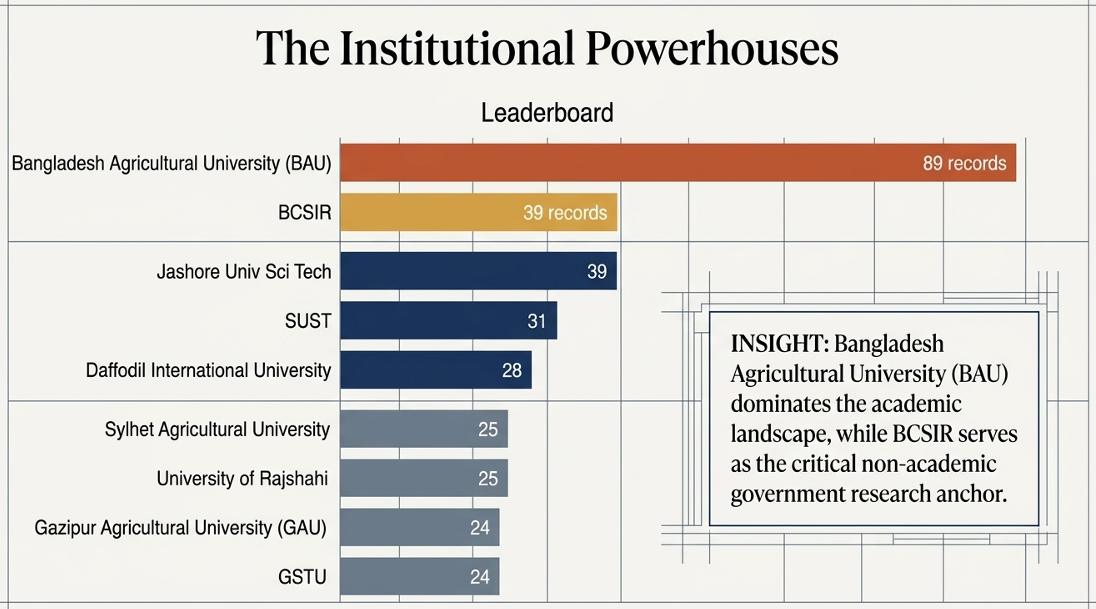
The institutional distribution demonstrates that food and agricultural research was being conducted across both specialized agricultural universities and broader science and technology institutions. BAU’s 89 publications represented approximately 20% of the 444-document dataset, highlighting its substantial contribution to the national publication output represented here.
Leading Researchers
The supplied dataset identifies Mahabub Alam, Nushrat Yeasmen, and Md. Hafizur Rahman Bhuiyan among the most prolific researchers, with 9 publications each.
| Researcher | Publications |
|---|---|
| Mahabub Alam | 9 |
| Nushrat Yeasmen | 9 |
| Md. Hafizur Rahman Bhuiyan | 9 |
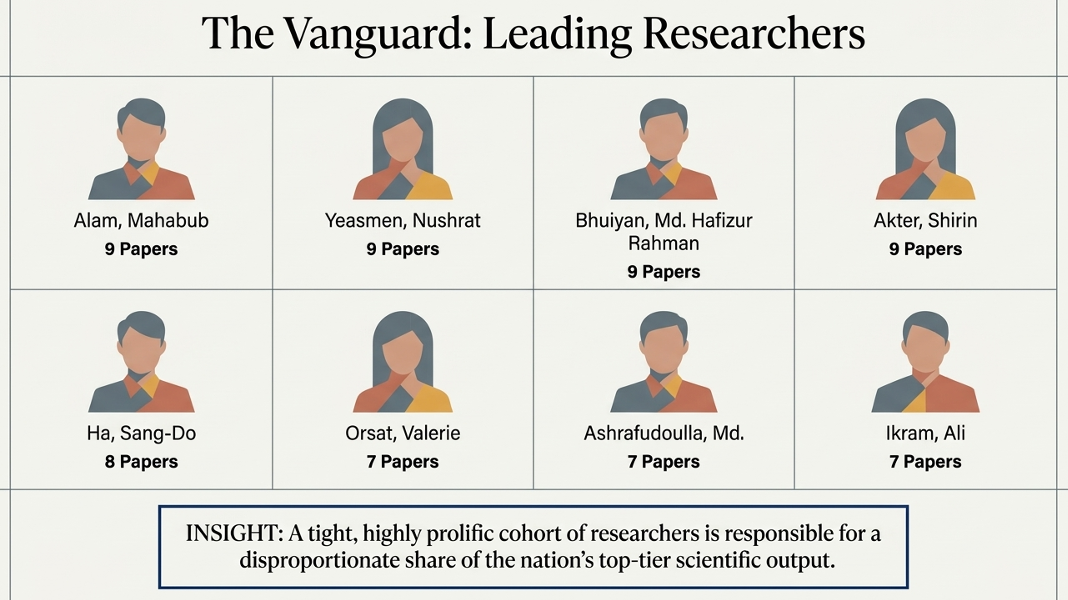
These researchers represent part of a broader research community working across food science, agriculture, nutrition, food chemistry, and related disciplines. The institutional concentration at BAU and other agricultural and science universities provides an important organizational foundation for this research activity.
International Collaboration
The Bangladesh food and agricultural research portfolio was also characterized by international collaboration. Among the international co-authorship links identified in the dataset, the United States was associated with 71 publications, followed by Australia (46), China (37), and Saudi Arabia (35).
| Rank | International Collaborating Country | Publications |
|---|---|---|
| 1 | United States | 71 |
| 2 | Australia | 46 |
| 3 | China | 37 |
| 4 | Saudi Arabia | 35 |
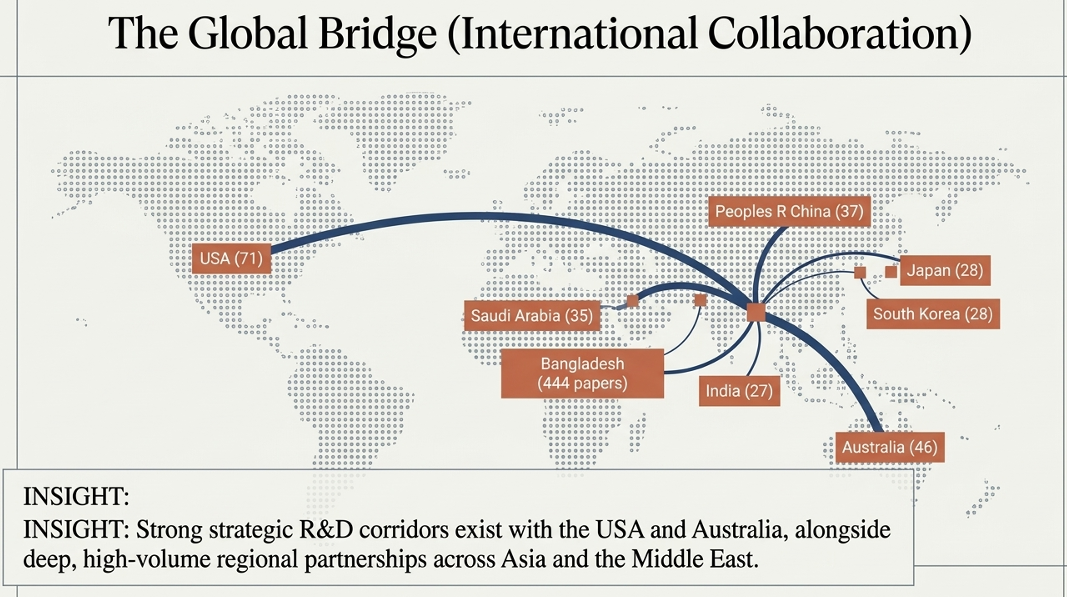
Such collaboration provides opportunities for Bangladeshi researchers to access international expertise, laboratory facilities, datasets, technologies, and multidisciplinary research networks.
Research Funding
International funding organizations were also represented in the research portfolio. The National Research Foundation of Korea was identified as the leading funding agency in the supplied information, supporting 10 publications, followed by the University Grants Commission of India, associated with 9 publications.
| Rank | Funding Agency | Publications |
|---|---|---|
| 1 | National Research Foundation of Korea | 10 |
| 2 | University Grants Commission of India | 9 |
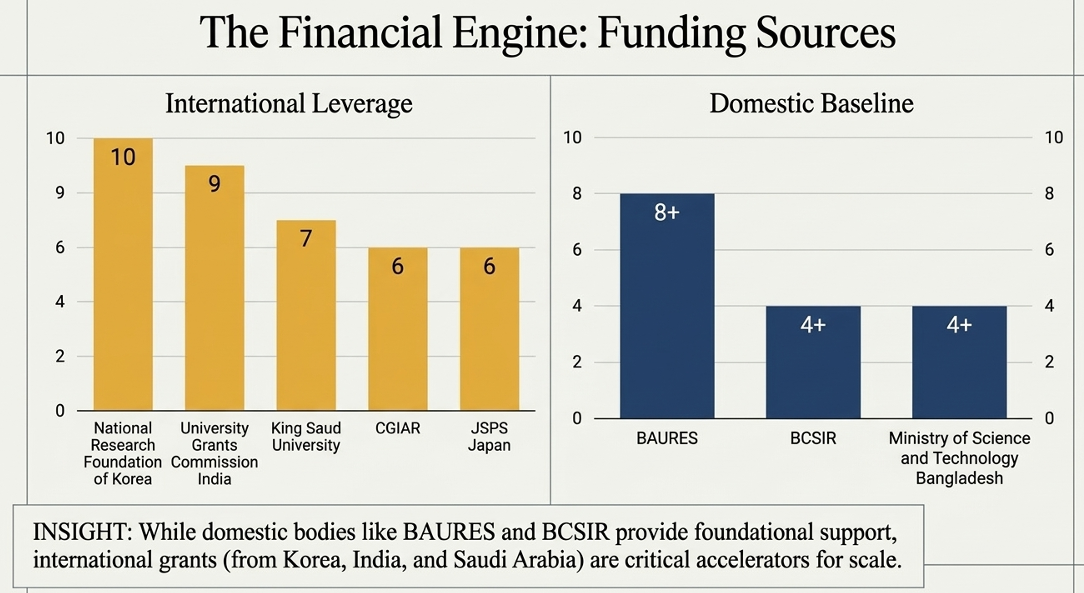
The presence of international funding alongside extensive international co-authorship indicates that Bangladesh’s food and agricultural research was being integrated into broader international research networks.
Overall Research Profile
The 2025 publication profile reveals several interconnected characteristics of Bangladesh’s food science and agricultural research:
- Food science was the central research domain, with 444 publications in the supplied dataset.
- Agriculture provided a major complementary research dimension, accounting for 119 publications.
- Phytochemicals and antioxidant activity were major scientific interests, suggesting strong attention to functional foods and bioactive compounds.
- Food processing and preservation were important practical themes, particularly advanced drying, meat quality, cereal starch properties, and postharvest fruit quality.
- Nutrition and health were strongly represented, reflected by 247 publications associated with SDG 3.
- Food security remained a major priority, with 94 publications associated with SDG 2.
- Sustainability was integrated into the research portfolio, including climate action, responsible consumption and production, sustainable farming, and ecosystem-related research.
- Bangladesh Agricultural University was the largest institutional contributor, with 89 publications.
- International collaboration was substantial, particularly with the United States, Australia, China, and Saudi Arabia.
- The research was multidisciplinary, extending into chemistry, biotechnology, microbiology, nutrition, plant sciences, economics, pharmacology, and toxicology.
Conclusion
Research on food science and agriculture from Bangladesh in Web of Science-indexed journals in 2025 was characterized by a broad and highly interdisciplinary portfolio of 444 publication documents. Food Science & Technology constituted the central research area, while agriculture, chemistry, nutrition, plant sciences, biotechnology, and related disciplines expanded the scope of the research. The strongest specialized interests were antioxidant activity, advanced food drying, meat quality, lactic acid bacteria, cereal starch properties, child malnutrition, postharvest fruit quality, chitosan packaging films, and sustainable farming adoption. These themes demonstrate a combination of fundamental scientific investigation and applied research addressing food quality, nutrition, preservation, agricultural productivity, and sustainability.