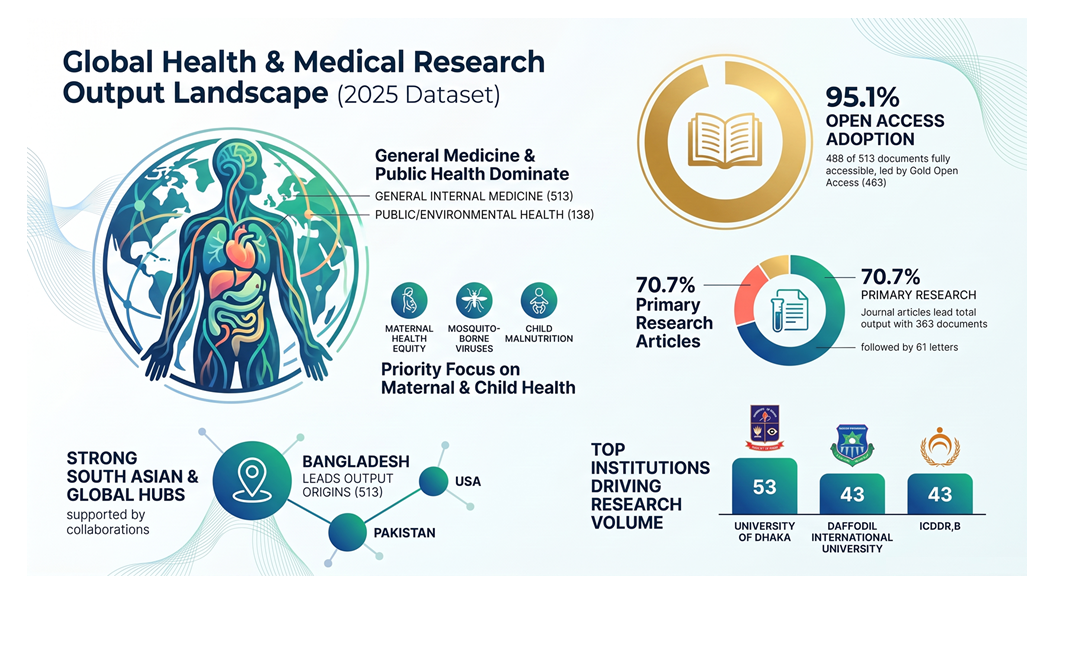
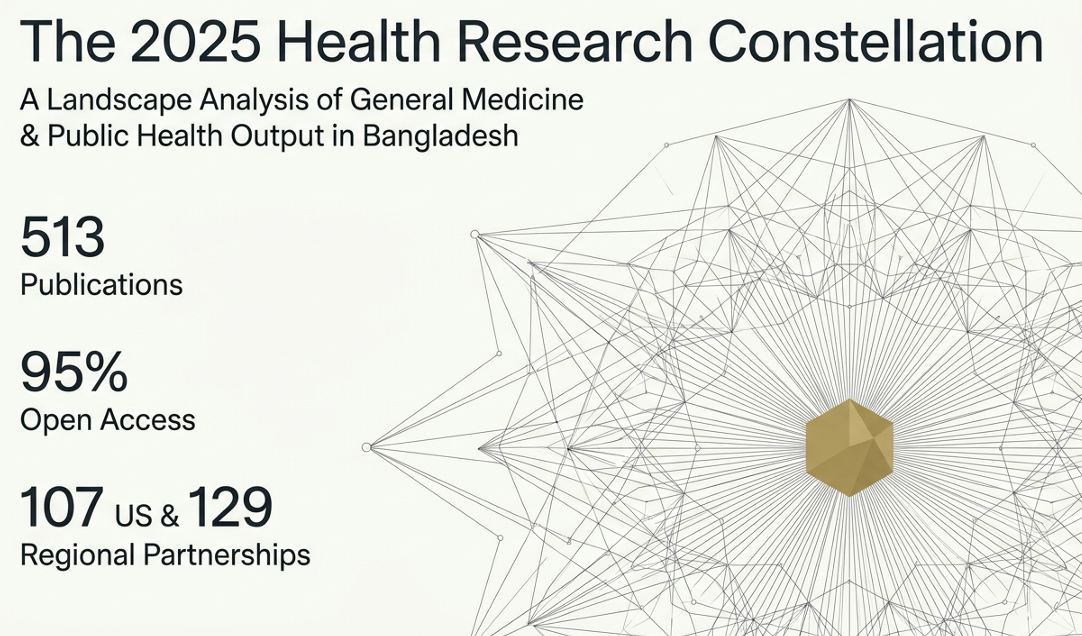
Bibliometric analysis provides a quantitative view of how scientific research is distributed across disciplines, institutions, researchers, countries, journals, funding agencies, and global development priorities. In 2025, research involving Bangladesh in General Medicine and Public Health was characterized by a strong emphasis on practical healthcare challenges, disease prevention, maternal and child health, infectious diseases, and health equity. The dataset examined in this report contained 513 journal articles, together with 61 letters and 45 editorial contributions. The dominant Web of Science research category was Medicine, General & Internal, with 513 publications, followed by Public, Environmental & Occupational Health, with 138 publications. The research was supported by extensive international collaboration, with major contributions involving Pakistan, the United States, India, England, Australia, Saudi Arabia, Canada, Nepal, and China. The publication profile also demonstrated a strong connection with the United Nations Sustainable Development Goals (SDGs). In particular, SDG 3: Good Health and Well-Being was associated with 455 publications, while SDG 5: Gender Equality was associated with 56 publications. Maternal health equity, mosquito-borne diseases, child malnutrition, diabetes, coronavirus research, tuberculosis, smoking cessation, mental health, and insomnia were among the prominent research topics. Web of Science
Overall Research Landscape
The 2025 publication profile indicates that Bangladesh’s General Medicine and Public Health research was concentrated primarily in broad clinical and population-health areas rather than highly specialized medical disciplines.
Major Web of Science Research Categories
| Rank | Web of Science Category | Publications |
|---|---|---|
| 1 | Medicine, General & Internal | 513 |
| 2 | Public, Environmental & Occupational Health | 138 |
| 3 | Health Care Sciences & Services | 5 |
| 4 | Medicine, Research & Experimental | 5 |
| 5 | Pharmacology & Pharmacy | 3 |
| 6 | Primary Health Care | 2 |
| 7 | Clinical Neurology | 1 |
| 8 | Immunology | 1 |
| 9 | Medical Informatics | 1 |
| 10 | Psychology | 1 |
| 11 | Social Sciences | 1 |
| 12 | Urology & Nephrology | 1 |
| 13 | Women’s Studies | 1 |
The concentration in General & Internal Medicine and Public, Environmental & Occupational Health indicates that considerable attention was directed toward broad medical care, disease prevention, population health, and health-system challenges. The distribution also suggests that research was not confined to clinical treatment but extended into environmental, occupational, behavioral, and social dimensions of health.
Leading Researchers
A relatively concentrated group of researchers accounted for substantial publication activity in the dataset. Muhammad Talha was associated with the largest number of publications, with 22, followed by Mahnoor Fatima with 19 and SakanBinte Imran with 18.
Top Researchers by Publication Output
| Rank | Researcher | Publications |
|---|---|---|
| 1 | Muhammad Talha | 22 |
| 2 | Mahnoor Fatima | 19 |
| 3 | SakanBinte Imran | 18 |
| 4 | Mohammad Khursheed Alam | 17 |
| 5 | Ariful Haque | 16 |
| 6 | Syed Masudur Rahman Dewan | 15 |
| 7 | Ibrahim Khalil | 13 |
| 8 | Md. Rabiul Islam | 11 |
| 9 | Noor Un Nisa | 11 |
| 10 | Mohammad Shahangir Biswas | 9 |
| 10 | Mayowa O. Owolabi | 9 |
| 10 | Safayet Jamil | 9 |
| 10 | S M Yasir Arafat | 9 |
| 10 | Chiranjib Chakraborty | 9 |
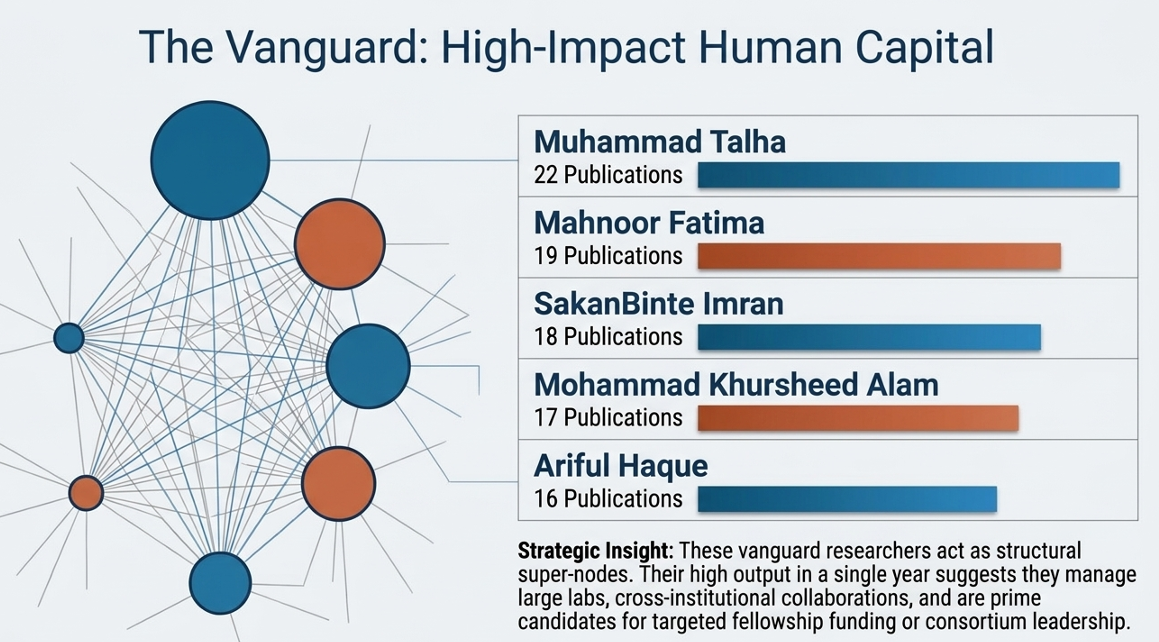
The researcher profile reflects a highly collaborative research environment in which Bangladesh-affiliated scholars were connected with researchers from several countries. The presence of multiple researchers at the same publication level also indicates that research output was distributed across a relatively broad author network rather than being concentrated in a single investigator.
Leading Institutional Affiliations
Major Bangladeshi universities, medical colleges, research organizations, and international co-affiliations were represented among the leading institutional contributors.
Top Institutional Affiliations
| Rank | Institution / University | Publications |
|---|---|---|
| 1 | University of Dhaka | 53 |
| 2 | Daffodil International University | 43 |
| 3 | International Centre for Diarrhoeal Disease Research, Bangladesh (icddr,b) | 43 |
| 4 | King Edward Medical University, Pakistan co-affiliation | 37 |
| 5 | Dhaka Medical College | 35 |
| 6 | Jinnah Sindh Medical University, Pakistan co-affiliation | 35 |
| 7 | North South University (NSU) | 31 |
| 8 | Bangladesh Rural Advancement Committee (BRAC) | 30 |
| 9 | Saveetha Institute of Medical and Technical Sciences, India co-affiliation | 30 |
| 10 | Sir Salimullah Medical College | 27 |
Several additional institutions were closely represented, including Bangladesh Medical University (BMU), BRAC University, University of London, and Dow University of Health Sciences, with 26 publications each.
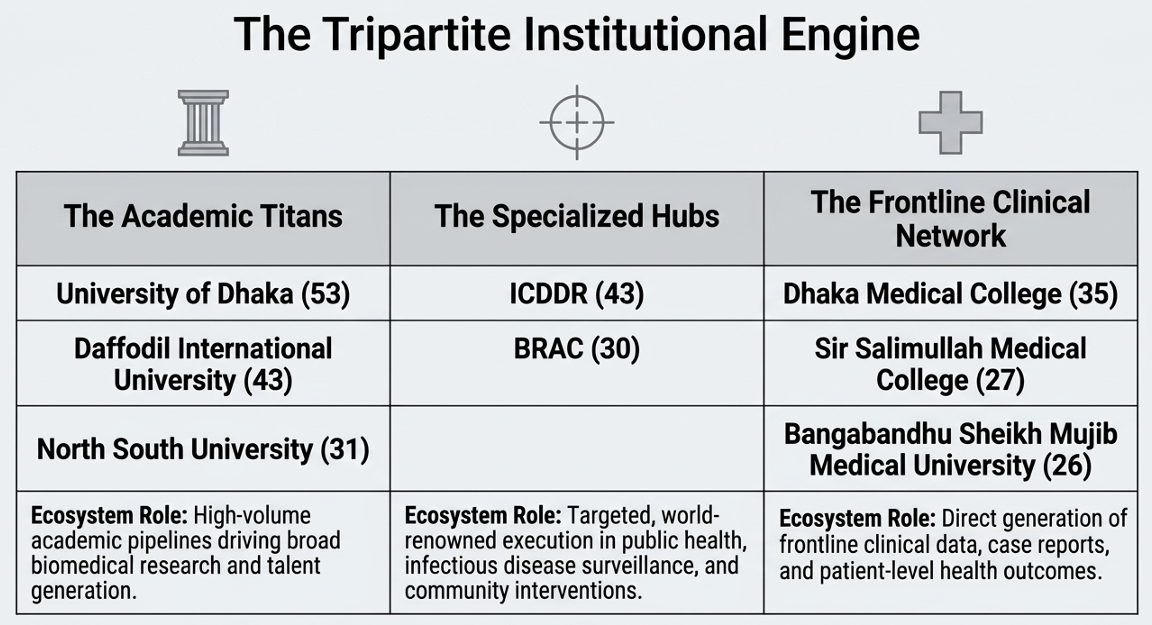
The institutional distribution demonstrates the importance of both universities and specialized research organizations in Bangladesh’s medical research system. The presence of icddr,b and BRAC is particularly consistent with the strong population-health, infectious-disease, maternal-health, and community-health orientation of the research profile.
Major Research Topics
The citation-topic data demonstrate that the research was strongly oriented toward contemporary health challenges affecting populations in Bangladesh and other low- and middle-income settings.
Top Specific Research Topics
| Rank | Research Topic | Publications |
|---|---|---|
| 1 | Maternal Health Equity | 23 |
| 2 | Mosquito-borne Viruses | 14 |
| 3 | Child Malnutrition | 13 |
| 4 | Coronavirus Research | 11 |
| 5 | Diabetes Management | 11 |
| 6 | Smoking Cessation | 9 |
| 7 | Insomnia | 7 |
| 8 | TB Diagnostics & Treatment | 7 |
| 9 | Mindfulness and Mental Health | 7 |
| 10 | Suicide Prevention | 7 |
Maternal Health Equity was the most prominent specific citation topic, with 23 publications. This emphasis was complemented by substantial research on child malnutrition, infectious diseases, and other conditions affecting vulnerable populations.
Research on mosquito-borne viruses was also prominent, reflecting the continuing importance of vector-borne diseases in tropical and subtropical settings. Coronavirus research remained visible in 2025, while diabetes management demonstrated the increasing representation of non-communicable diseases alongside infectious diseases.
Behavioral and mental-health subjects—including smoking cessation, insomnia, mindfulness, and suicide prevention—also appeared among the leading topics, indicating an expansion of health research beyond conventional infectious-disease priorities.
International Research Collaboration
The research was characterized by substantial international collaboration. Bangladesh was represented in 513 publications, while researchers and institutions from several other countries were also frequently involved.
Top Collaborating Countries and Regions
| Rank | Country / Region | Publications |
|---|---|---|
| 1 | Bangladesh | 513 |
| 2 | Pakistan | 129 |
| 3 | United States | 107 |
| 4 | India | 68 |
| 5 | England | 62 |
| 6 | Australia | 42 |
| 7 | Saudi Arabia | 39 |
| 8 | Canada | 36 |
| 9 | Nepal | 33 |
| 10 | People’s Republic of China | 33 |
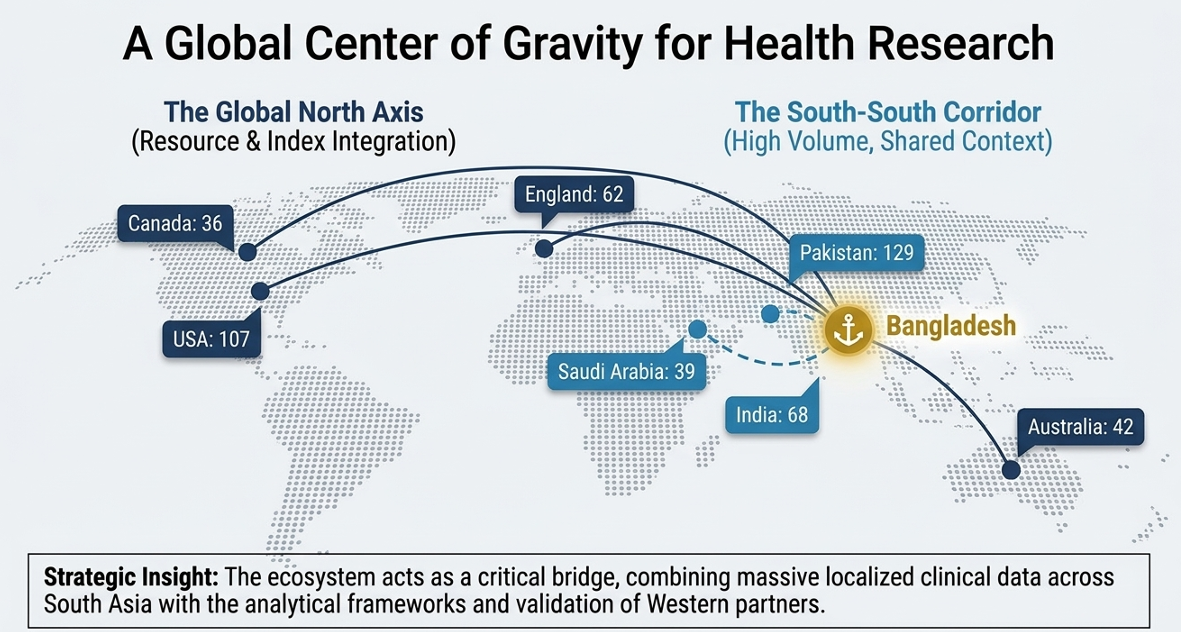
The collaboration pattern was particularly strong across South Asia, with Pakistan and India occupying prominent positions. Significant connections with the United States, England, Australia, Canada, Saudi Arabia, Nepal, and China further demonstrate the international character of Bangladesh’s medical and public-health research.
Leading Journals
The research was distributed across a broad range of international medical and public-health journals.
Table. Leading Journals by Publication Output
| Rank | Journal | Publications |
|---|---|---|
| 1 | Health Science Reports | 134 |
| 2 | Annals of Medicine and Surgery | 120 |
| 3 | BMJ Open | 56 |
| 4 | Clinical Case Reports | 38 |
| 5 | Bangladesh Journal of Medical Science | 30 |
| 6 | The Lancet | 18 |
| 7 | Diagnostics | 17 |
| 8 | Medicine | 14 |
| 9 | EClinicalMedicine | 7 |
| 10 | JAMA Network Open | 6 |
The journal distribution indicates that publications were placed in both broad multidisciplinary medical journals and specialized clinical/public-health outlets. The presence of internationally recognized journals such as The Lancet, JAMA Network Open, BMJ Open, and EClinicalMedicine further illustrates the international reach of the research.
Sustainable Development Goal Alignment
The 2025 research profile showed a particularly strong connection with the United Nations Sustainable Development Goals.
Top SDGs Represented in the Research
| Rank | Sustainable Development Goal | Publications |
|---|---|---|
| 1 | SDG 3 – Good Health and Well-Being | 455 |
| 2 | SDG 5 – Gender Equality | 56 |
| 3 | SDG 1 – No Poverty | 14 |
| 4 | SDG 2 – Zero Hunger | 14 |
| 5 | SDG 14 – Life Below Water | 12 |
| 6 | SDG 11 – Sustainable Cities and Communities | 10 |
| 7 | SDG 6 – Clean Water and Sanitation | 9 |
| 8 | SDG 4 – Quality Education | 6 |
| 9 | SDG 13 – Climate Action | 5 |
| 10 | SDG 9 – Industry, Innovation and Infrastructure | 4 |
SDG 3 was overwhelmingly dominant, being associated with 455 publications. This strong alignment is consistent with the concentration on disease prevention, clinical medicine, maternal health, infectious diseases, nutrition, and population health.
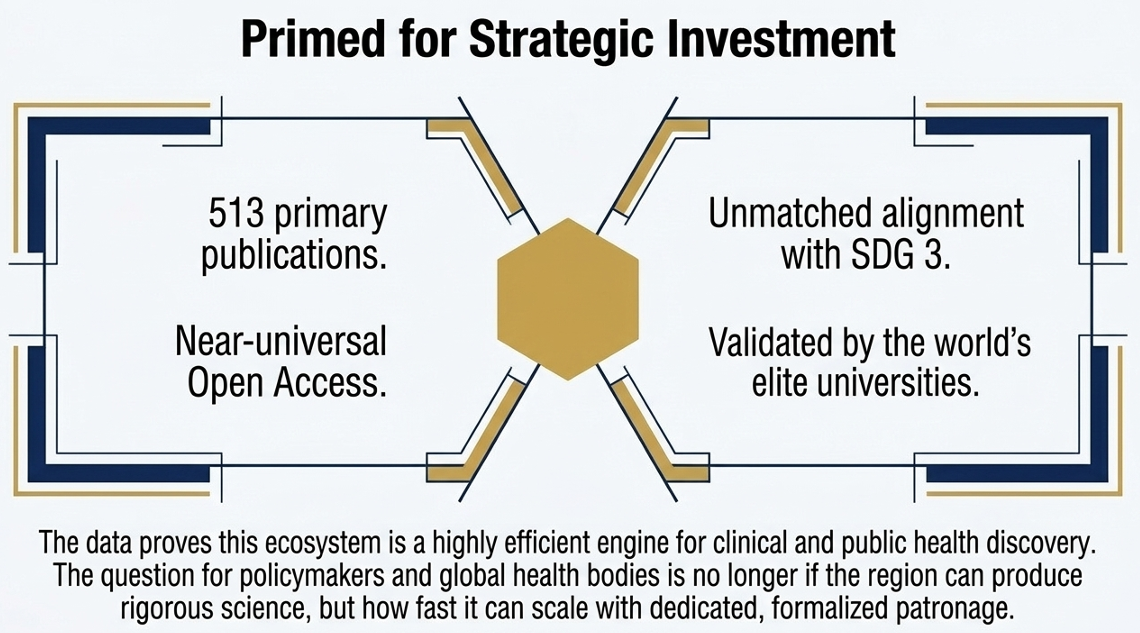
The substantial presence of SDG 5 was consistent with the prominence of maternal health equity and women’s healthcare. Connections with SDG 1 and SDG 2 further demonstrate the relationship between health, poverty, food security, and nutrition.
Research Funding
International funding organizations played an important role in supporting the research represented in the dataset.
Leading Funding Agencies
| Rank | Funding Agency | Publications |
|---|---|---|
| 1 | No Specific Funding Listed | 51 |
| 2 | Bill & Melinda Gates Foundation | 16 |
| 3 | CGIAR | 7 |
| 4 | United States Department of Health & Human Services | 7 |
| 5 | National Institutes of Health (NIH), USA | 6 |
| 6 | National Institute for Health and Care Research (NIHR), UK | 6 |
| 7 | UK Research & Innovation (UKRI) | 6 |
| 8 | Bloomberg Philanthropies | 4 |
| 9 | Medical Research Council (MRC), UK | 4 |
| 10 | Prince Sattam Bin Abdulaziz University | 4 |
A substantial portion of the publications—51 records—did not contain a specific funding agency in the available metadata. Among the named funders, the Bill & Melinda Gates Foundation was the most frequently represented, followed by CGIAR and United States Department of Health & Human Services.
The involvement of NIH, NIHR, UKRI, MRC, Bloomberg Philanthropies, and other international organizations illustrates the importance of international funding networks in Bangladesh-related medical and public-health research.
Major Themes Emerging from the 2025 Research
Maternal and Women’s Health
Maternal health equity was the largest individual citation topic. The prominence of SDG 5 also indicates substantial attention to gender-related health inequalities and women’s healthcare. Research in this area was therefore positioned at the intersection of clinical medicine, public health, and social equity.
Infectious and Vector-Borne Diseases
Mosquito-borne viruses, tuberculosis, and coronavirus research remained important components of the research portfolio. These topics are particularly relevant to population health because infectious diseases can place substantial burdens on healthcare systems and vulnerable communities.
Child Nutrition and Food Security
Child malnutrition was identified as one of the ten leading citation topics. Its connection with SDG 2 and SDG 1 indicates that nutritional health was being investigated within a broader socioeconomic context rather than solely as a clinical problem.
Non-Communicable Diseases
Diabetes management was among the leading research topics, demonstrating that Bangladesh’s medical research agenda was addressing chronic diseases alongside infectious diseases. Smoking cessation research further connected disease prevention with behavioral health.
Mental and Behavioral Health
Insomnia, mindfulness and mental health, and suicide prevention were among the leading specific topics. This indicates that psychological and behavioral health concerns had become visible components of the broader medical research portfolio.
Research Ecosystem and Collaboration
The combination of universities, medical colleges, research organizations, international institutions, and funding agencies demonstrates a multidimensional research ecosystem.
The University of Dhaka occupied the leading institutional position with 53 publications, while Daffodil International University and icddr,b each contributed 43 publications. Medical colleges such as Dhaka Medical College and Sir Salimullah Medical College also occupied prominent positions.
International co-affiliations were strongly represented, particularly through Pakistani and Indian institutions. This pattern is consistent with the high levels of collaboration recorded for Pakistan and India and demonstrates the regional nature of contemporary health research.
The research ecosystem was therefore characterized by connections among academic institutions, medical centers, public-health organizations, and international research partners.
Key Findings
| Area | Key Finding |
|---|---|
| Overall research profile | 513 journal articles were recorded, accompanied by 61 letters and 45 editorials |
| Dominant category | Medicine, General & Internal – 513 publications |
| Public-health category | Public, Environmental & Occupational Health – 138 publications |
| Leading researcher | Muhammad Talha – 22 publications |
| Leading institution | University of Dhaka – 53 publications |
| Leading topic | Maternal Health Equity – 23 publications |
| Leading collaborating country outside Bangladesh | Pakistan – 129 publications |
| Leading journal | Health Science Reports – 134 publications |
| Dominant SDG | SDG 3 – 455 publications |
| Leading named funding agency | Bill & Melinda Gates Foundation – 16 publications |
Conclusion
The 2025 Web of Science publication profile presents Bangladesh as an important contributor to contemporary General Medicine and Public Health research. The research was dominated by General & Internal Medicine and Public, Environmental & Occupational Health, while a broad range of clinical, infectious-disease, nutritional, behavioral, and population-health subjects was addressed. Particular emphasis was placed on maternal health equity, mosquito-borne diseases, child malnutrition, coronavirus research, diabetes, tuberculosis, smoking cessation, and mental health. The institutional landscape was led by the University of Dhaka, Daffodil International University, and icddr,b, while a wide network of medical colleges and international partner institutions contributed to the research output. The international character of the research was further demonstrated by substantial collaboration with Pakistan, the United States, India, England, Australia, Saudi Arabia, Canada, Nepal, and China. International funding organizations, including the Bill & Melinda Gates Foundation, NIH, NIHR, UKRI, MRC, and Bloomberg Philanthropies, were also represented.