
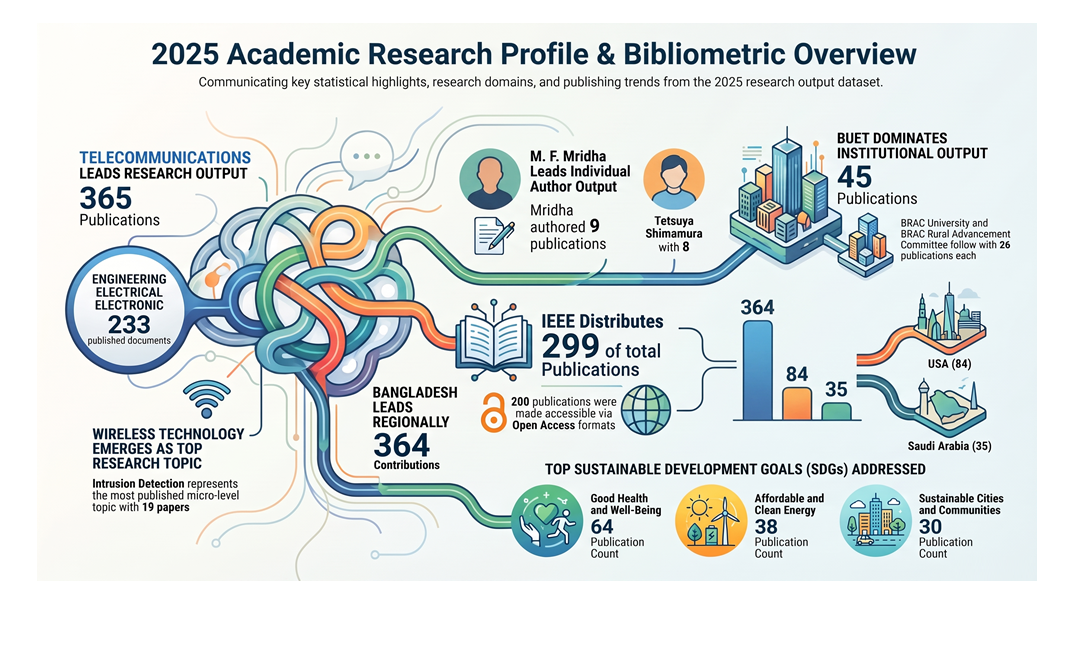
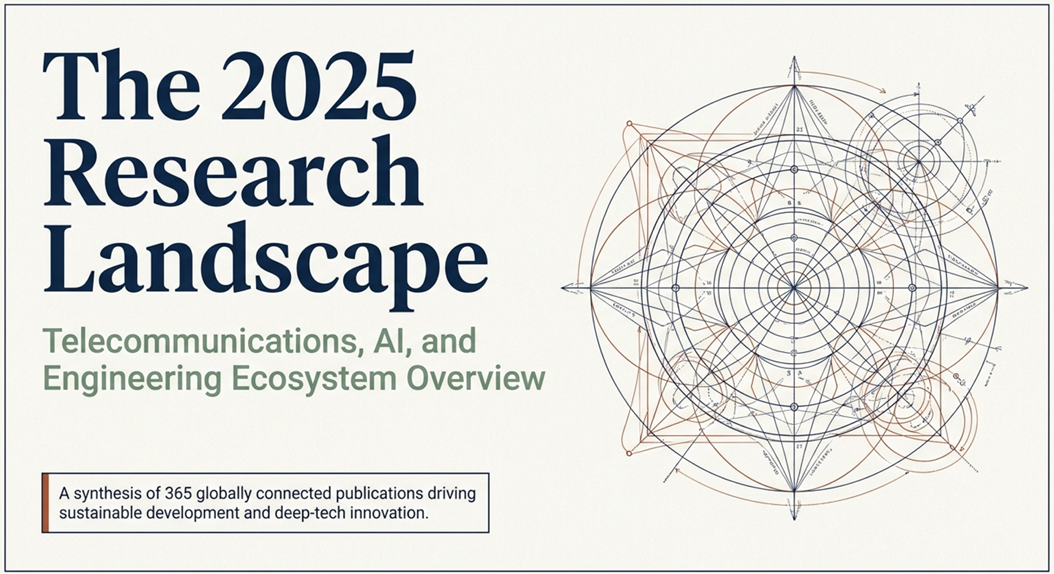
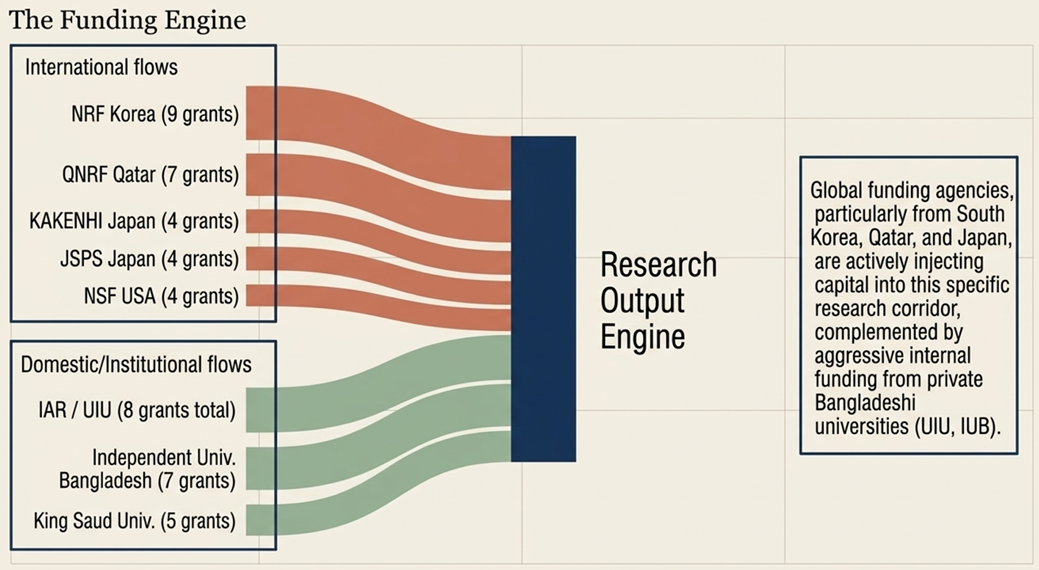
Research output from Bangladesh in Telecommunications and Computer Science during 2025 reveals a strong concentration on wireless communication, electrical and electronic engineering, computer science, optics, artificial intelligence, and intelligent information systems. The dataset comprises 365 publications associated with Telecommunications, alongside substantial activity in related Web of Science categories. The publication landscape indicates that research is being conducted at the intersection of next-generation communication technologies and computational intelligence. Wireless technologies, computer vision, artificial intelligence and machine learning, optical engineering, security systems, smart transportation, and information retrieval constitute some of the principal research themes. Bangladesh-based researchers are also participating in an increasingly international research network. While Bangladesh accounts for 364 publications in the dataset, collaborators from the United States, Saudi Arabia, Australia, Japan, Malaysia, Canada, and South Korea also make substantial contributions. Web of Science
Research at a Glance
| Indicator | Publications |
|---|---|
| Telecommunications | 365 |
| Electrical & Electronic Engineering | 233 |
| Computer Science, Information Systems | 211 |
| Optics | 72 |
| Computer Science, Theory & Methods | 22 |
| Computer Science, Interdisciplinary Applications | 21 |
| Computer Science, Artificial Intelligence | 14 |
| Transportation Science & Technology | 6 |
| Computer Science, Hardware & Architecture | 6 |
| Computer Science, Cybernetics | 5 |
Counts represent category assignments and therefore may overlap because individual publications can belong to multiple Web of Science categories.
The Core Research Landscape
Telecommunications emerged as the largest Web of Science category, with 365 publications. The scale of activity demonstrates the importance of communication technologies within Bangladesh’s contemporary technology research landscape. Electrical and electronic engineering followed with 233 publications, while computer science–information systems accounted for 211. Research in Optics, represented by 72 publications, provides another important component of the technological ecosystem. The combination of these fields suggests a research environment in which communication infrastructure, electronic systems, optical technologies, and computational methods are being developed alongside one another.
Leading Web of Science Research Areas
| Rank | Web of Science Category | Publications |
|---|---|---|
| 1 | Telecommunications | 365 |
| 2 | Engineering, Electrical & Electronic | 233 |
| 3 | Computer Science, Information Systems | 211 |
| 4 | Optics | 72 |
| 5 | Computer Science, Theory & Methods | 22 |
| 6 | Computer Science, Interdisciplinary Applications | 21 |
| 7 | Computer Science, Artificial Intelligence | 14 |
| 8 | Transportation Science & Technology | 6 |
| 9 | Computer Science, Hardware & Architecture | 6 |
| 10 | Computer Science, Cybernetics | 5 |
From Wireless Networks to Artificial Intelligence
The citation-topic structure provides a more detailed view of what researchers are studying within these broad categories. Wireless Technology was the largest identified focus topic, with 44 publications, followed by Telecommunications with 34. Computer Vision & Graphics accounted for 32 publications, while Artificial Intelligence & Machine Learning contributed 27.
Top Research Focus Topics
| Rank | Research Focus | Publications |
|---|---|---|
| 1 | Wireless Technology | 44 |
| 2 | Telecommunications | 34 |
| 3 | Computer Vision & Graphics | 32 |
| 4 | Artificial Intelligence & Machine Learning | 27 |
| 5 | Optical Electronics & Engineering | 19 |
| 6 | Security Systems | 18 |
| 7 | Power Systems & Electric Vehicles | 17 |
| 8 | Transportation | 11 |
| 9 | Information Retrieval & Knowledge Systems | 11 |
| 10 | Geometrical Optics | 11 |
These themes demonstrate the breadth of the research portfolio. Communication technologies are being investigated alongside computer vision, deep learning, optical systems, cybersecurity, electric vehicles, transportation technologies, and information systems. Particular attention is being given to areas such as wireless communication, MIMO optimization, metasurfaces, photonic technologies, deep-learning-based image recognition, and intelligent transportation systems.
The Researchers Behind the Research
A relatively concentrated group of highly productive researchers appears at the top of the publication dataset.
Top 10 Researchers
| Rank | Researcher | Publications |
|---|---|---|
| 1 | M. F. Mridha | 9 |
| 2 | Tetsuya Shimamura | 8 |
| 3 | M. Ashraful Amin | 6 |
| 4 | Mohammad Mehedi Hassan | 5 |
| 5 | Zia Uddin | 5 |
| 6 | M. Shamim Kaiser | 5 |
| 7 | Md. Motaharul Islam | 5 |
| 8 | Ashraful Islam | 5 |
| 9 | Muhammad E. H. Chowdhury | 5 |
| 10 | Md. Abdur Razzaque | 4 |
Several additional researchers recorded four publications, including Shekh Md Mahmudul Islam, Riasat Khan, Tanjim Mahmud, Md. Golam Rabiul Alam, Nuruzzaman Faruqui, Karl Andersson, Touhid Bhuiyan, Khorshed Alam, M. Mofazzal Hossain, Rakayet Rafi, MdFahad Monir, M. R. Karim, and Saifur Rahman Sabuj.
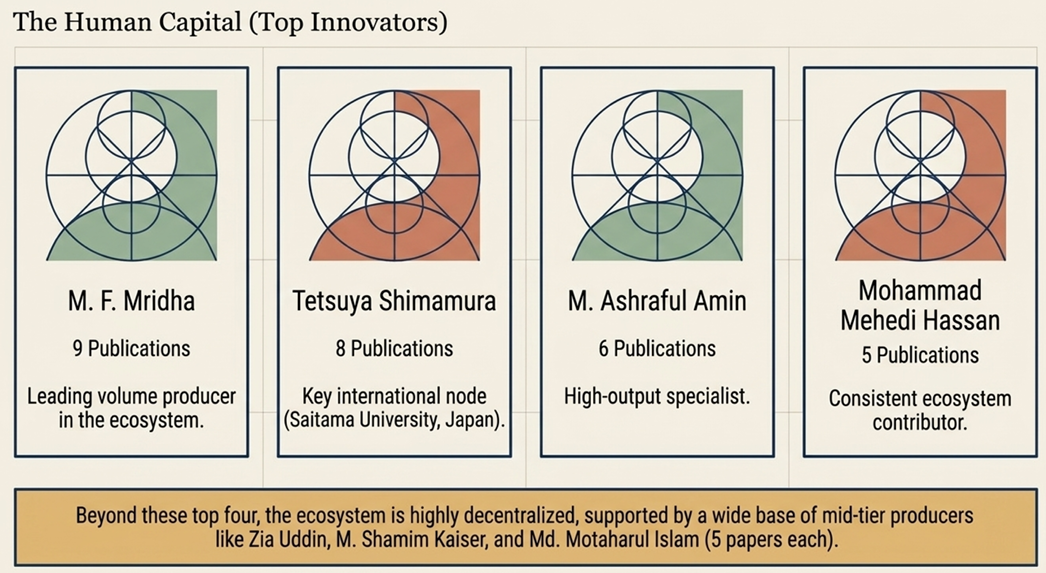
The researcher distribution also illustrates the international character of the field, with some scholars working across institutional and national research networks.
Bangladesh’s Universities Form the Main Research Hubs
The institutional distribution shows that engineering-focused universities occupy a central position in Bangladesh’s telecommunications and computing research. Bangladesh University of Engineering and Technology (BUET) recorded the highest institutional output in the dataset, with 45 publications. BRAC/BRAC University and Daffodil International University followed with 26 publications each, while CUET and RUET each contributed 25.
Top 10 Institutions
| Rank | Institution | Publications |
|---|---|---|
| 1 | Bangladesh University of Engineering and Technology (BUET) | 45 |
| 2 | BRAC / BRAC University | 26 |
| 3 | Daffodil International University (DIU) | 26 |
| 4 | Chittagong University of Engineering and Technology (CUET) | 25 |
| 5 | Rajshahi University of Engineering and Technology (RUET) | 25 |
| 6 | United International University (UIU) | 23 |
| 7 | University of Dhaka | 20 |
| 8 | American International University-Bangladesh (AIUB) | 19 |
| 9 | Khulna University of Engineering and Technology (KUET) | 17 |
| 10 | North South University / Southeast University | 17 |
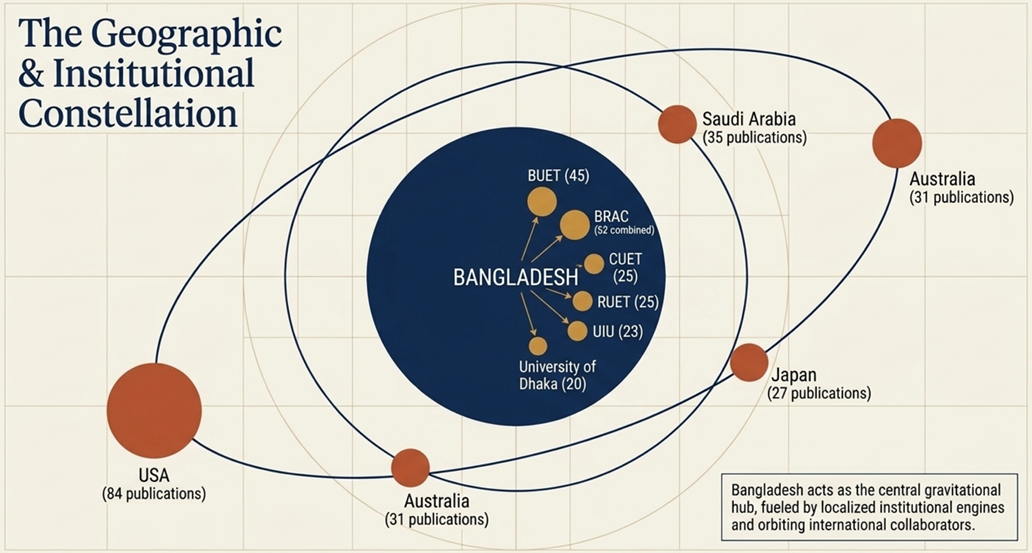
The distribution indicates that research capacity is not restricted to a single university. Both public engineering universities and private universities are represented among the leading contributors.
An International Research Network
Although the analysis is centered on Bangladesh, the publications demonstrate substantial international collaboration.
Leading Countries and Regions
| Rank | Country/Region | Publications |
|---|---|---|
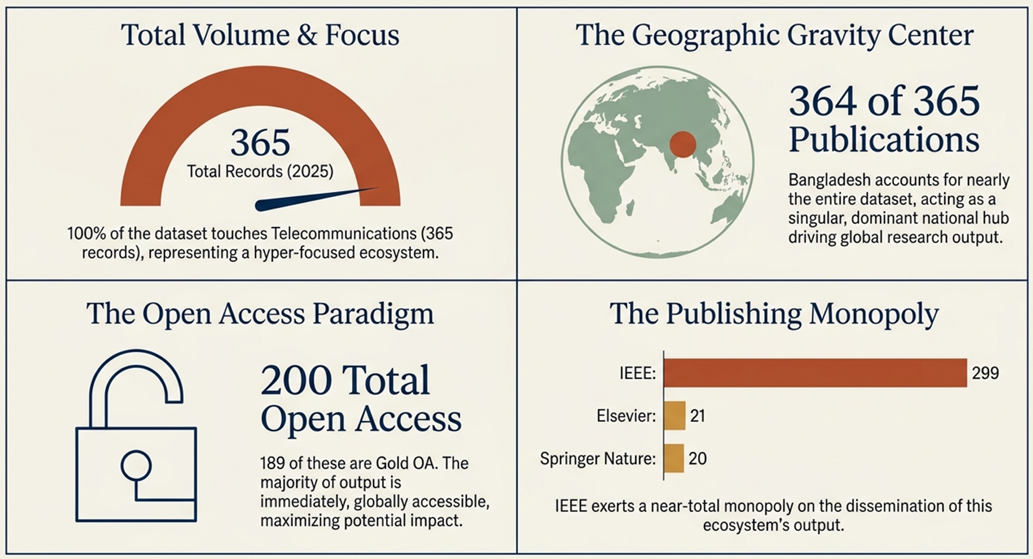
| 1 | Bangladesh | 364 |
| 2 | United States | 84 |
| 3 | Saudi Arabia | 35 |
| 4 | Australia | 31 |
| 5 | Japan | 27 |
| 6 | Malaysia | 26 |
| 7 | Canada | 22 |
| 8 | South Korea | 18 |
| 9 | England | 16 |
| 10 | Qatar / Sweden | 10 each |
The United States represents the largest international collaboration component after Bangladesh, followed by Saudi Arabia and Australia. Japan and Malaysia also appear prominently.
This distribution illustrates that Bangladesh’s telecommunications and computing research is connected to research communities extending across North America, Europe, Asia, and the Middle East.
IEEE Dominates the Publication Landscape
The publication outlets reflect the technical orientation of the research. IEEE Access alone accounted for 157 publications, making it by far the largest individual publication outlet in the dataset.
Leading Publication Outlets
| Rank | Publication Outlet | Publications |
|---|---|---|
| 1 | IEEE Access | 157 |
| 2 | IEEE International Conference on Telecommunications and Photonics (ICTP) | 68 |
| 3 | ICT Express | 7 |
| 4 | IEEE Open Journal of the Communications Society | 7 |
| 5 | Lecture Notes in Computer Science | 6 |
| 6 | Lecture Notes in Networks and Systems | 6 |
| 7 | 10th International Congress on Information and Communication Technology (ICICT) | 6 |
| 8 | Human-Centered Design, Operation and Evaluation of Mobile Communications | 5 |
| 9 | IEEE Internet of Things Journal | 5 |
| 10 | Ad Hoc Networks / IEEE Transactions on Consumer Electronics | 4 each |
At the publisher level, IEEE accounted for approximately 299 publications, followed by Elsevier (21) and Springer Nature (20).
The dominance of IEEE outlets is consistent with the dataset’s strong emphasis on telecommunications, electrical engineering, wireless technologies, electronics, and computer systems.
Research Connected to the Sustainable Development Goals
The research is also associated with multiple United Nations Sustainable Development Goals (SDGs). The largest SDG association was SDG 3: Good Health and Well-Being, with 64 publications.
Top SDG Associations
| Rank | Sustainable Development Goal | Publications |
|---|---|---|
| 1 | SDG 03 – Good Health and Well-Being | 64 |
| 2 | SDG 07 – Affordable and Clean Energy | 38 |
| 3 | SDG 11 – Sustainable Cities and Communities | 30 |
| 4 | SDG 09 – Industry, Innovation and Infrastructure | 21 |
| 5 | SDG 13 – Climate Action | 17 |
| 6 | SDG 12 – Responsible Consumption and Production | 8 |
| 7 | SDG 14 – Life Below Water | 5 |
| 8 | SDG 15 – Life on Land | 5 |
| 9 | SDG 05 – Gender Equality | 4 |
| 10 | SDG 04 – Quality Education / SDG 06 – Clean Water and Sanitation | 3 each |
The prominence of SDG 3 reflects the growing use of computational and communication technologies in health-related applications, including medical imaging, disease detection, cardiac monitoring, and wireless health-monitoring systems.
Research associated with SDG 7 includes areas such as smart grids, renewable-energy forecasting, photovoltaic systems, and energy-efficient technologies. Meanwhile, SDG 11 connects computing and telecommunications with smart cities, Internet of Things applications, traffic management, and intelligent transportation.
What the 2025 Dataset Reveals
Several broad patterns emerge from the publication data.
First, telecommunications remains the central technological domain. With 365 category assignments, it substantially exceeds most other individual research categories.
Second, telecommunications and computer science are increasingly interconnected. Wireless communication research is being conducted alongside artificial intelligence, machine learning, computer vision, information retrieval, cybersecurity, and intelligent systems.
Third, optical technologies constitute an important supporting research area. The presence of 72 publications in Optics and substantial activity in optical electronics and geometrical optics indicates continued attention to technologies underlying high-speed communication and sensing.
Fourth, Bangladesh’s engineering universities form major research hubs. BUET, CUET, RUET, KUET, and other universities feature prominently alongside major private institutions.
Fifth, international collaboration is an important component of the research ecosystem. The substantial participation of researchers from the United States, Saudi Arabia, Australia, Japan, Malaysia, Canada, and other countries demonstrates that Bangladesh’s research output is embedded in international scientific networks.
Finally, technology research is increasingly connected to societal applications. The strong representation of health, clean energy, sustainable cities, infrastructure, and climate-related SDGs indicates that telecommunications and computer science are being applied beyond purely technical problems.
Conclusion
Bangladesh’s 2025 Web of Science research landscape in Telecommunications and Computer Science reflects a broad transition toward interconnected technological research. Wireless communications, artificial intelligence, computer vision, optical engineering, security, smart transportation, and information systems are being developed within an increasingly integrated research environment. With 365 Telecommunications publications, substantial activity in Electrical & Electronic Engineering and Computer Science, and leading contributions from institutions such as BUET, BRAC University, Daffodil International University, CUET, and RUET, Bangladesh’s research activity spans both fundamental technologies and applied digital solutions.