
Mapping Bangladesh’s Green Research Landscape
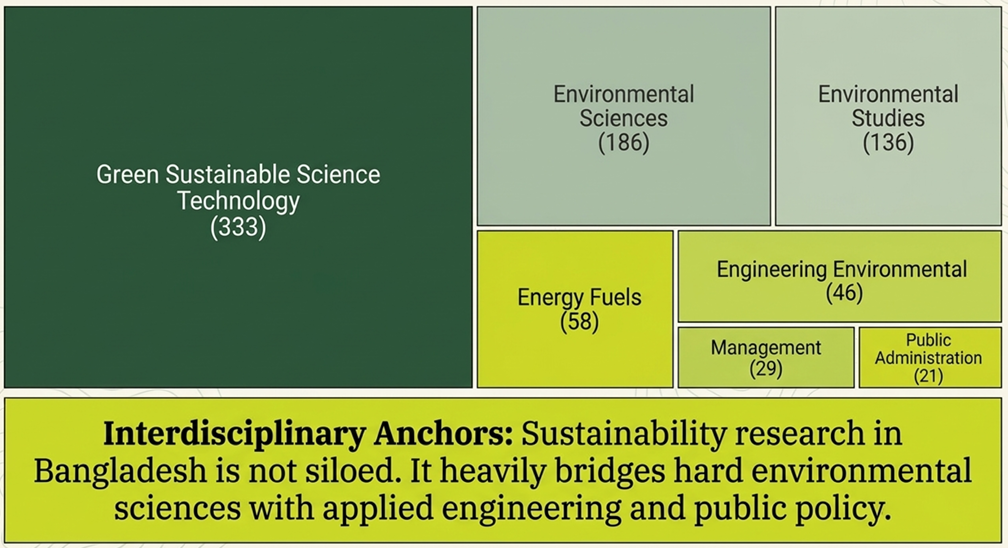
The dominant Web of Science research category was Green Sustainable Science & Technology, accounting for all 333 publications in the dataset. It was followed by Environmental Sciences and Environmental Studies.
| Web of Science Research Area / Category | Publications |
|---|---|
| Green Sustainable Science & Technology / Science & Technology – Other Topics | 333 |
| Environmental Sciences / Environmental Sciences & Ecology | 186 / 200 |
| Environmental Studies | 136 |
| Engineering – General / Environmental | 65 / 46 |
| Energy & Fuels | 58 |
| Regional & Urban Planning / Public Administration | 22 |
| Development Studies | 15 |
| Materials Science – Multidisciplinary | 15 |
| Engineering – Chemical | 14 |
| Social Psychology | 13 |
Note: Some publications are assigned to more than one Web of Science category; therefore, category totals should not be added together.
The breadth of these categories demonstrates that sustainability research was being approached from multiple directions—from environmental monitoring and energy systems to engineering, urban planning, materials science, economics, management, and human behavior.
SDGs at the Heart of the Research
The publication profile shows a particularly strong connection with the United Nations Sustainable Development Goals.
| Rank | Sustainable Development Goal | Publications |
|---|---|---|
| 1 | SDG 13 – Climate Action | 115 |
| 2 | SDG 7 – Affordable and Clean Energy | 98 |
| 3 | SDG 12 – Responsible Consumption and Production | 90 |
| 4 | SDG 9 – Industry, Innovation and Infrastructure | 77 |
| 5 | SDG 11 – Sustainable Cities and Communities | 69 |
| 6 | SDG 2 – Zero Hunger | 56 |
| 7 | SDG 14 – Life Below Water | 48 |
| 8 | SDG 3 – Good Health and Well-Being | 43 |
| 9 | SDG 15 – Life on Land | 37 |
| 10 | SDG 8 – Decent Work and Economic Growth | 36 |
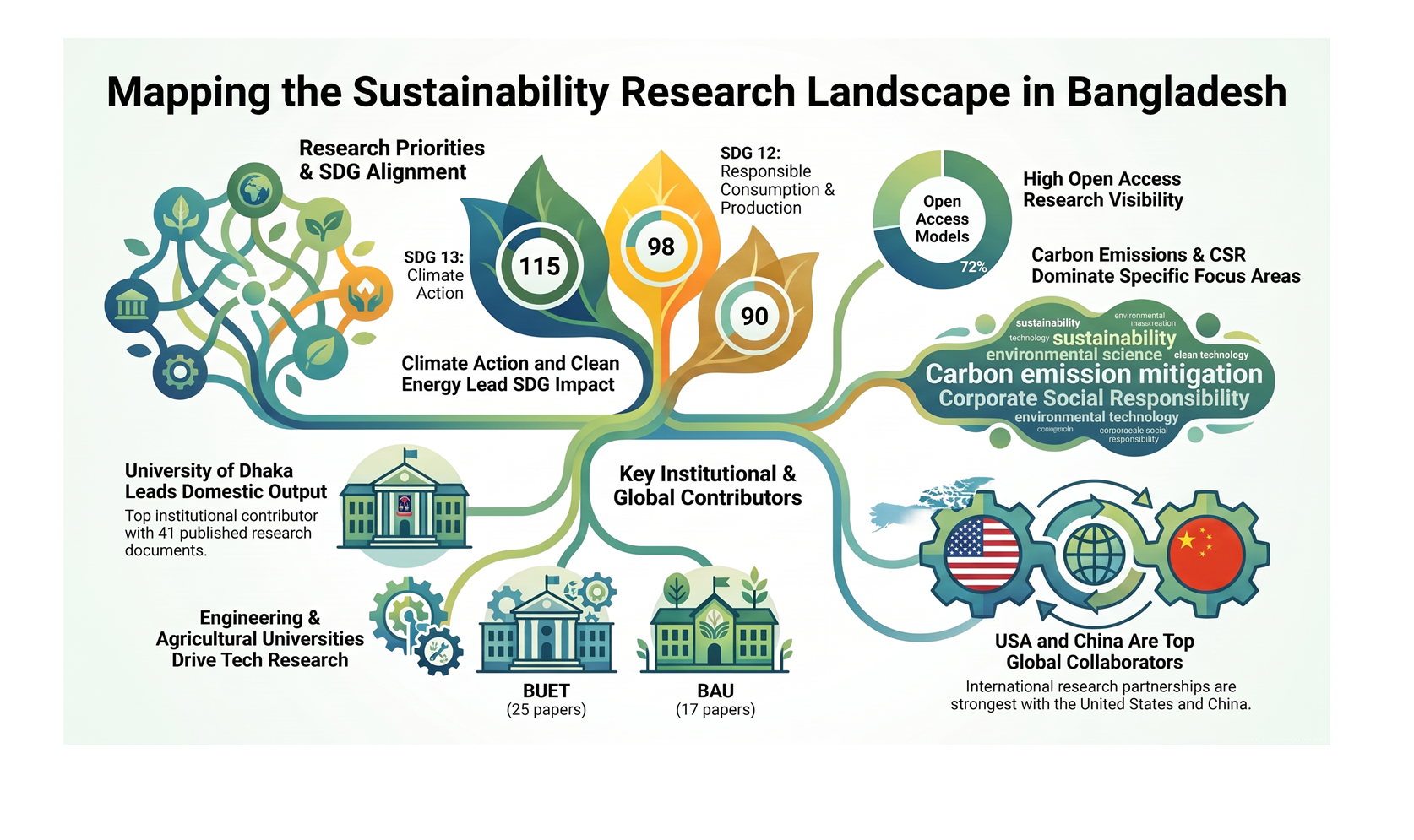
The prominence of SDG 13 and SDG 7 is particularly notable. Research addressing climate change and clean energy was substantially represented, while responsible consumption, sustainable infrastructure, and sustainable urban development formed additional major pillars.
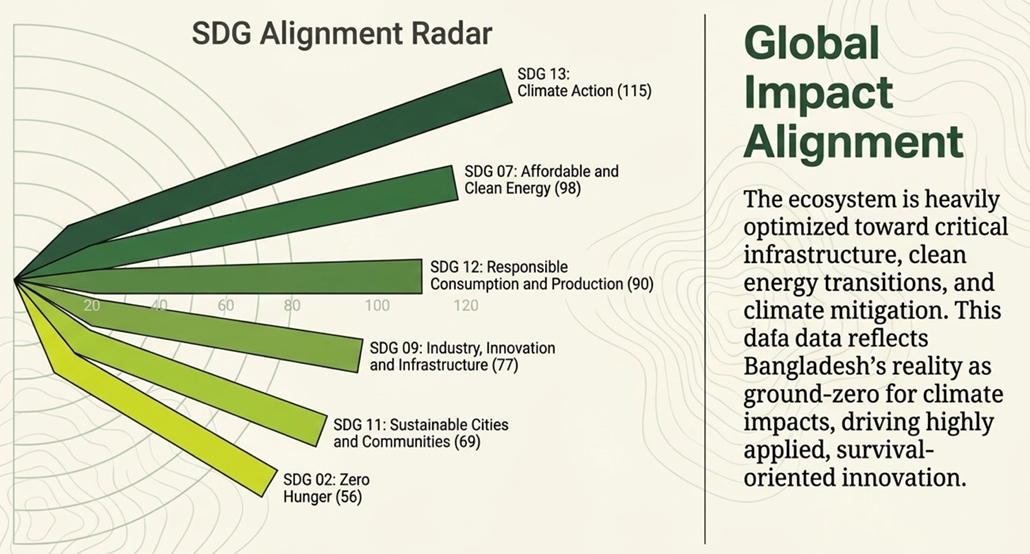
Taken together, the SDG profile suggests that Bangladesh’s green research agenda is simultaneously addressing environmental risks, energy transitions, industrial development, urbanization, food systems, ecosystems, and human well-being.
The Institutions Driving Green Research
The institutional distribution shows a relatively broad national research base, although several universities emerged as particularly active contributors.
| Rank | Institution | Publications |
|---|---|---|
| 1 | University of Dhaka | 41 |
| 2 | Daffodil International University | 26 |
| 3 | Bangladesh University of Engineering & Technology (BUET) | 25 |
| 4 | Khulna University of Engineering & Technology (KUET) | 23 |
| 5 | Noakhali Science & Technology University (NSTU) | 19 |
| 6 | Bangladesh Agricultural University (BAU) | 17 |
| 7 | Rajshahi University of Engineering & Technology (RUET) | 16 |
| 8 | Bangladesh Rural Advancement Committee (BRAC) | 15 |
| 9 | University of Chittagong | 15 |
| 10 | BRAC University | 14 |
The University of Dhaka led the institutional publication count with 41 papers, followed by Daffodil International University with 26 and BUET with 25.
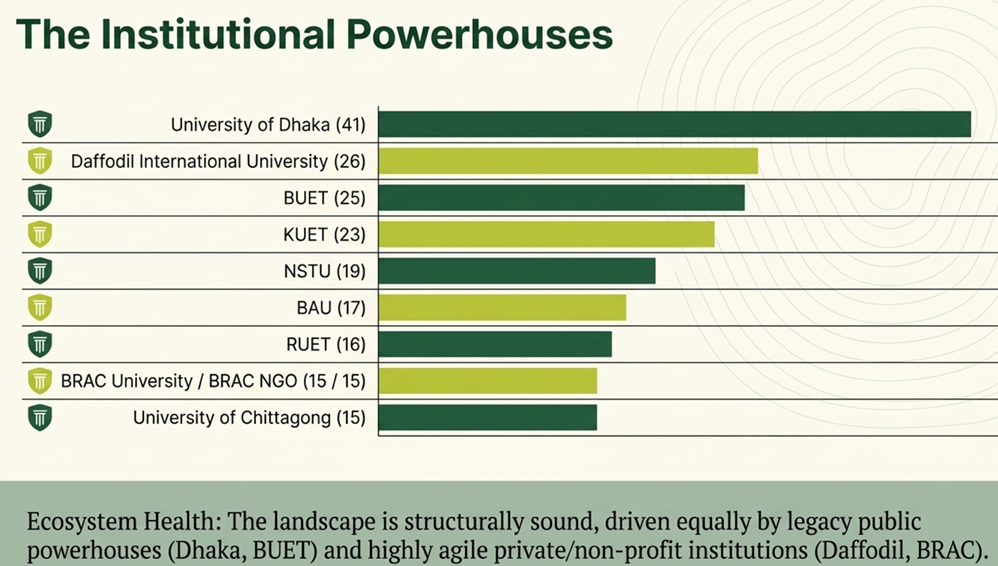
The appearance of engineering universities, agricultural institutions, comprehensive universities, and development-oriented organizations within the leading affiliations highlights the multidisciplinary nature of green sustainability research.
Who Is Publishing the Research?
The leading researchers were distributed across environmental science, economics, engineering, sustainability, development studies, and related disciplines.
| Rank | Researcher | Publications |
|---|---|---|
| 1 | Md. Abdus Shabur | 6 |
| 2 | Miguel Angel Esquivias Padilla | 6 |
| 3 | Ismat Ara Begum | 5 |
| 4 | Barun Das | 5 |
| 5 | Abu Reza Md. Towfiqul Islam | 5 |
| 6 | Mohammad Atique Ul Alam | 5 |
| 7 | Md. Shahriar Mohtasim | 5 |
| 8 | Edris Alam | 4 |
| 9 | Roberto Baldacci | 4 |
| 10 | Md. Mominur Rahman | 4 |
A substantial group of additional researchers recorded four publications each, including Md. Emran Hossain, Liton Chandra Voumik, A. B. M. Mainul Bari, Kamrul Islam, Mohammad Kholid Ridwan, Mohammad Bin Amin, Qamruzzaman, Abdullah Al Masud, and Afsana Akther.
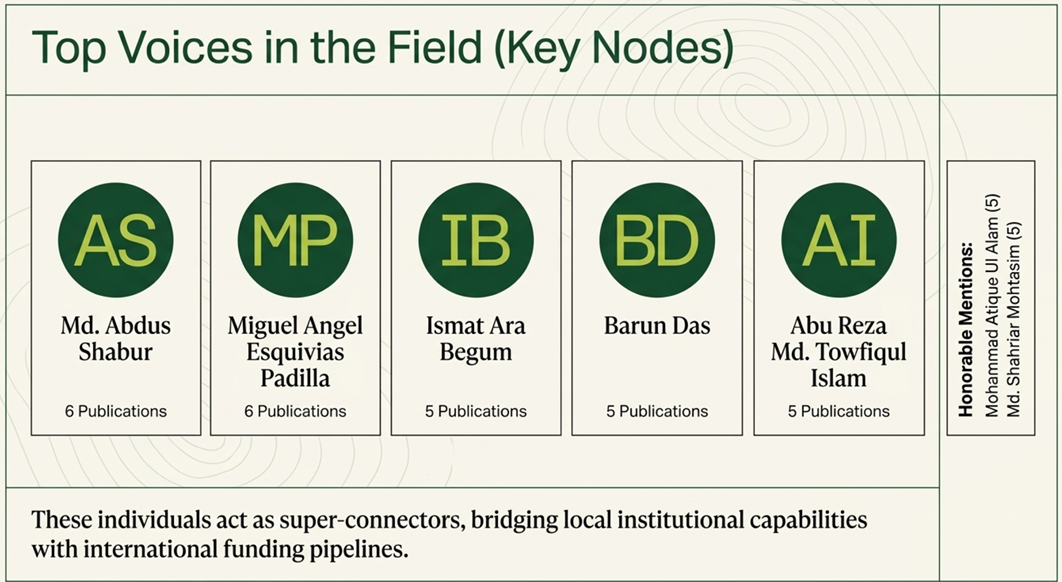
This distribution indicates that the field is not dominated by a single research group. Instead, green sustainability research is being produced through a network of researchers working across different disciplines and institutions.
Bangladesh’s Global Research Connections
Although Bangladesh accounted for all 333 publications in the dataset, substantial international participation was evident.
| Rank | Country / Region | Publications |
|---|---|---|
| 1 | Bangladesh | 333 |
| 2 | United States | 51 |
| 3 | People’s Republic of China | 43 |
| 4 | Malaysia | 42 |
| 5 | Australia | 37 |
| 6 | India | 27 |
| 7 | England | 24 |
| 8 | Japan | 23 |
| 9 | Saudi Arabia | 23 |
| 10 | Hungary | 15 |
The United States, China, and Malaysia represented the three largest international collaboration partners in the dataset.
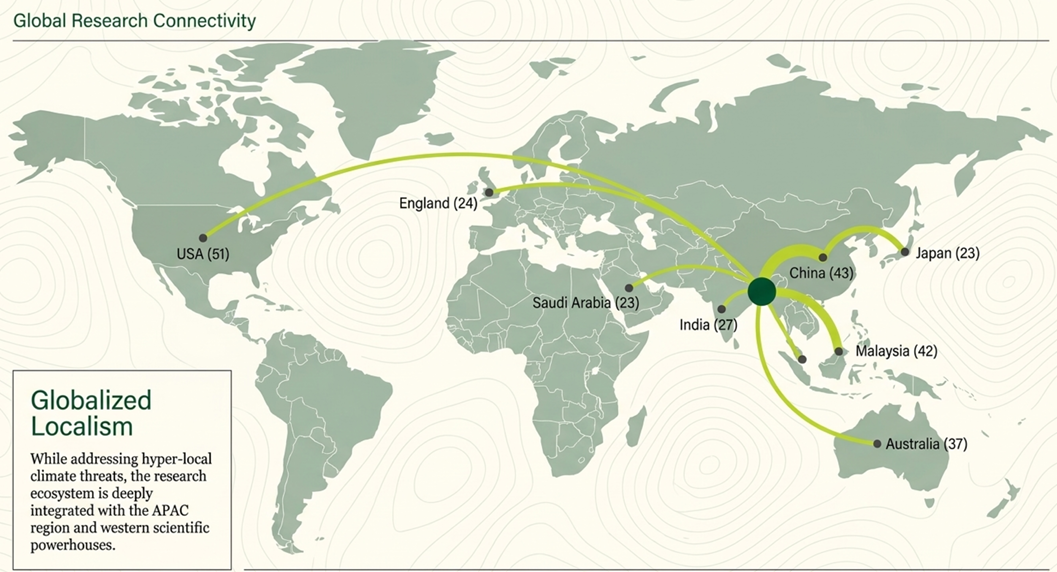
The presence of Australia, India, England, Japan, Saudi Arabia, and Hungary further demonstrates that Bangladesh’s sustainability research has developed beyond a purely national research framework.
From Carbon Emissions to Corporate Responsibility
The citation-topic profile provides a closer look at the intellectual themes behind the publications.
Major Micro-Level Research Topics
| Topic | Publications |
|---|---|
| Carbon Emissions | 33 |
| Corporate Social Responsibility | 20 |
| Pro-environmental Behavior | 13 |
Carbon emissions represented the largest specific topic, reflecting research concerned with greenhouse-gas emissions, environmental impacts, modeling, mitigation, and sustainable economic development.
Corporate Social Responsibility (CSR) was another important theme. Its presence indicates that the transition toward sustainability was being examined not only as a technological or environmental problem but also as an organizational and business responsibility.
Pro-environmental behavior added a human dimension, examining the behavioral and social factors associated with sustainable practices.
The Broader Citation-Topic Structure
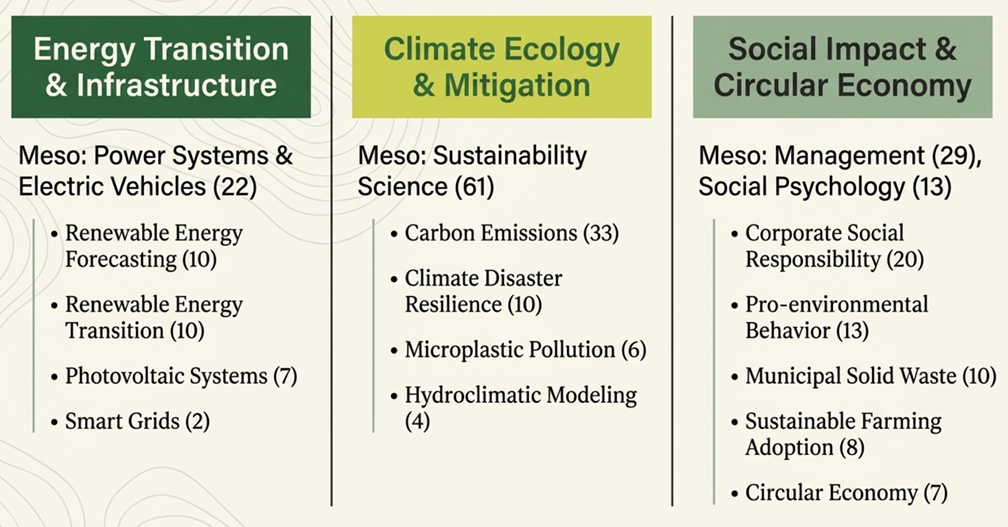
At the meso level, the research was distributed across a wider collection of scientific and social-science themes.
| Rank | Meso Citation Topic | Publications |
|---|---|---|
| 1 | Sustainability Science | 61 |
| 2 | Management | 29 |
| 3 | Power Systems & Electric Vehicles | 22 |
| 4 | Social Psychology | 13 |
| 5 | Climate Change | 11 |
| 6 | Agricultural Policy | 10 |
| 7 | Soil Science | 9 |
| 8 | Construction & Building Technology | 8 |
| 9 | Urban Studies | 7 |
| 10 | Electrical & Electronic Engineering | 6 |
The combination of sustainability science, management, energy technologies, climate change, agriculture, construction, urban studies, and social psychology illustrates the unusually broad scope of the field.
A Research Ecosystem Rather Than a Single Discipline
The publication profile can be understood as a three-part sustainability ecosystem:
Technology and engineering address solutions such as clean energy, power systems, electric vehicles, sustainable construction, and innovative materials.
Environmental research investigates climate change, carbon emissions, soil, ecosystems, pollution, and resource management.
Social and organizational research examines management, corporate social responsibility, public behavior, agricultural policy, and sustainable development.
These components are interconnected. Technological solutions require environmental assessment, while their successful adoption can depend on organizational decisions, policies, and human behavior.
Publishers Behind the Research
The publications were distributed across a diverse international publishing landscape.
| Publisher | Publications |
|---|---|
| Springer Nature | 112 |
| Elsevier | 84 |
| MDPI | 39 |
| Wiley | 32 |
| Taylor & Francis | 21 |
| KeAi Publishing Ltd | 11 |
Springer Nature accounted for the largest number of publications in the dataset, followed by Elsevier and MDPI.
This distribution indicates that Bangladesh’s green research is being disseminated through a broad range of international scholarly publishing platforms.
Leading Journals
Several journals were particularly prominent in the dataset.
| Journal | Publications |
|---|---|
| Discover Sustainability | 83 |
| Sustainability | 31 |
| Environment, Development and Sustainability | 17 |
| Journal of Cleaner Production | 15 |
| Sustainable Development | 15 |
| Renewable Energy | 12 |
| Renewable & Sustainable Energy Reviews | 12 |
| Green Technologies and Sustainability | 11 |
Discover Sustainability was the most prominent journal in the dataset, with 83 publications, substantially exceeding the publication counts of the other listed journals.
What Does the 2025 Publication Profile Reveal?
Three broad patterns emerge.
1. Climate and energy dominate the sustainability agenda
With 115 papers linked to SDG 13 and 98 linked to SDG 7, climate action and clean energy formed two of the strongest pillars of Bangladesh’s green research output.
2. Sustainability is increasingly interdisciplinary
The research extends well beyond environmental science. Engineering, energy, agriculture, management, psychology, urban studies, materials science, and social sciences are all represented.
3. Local research is strongly connected internationally
Bangladesh-based research was linked with researchers from the United States, China, Malaysia, Australia, India, England, Japan, Saudi Arabia, and other countries. This international connectivity provides a substantial collaborative dimension to the research landscape.
Key Numbers at a Glance
| Indicator | 2025 Dataset |
|---|---|
| Green Sustainable Science & Technology publications | 333 |
| Environmental Sciences publications | 186 |
| SDG 13 – Climate Action | 115 |
| SDG 7 – Clean Energy | 98 |
| Leading institution: University of Dhaka | 41 |
| Leading researchers | 6 publications each |
| Largest international partner: USA | 51 |
| Top citation topic: Sustainability Science | 61 |
| Top specific topic: Carbon Emissions | 33 |
| Largest publisher: Springer Nature | 112 |
| Largest journal: Discover Sustainability | 83 |
Conclusion
The 2025 Web of Science publication profile presents Green Sustainable Science and Technology as a major interdisciplinary research domain in Bangladesh. Across 333 publications, research was concentrated around climate action, clean energy, responsible production, sustainable infrastructure, and sustainable communities. The University of Dhaka, Daffodil International University, and BUET emerged as the three leading institutional contributors, while researchers such as Md. Abdus Shabur and Miguel Angel Esquivias Padilla were among the most prolific individual contributors. At the thematic level, Sustainability Science, Management, Power Systems & Electric Vehicles, Climate Change, Carbon Emissions, Corporate Social Responsibility, and Pro-environmental Behavior demonstrate how technological, environmental, economic, and behavioral perspectives are converging. Most importantly, the research profile shows that Bangladesh’s green research agenda is simultaneously local in its environmental concerns and global in its scientific collaboration. The combination of climate-focused research, clean-energy innovation, institutional diversity, and international co-authorship positions sustainability as a broad research platform connecting science, technology, policy, business, and society.