
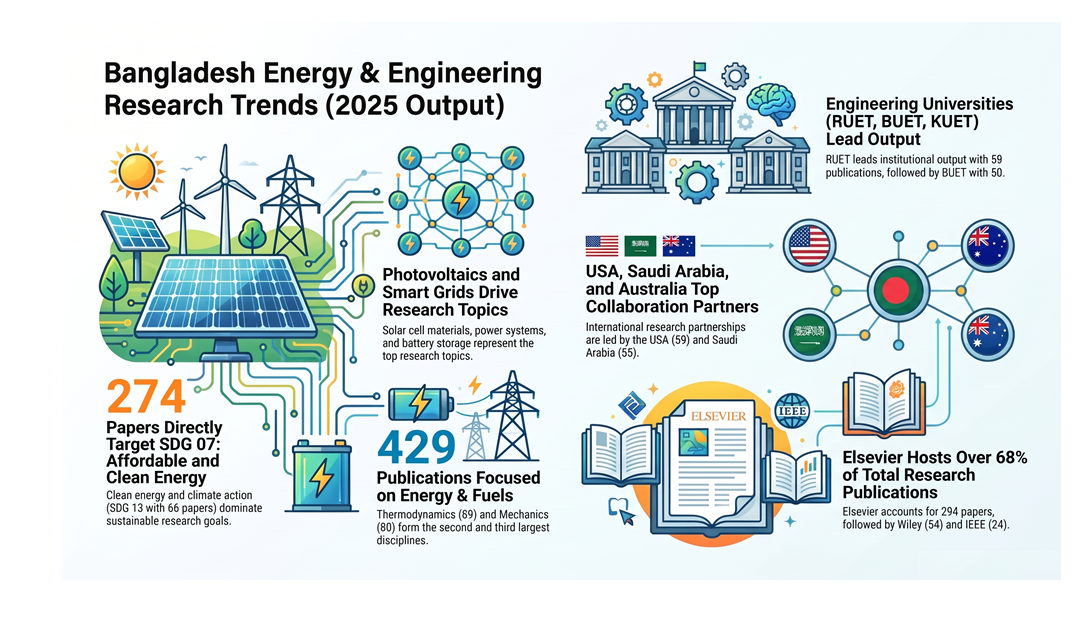
Research on energy and fuels from Bangladesh in Web of Science-indexed journals in 2025 was characterized by a strong emphasis on renewable energy, power systems, energy efficiency, advanced materials, and sustainable energy transitions. A dataset of 429 publications classified under Energy & Fuels provides a detailed picture of the research priorities being pursued by Bangladeshi researchers and their international collaborators. The publication landscape indicates that energy research was no longer concentrated solely on conventional energy generation. Considerable attention was directed toward photovoltaic systems, renewable-energy forecasting, smart grids, electric vehicles, perovskite solar materials, energy-system optimization, and energy storage. These themes demonstrate the increasingly interdisciplinary nature of energy research, linking electrical engineering, materials science, thermodynamics, chemistry, environmental science, and computational modelling. Web of Science
Major Research Areas
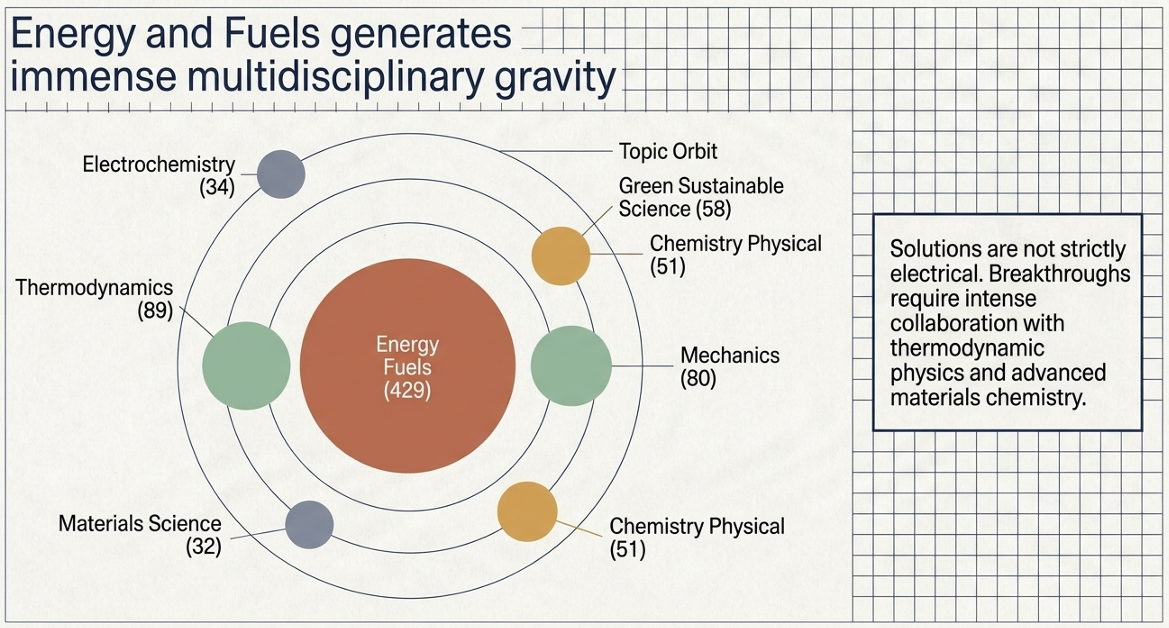
The 429 publications were distributed across a broad interdisciplinary research landscape. Energy & Fuels itself accounted for all 429 documents, while substantial contributions were also associated with thermodynamics, mechanics, engineering, sustainable science, chemistry, electrochemistry, materials science, and environmental sciences.
| Research area | Publications/documents | Major research emphasis |
|---|---|---|
| Energy & Fuels | 429 | Power systems, renewable energy, EVs, photovoltaics |
| Thermodynamics | 89 | Energy optimization, phase-change materials, nanofluids |
| Mechanics | 80 | Hydraulics, vibration, rotating machinery |
| Green & Sustainable Science & Technology | 58 | Carbon reduction, circular economy, energy efficiency |
| Chemistry | 53+ | Perovskites, photocatalysts, advanced materials |
| Electrochemistry | 34 | Electrodes, fuel cells, batteries, electrocatalysis |
| Materials Science | 32 | Thin films, functional materials, bio-based materials |
| Environmental Sciences & Ecology | 28 | Carbon capture, climate resilience, pollution |
| Nuclear Science | 22 | Hydrogen, fusion and energy materials |
| Biotechnology | 19 | Anaerobic digestion, bioenergy, microbial systems |
| Agriculture | 9 | Agrivoltaics and energy-related agricultural systems |
Note: Some publications can be assigned to more than one Web of Science research area; therefore, these figures should not be summed as mutually exclusive categories.
Dominant Research Topics
The research topics provide a more detailed picture of where scientific attention was concentrated. Power Systems & Electric Vehicles formed the largest thematic cluster, with 112 publications. Photovoltaic technologies, renewable-energy forecasting, and perovskite materials were also prominent.
| Rank | Research topic | Publications |
|---|---|---|
| 1 | Power Systems & Electric Vehicles | 112 |
| 2 | Photovoltaic Systems | 44 |
| 3 | Renewable Energy Forecasting | 31 |
| 4 | Perovskite Solar Materials | 28 |
| 5 | Smart Grids | 21 |
| 6 | Renewable Energy Transition | 13 |
| 7 | Electric Vehicles | 6 |
| 8 | TiO₂ Photocatalysts | 5 |
| 9 | Solar Thermal Systems | 5 |
| 10 | Lithium-ion Batteries | 4 |
The distribution suggests that energy research was increasingly concerned with integration and system management, rather than merely increasing energy-generation capacity. Renewable-energy forecasting, smart grids, energy storage, and electric mobility address the challenges created by intermittent renewable generation and rapidly changing electricity-demand patterns.
Photovoltaic Systems
With 44 publications, photovoltaic systems represented one of the largest specialized research themes. Research in this area was complemented by work on thin-film materials, perovskites, solar thermal technologies, and energy-system integration.
Renewable-Energy Forecasting
Thirty-one publications were associated with renewable-energy forecasting. Artificial intelligence, machine learning, statistical modelling, and computational optimization have become increasingly important for predicting renewable generation and supporting grid management.
Perovskite Solar Materials
Perovskite-related research accounted for 28 publications. The topic connects energy research with physical chemistry and materials science and reflects continuing interest in next-generation photovoltaic materials.
Smart Grids
Smart-grid research accounted for 21 publications. This research area is particularly important for integrating distributed solar generation, electric vehicles, energy storage, and other decentralized energy resources into electricity networks.
Research on Thermodynamics and Energy Conversion
Thermodynamics represented the second-largest broad research category, with 89 documents. The research included both fundamental and applied approaches to improving energy conversion and thermal management.
| Research topic | Publications |
|---|---|
| Energy Systems Optimization | 10 |
| Phase Change Materials | 9 |
| Nanofluids | 8 |
| Solar Desalination | Not separately quantified |
| Ground Source Heat Pumps | Not separately quantified |
Phase-change materials and nanofluids are particularly relevant to thermal-energy storage and heat-transfer enhancement. Solar desalination and ground-source heat pumps further demonstrate the connection between thermodynamic research and sustainable infrastructure.
Researchers including Prangon Chowdhury and Sanowar Hossain, with 11 publications each, were among the prominent contributors in this broader research landscape.
Sustainable Energy and Environmental Research
A substantial portion of the research was connected with sustainability and environmental objectives. Green & Sustainable Science & Technology accounted for 58 documents, while environmental sciences contributed another 28 documents.
Major themes included:
- Carbon-emission reduction
- Circular-economy models
- Building-energy efficiency
- Sustainable construction
- Municipal solid-waste management
- Carbon capture
- Climate-disaster resilience
- Microplastic pollution
- Water-resource optimization
The research therefore extended beyond electricity generation to encompass the environmental footprint and resource efficiency of energy systems.
Chemistry, Electrochemistry, and Advanced Energy Materials
The energy research ecosystem was strongly supported by chemistry and electrochemistry.
Chemistry
More than 53 publications were associated with chemistry-related areas, with 28 publications focusing on perovskite solar materials. Other themes included TiO₂ photocatalysts, metal-organic frameworks, and related functional materials.
Rehena Nasrin, with 9 publications, was identified among the leading contributors in this research area.
Electrochemistry
Electrochemistry accounted for 34 documents, with research extending into several important energy technologies.
| Research topic | Publications |
|---|---|
| Electrode Materials | 17 |
| Fuel Cell Membranes | 11 |
| Electrocatalysis | 7 |
| Lithium-ion Batteries | 4 |
| Battery Electrolytes | 4 |
| CO₂ Electroreduction | Emerging topic |
These topics demonstrate the increasing overlap between energy research and advanced materials chemistry, particularly in fuel cells, batteries, electrocatalysis, and carbon-conversion technologies.
Materials Science and Emerging Energy Technologies
Materials Science contributed 32 documents, including research on:
- Functional chalcogenides
- Cellulose composites
- Thin-film solar cells
- Thermoelectric materials
- Two-dimensional materials
- Graphene
- Bio-based materials
M. Monjurul Ehsan, with 9 publications, was identified among the leading researchers associated with this research area.
The presence of these themes indicates that the development of future energy technologies is increasingly dependent on the discovery and engineering of materials with improved electrical, thermal, optical, catalytic, and mechanical properties.
Sustainable Development Goal Alignment
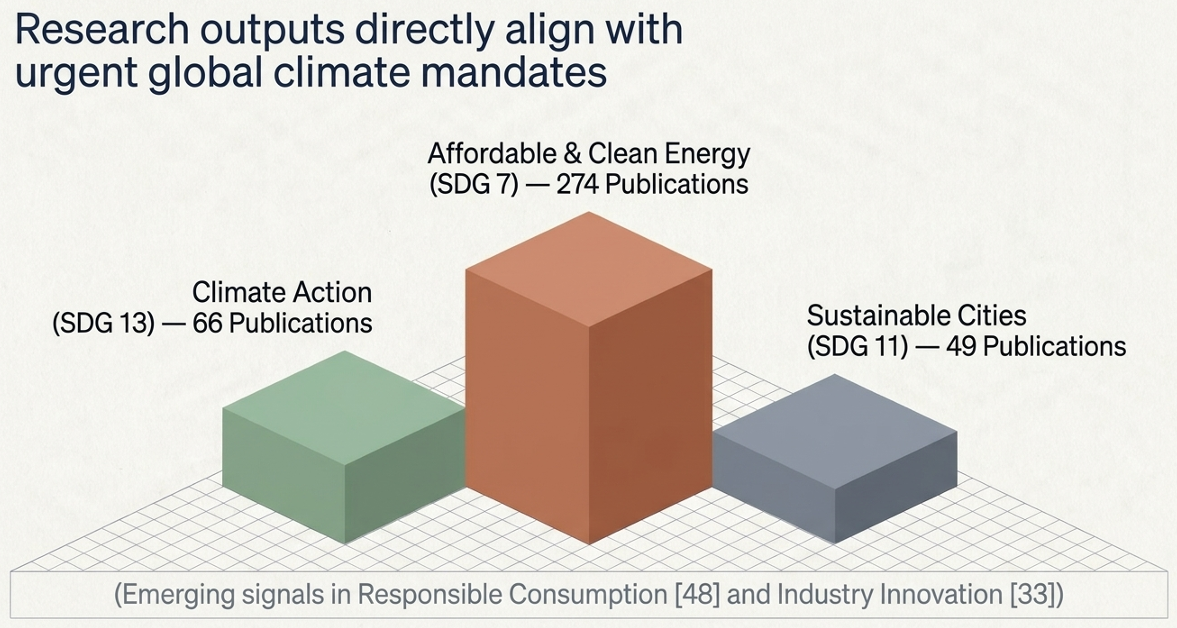
The publications showed particularly strong alignment with the United Nations Sustainable Development Goals.
| SDG | Sustainable Development Goal | Publications |
|---|---|---|
| SDG 7 | Affordable and Clean Energy | 274 |
| SDG 13 | Climate Action | 66 |
| SDG 11 | Sustainable Cities and Communities | 49 |
| SDG 12 | Responsible Consumption and Production | 48 |
| SDG 6 | Clean Water and Sanitation | 27 |
| SDG 2 | Zero Hunger | 7 |
| SDG 14 | Life Below Water | 5 |
| SDG 3 | Good Health and Well-Being | 4 |
| SDG 15 | Life on Land | 3 |
SDG 7 was clearly the most strongly represented goal, being associated with 274 publications. This was followed by SDG 13, which was connected with 66 publications.
The strong representation of SDGs 11 and 12 also demonstrates that energy research was being connected with urban sustainability, responsible production, resource efficiency, and infrastructure development rather than being treated as an isolated technological issue.
Leading Bangladeshi Institutions
The institutional distribution demonstrates the important role of Bangladesh’s engineering universities in energy and fuel research.
| Rank | Institution | Publications |
|---|---|---|
| 1 | Rajshahi University of Engineering & Technology (RUET) | 59 |
| 2 | Bangladesh University of Engineering & Technology (BUET) | 50 |
| 3 | Khulna University of Engineering & Technology (KUET) | 46 |
These institutions collectively accounted for a substantial share of the identified publication output.
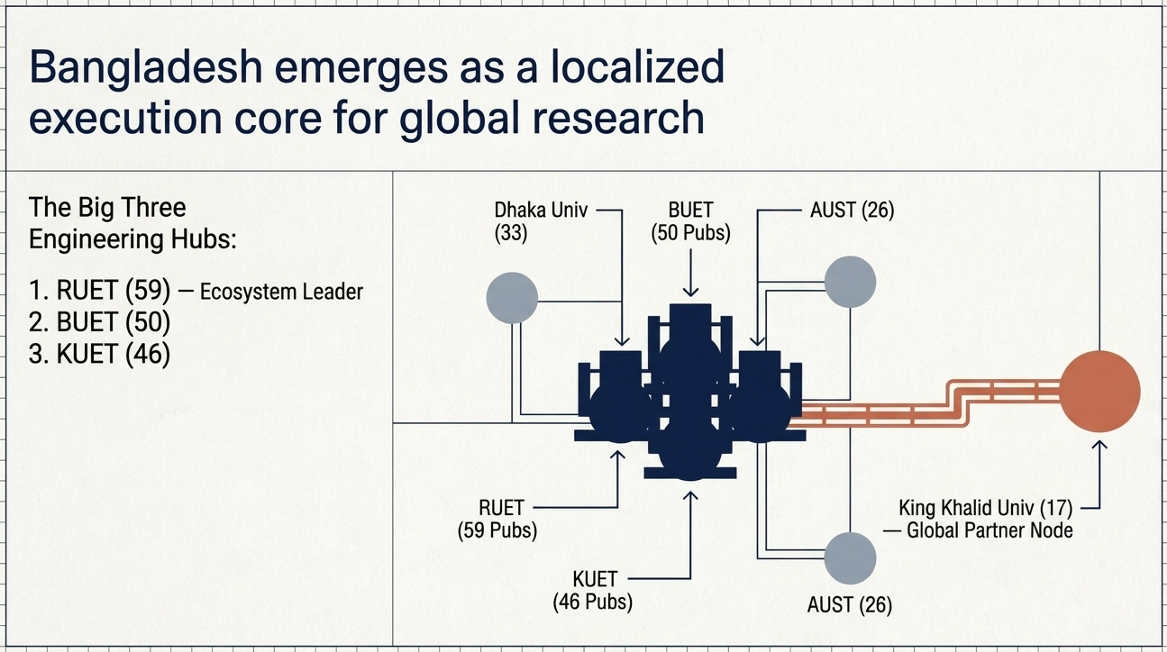
The prominence of RUET, BUET, and KUET is consistent with the highly engineering-oriented character of the dataset. Research involving electrical systems, power electronics, renewable generation, thermal systems, computational modelling, and energy optimization is particularly compatible with the research infrastructure and expertise developed at these institutions.
Leading Researchers
Several researchers emerged as important contributors to the 2025 publication landscape.
| Rank | Researcher | Publications |
|---|---|---|
| 1 | Monjur Mourshed | 15 |
| 2 | Prangon Chowdhury | 11 |
| 3 | Sanowar Hossain | 11 |
| 4 | Md. Golam Kibria | 11 |
| 5 | Rehena Nasrin | 9 |
| 6 | M. Monjurul Ehsan | 9 |
| 7 | Abu Shufian | 8 |
| 8 | Yassine El Alami | 8 |
| 9 | Elhadi Baghaz | 8 |
| 10 | Yasin Khan | 8 |
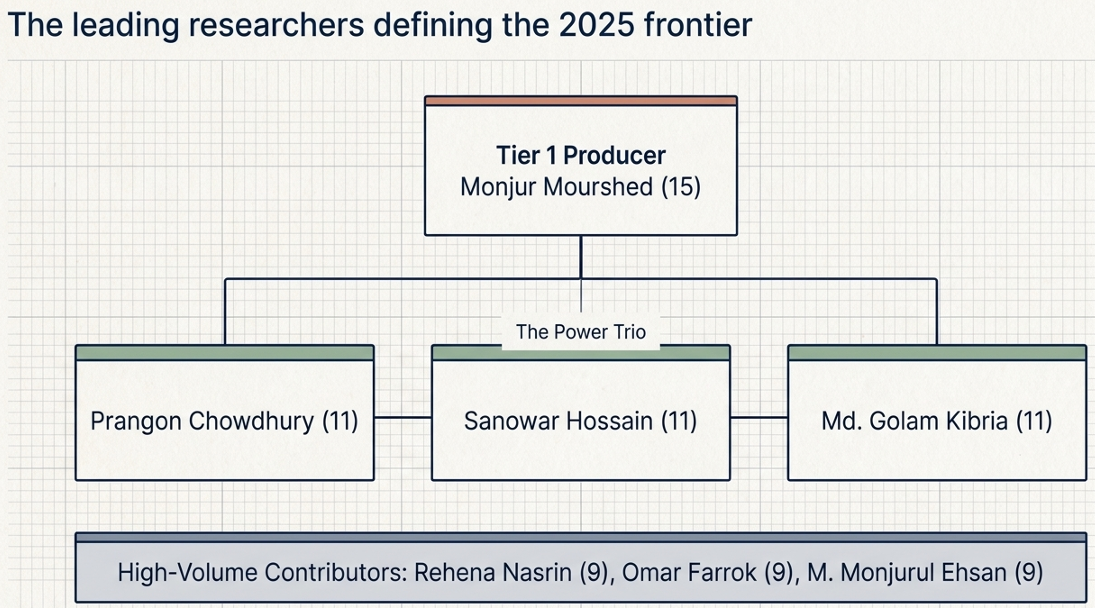
The publication patterns suggest that the research was conducted through relatively large and interdisciplinary teams. Individual researchers were frequently connected with multiple institutions, research themes, and international collaborators.
International Funding and Collaboration
Although the publication output was centered strongly on Bangladeshi institutions, the funding structure demonstrated an international research ecosystem.
| Funding agency | Funded projects/publications |
|---|---|
| Deanship of Research and Graduate Studies, King Khalid University, Saudi Arabia | 8 |
| National Natural Science Foundation of China (NSFC) | 7 |
The involvement of Saudi Arabian and Chinese funding agencies illustrates the international character of energy research. Energy transition, renewable integration, carbon reduction, and advanced materials are global research challenges, and collaborative funding provides access to specialized expertise, facilities, datasets, and research networks.
Research Ecosystem
The 2025 publication landscape can be conceptualized as a connected research ecosystem:
Bangladeshi engineering universities
↓
Power systems + renewable energy + thermal systems
↓
Solar photovoltaics + smart grids + forecasting + electric vehicles
↓
Advanced materials + batteries + fuel cells + electrochemistry
↓
Energy efficiency + carbon reduction + sustainable infrastructure
↓
SDG 7 + SDG 11 + SDG 12 + SDG 13
This structure illustrates how apparently separate research fields were connected through the broader objective of developing more efficient and sustainable energy systems.
Publishing and Research Characteristics
The dataset was dominated by journal-based scientific communication, with Elsevier and Wiley among the major publishers represented in the research landscape. The publication pattern also indicates substantial interdisciplinary overlap: a single study could simultaneously contribute to Energy & Fuels, Thermodynamics, Materials Science, Environmental Sciences, and Sustainable Technology.
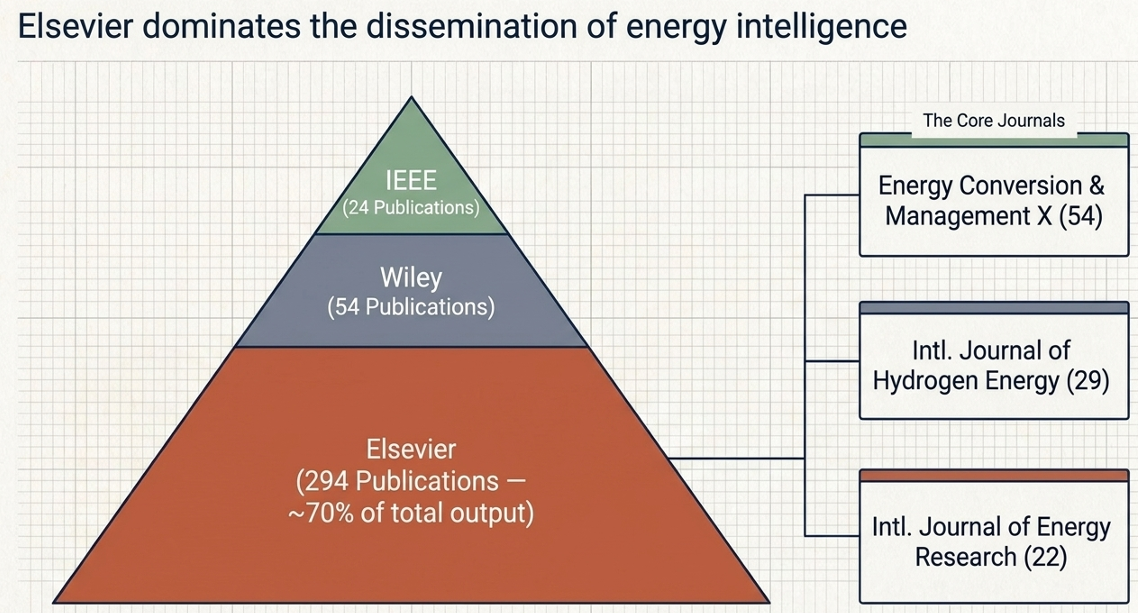
This interdisciplinary structure is particularly important because modern energy problems cannot be addressed through a single scientific discipline. For example, an electric-vehicle study may involve power electronics, battery chemistry, smart-grid integration, transportation systems, and environmental assessment simultaneously.
Key Observations
- Renewable and integrated energy systems were central to the research landscape. Photovoltaics, forecasting, smart grids, electric vehicles, and energy-system optimization represented major thematic areas within the 429 Energy & Fuels publications.
- Energy research was strongly connected with advanced materials. Perovskites, thin films, chalcogenides, graphene, thermoelectric materials, electrodes, electrolytes, and fuel-cell membranes demonstrate the importance of materials innovation in the energy transition.
- Bangladeshi engineering universities formed major research hubs. RUET, BUET, and KUET collectively represented 155 publications in the dataset, highlighting the contribution of engineering-focused institutions.
- International collaboration was embedded in the research structure. Funding from organizations in Saudi Arabia and China indicates that Bangladeshi energy research was connected with broader international scientific networks.
- The research was closely aligned with sustainability objectives. The association of 274 publications with SDG 7 and 66 with SDG 13 indicates a strong connection between the research portfolio and clean-energy and climate-action objectives.
Conclusion
The analysis of 429 Energy & Fuels publications from Bangladesh in Web of Science-indexed journals in 2025 reveals a research landscape centered on the transformation of energy systems. Although renewable-energy generation remained fundamental, increasing attention was directed toward the technologies required to make renewable energy reliable and scalable—including forecasting, smart grids, energy storage, electric vehicles, advanced photovoltaic materials, and system optimization. The strong representation of thermodynamics, chemistry, electrochemistry, materials science, and environmental sciences further demonstrates that Bangladesh’s energy research was becoming increasingly interdisciplinary. At the institutional level, RUET, BUET, and KUET emerged as major contributors, while researchers such as Monjur Mourshed, Prangon Chowdhury, Sanowar Hossain, and Md. Golam Kibria contributed prominently to the publication output.