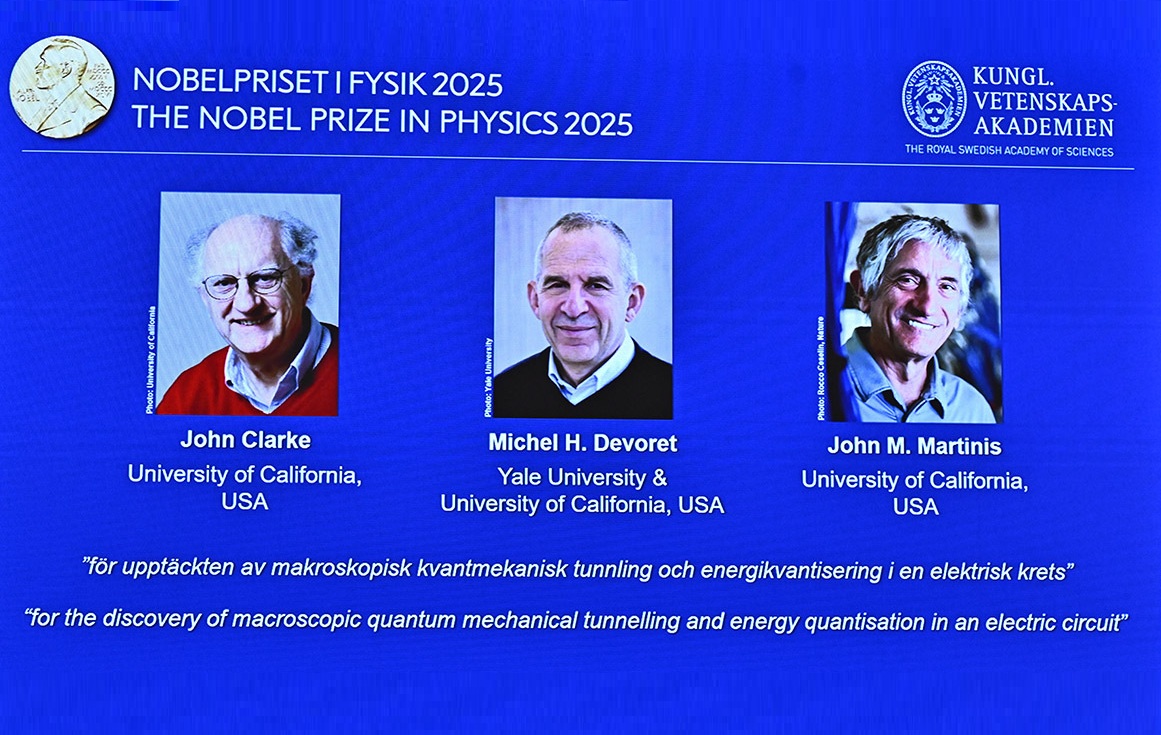
The 2025 Nobel Prize in Physics honors a groundbreaking experiment that proved quantum effects can exist in macroscopic electrical circuits, a discovery that later became the cornerstone of modern quantum computing. In the 1980s, three physicists at the University of California, Berkeley, achieved what was once thought impossible—demonstrating that superconducting circuits, visible to the naked eye, could behave according to the strange laws of quantum mechanics. Their pioneering work has since guided the development of quantum bits (qubits), the fundamental units of quantum computers. Science.
The Laureates:
🔹 John Clarke — University of California, Berkeley (USA).
Leader of the research group where the discovery was made, Clarke oversaw the experiments that first revealed quantum tunneling in superconducting circuits. His vision and mentorship shaped the field that now powers quantum technologies.
🔹 Michel H. Devoret — Yale University (USA).
Then a postdoctoral researcher in Clarke’s lab, Devoret played a central role in designing and interpreting the quantum measurements that proved the macroscopic wave of paired electrons behaves according to quantum theory.
🔹 John M. Martinis — University of California, Santa Barbara (USA).
As a graduate student during the discovery, Martinis helped carry out the experiments that confirmed the quantum behavior of the circuits. Decades later, he would lead Google’s quantum computing team, which in 2019 announced a milestone in quantum computation.
The Discovery: Quantum Mechanics Beyond the Microscopic:
In 1985, the three physicists demonstrated that a superconducting circuit—cooled close to absolute zero—could host a single macroscopic quantum wave formed by paired electrons. They used a Josephson junction, a tiny insulating barrier within the superconducting wire, to show quantum tunneling, where electron pairs can penetrate and flow through the barrier.
By carefully controlling the current and applying microwaves, they observed the junction’s discrete quantum energy states, providing direct evidence that large-scale electrical circuits can follow the laws of quantum mechanics.
Impact and Legacy:
This foundational work paved the way for superconducting qubits, now among the most promising technologies for building quantum computers. Unlike classical bits, which are strictly 0 or 1, qubits can exist in both states simultaneously, enabling exponentially faster computation for certain problems.
While this year’s award celebrates the fundamental discovery of quantum effects in circuits, it does not extend to the engineering of qubits themselves—an innovation that may yet earn future recognition. Other scientists, such as Hans Mooij (Delft University of Technology) and Yasunobu Nakamura (University of Tokyo), also contributed to that next stage of development.
A Prize Decades in the Making:
The laureates’ discovery was revolutionary at a time when most physicists doubted that large circuits could ever behave quantum mechanically. Reflecting on the honor, John Clarke said:
“It came as the surprise of my life. It had never occurred to me that this work might one day be the basis for a Nobel Prize.”
The award not only honors a key scientific milestone but also highlights the vision that bridged the quantum and classical worlds, making today’s quantum technologies a reality.