
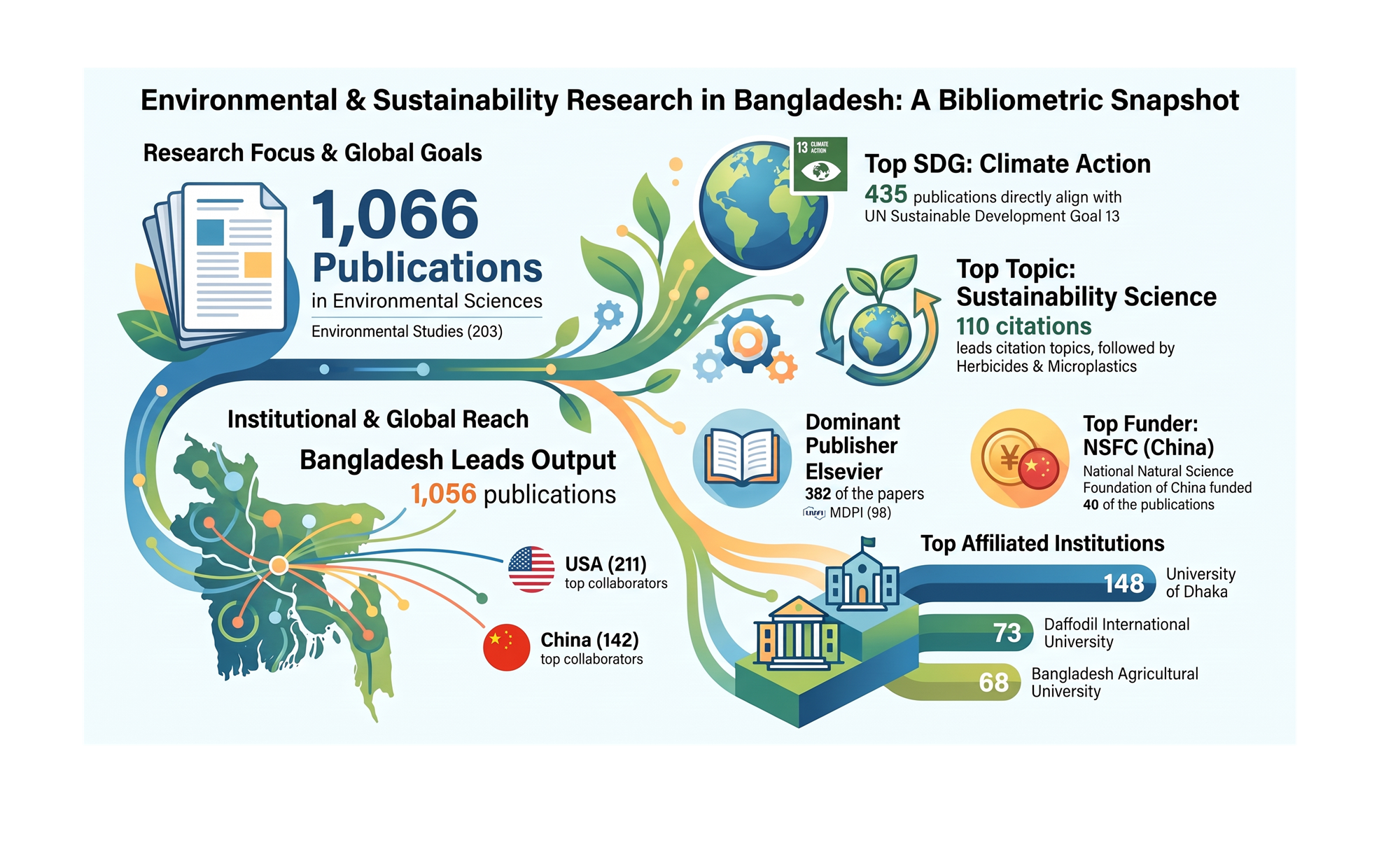
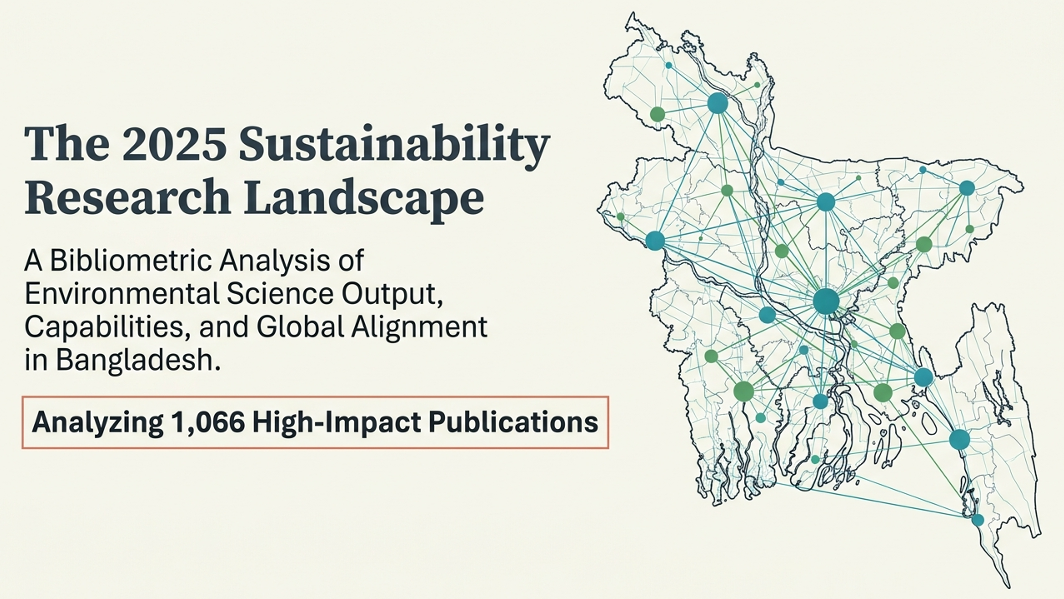
More than 1,000 Web of Science-indexed publications associated with Bangladesh were recorded in 2025 within the environmental science and sustainability research dataset provided. The research landscape was characterized by strong domestic participation, extensive international collaboration, and substantial alignment with the United Nations Sustainable Development Goals (SDGs). As Bangladesh is highly exposed to climate variability, coastal degradation, pollution, water insecurity, and ecosystem pressures, environmental research has been directed toward both locally relevant challenges and internationally recognized sustainability priorities. A total of 1,056 records were associated with Bangladesh, while substantial collaboration was recorded with researchers from the United States, China, Australia, Saudi Arabia, Malaysia, India, Japan, Canada, and other countries. The research was distributed across environmental sciences, sustainability, pollution control, water resources, marine ecosystems, agriculture, public health, climate action, and sustainable development. The publication profile indicates that environmental research in Bangladesh has increasingly been connected with broader sustainability objectives. SDG 13 (Climate Action), SDG 14 (Life Below Water), SDG 3 (Good Health and Well-Being), and SDG 6 (Clean Water and Sanitation) were among the most frequently represented goals. Web of Science
Research Output and International Collaboration
The dataset contained 1,056 publications associated with Bangladesh. This output was supported by a broad network of national universities, research organizations, and international collaborators. The United States was the most prominent international collaborator, with 211 records, followed by China with 142, Australia with 136, and Saudi Arabia with 120. Collaboration was also recorded with Malaysia, India, England, Japan, and Canada.
Major collaborating countries and regions
| Rank | Country/Region | Records |
|---|---|---|
| 1 | Bangladesh | 1,056 |
| 2 | USA | 211 |
| 3 | People’s Republic of China | 142 |
| 4 | Australia | 136 |
| 5 | Saudi Arabia | 120 |
| 6 | Malaysia | 103 |
| 7 | India | 90 |
| 8 | England | 68 |
| 9 | Japan | 65 |
| 10 | Canada | 51 |
This collaboration pattern indicates that Bangladeshi environmental research was not conducted in isolation. International research networks were extensively incorporated, particularly through partnerships involving North America, East Asia, Australia, the Middle East, and neighboring South Asian countries.
Leading Academic Institutions
The institutional distribution demonstrates that environmental and sustainability research was undertaken across a diverse group of Bangladeshi universities and research organizations. The University of Dhaka occupied the leading position with 148 publications, representing a substantial share of the institutional output in the dataset. Daffodil International University, Bangladesh Agricultural University, and Noakhali Science and Technology University also contributed strongly. The presence of Bangladesh Agricultural University reflects the importance of agriculture, environmental management, food security, and natural-resource research within the national sustainability agenda.
Top ten institutions
| Rank | Institution | Publications |
|---|---|---|
| 1 | University of Dhaka | 148 |
| 2 | Daffodil International University | 73 |
| 3 | Bangladesh Agricultural University | 68 |
| 4 | Noakhali Science & Technology University | 67 |
| 5 | Bangladesh Council of Scientific & Industrial Research (BCSIR) | 60 |
| 6 | Bangladesh University of Engineering & Technology (BUET) | 60 |
| 7 | University of Chittagong | 57 |
| 8 | Jahangirnagar University | 49 |
| 9 | Khulna University | 46 |
| 10 | Shahjalal University of Science & Technology (SUST) | 46 |
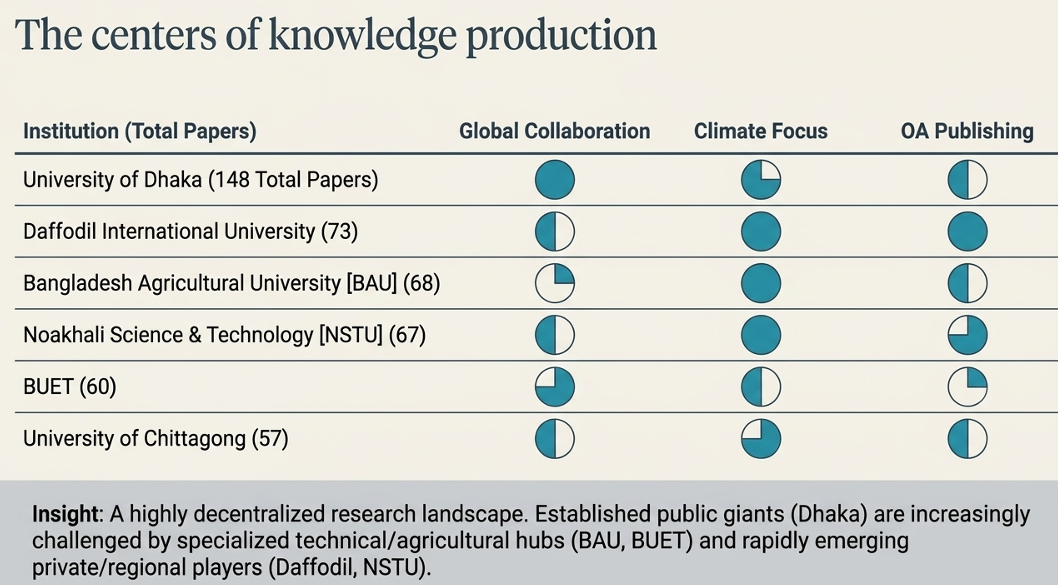
The institutional distribution shows that environmental research was being supported by conventional comprehensive universities, agricultural universities, engineering institutions, and national research organizations. This multidisciplinary structure is particularly relevant to sustainability research, where environmental problems frequently require contributions from biology, chemistry, engineering, agriculture, public health, and social sciences.
Top Ten Researchers
The researcher-level distribution was led by Abu Reza Md. Towfiqul Islam, who was associated with 21 records. Abubakr M. Idris and Mayeen Uddin Khandaker followed with 14 and 13 records, respectively.
Top ten researchers
| Rank | Researcher | Records |
|---|---|---|
| 1 | Abu Reza Md. Towfiqul Islam | 21 |
| 2 | Abubakr M. Idris | 14 |
| 3 | Mayeen Uddin Khandaker | 13 |
| 4 | Bazlar Rashid | 12 |
| 5 | M. Habibullah-Al-Mamun | 12 |
| 6 | M.M. Mahfuz Siraz | 11 |
| 7 | Hamid Osman Osman | 10 |
| 8 | Rahat Khan | 10 |
| 9 | Abdus Salam | 10 |
| 10 | Amit Hasan Anik | 10 |
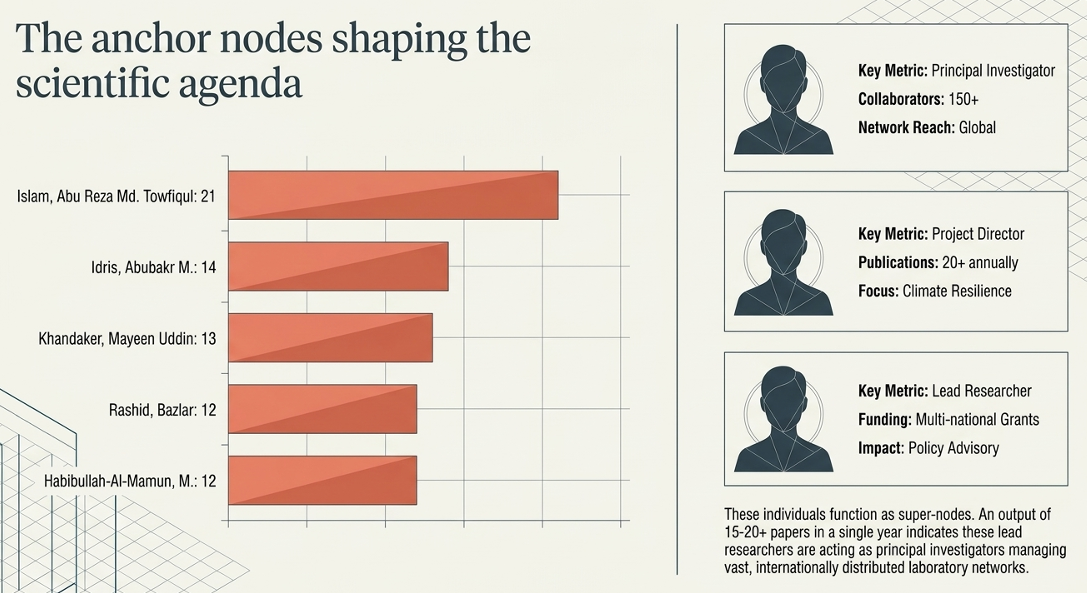
The presence of multiple researchers with approximately 10 or more publications suggests that environmental research was distributed among a relatively broad group of active contributors rather than being concentrated entirely in a single research group.
Funding Landscape
International and national funding agencies played an important role in supporting the research output. The National Natural Science Foundation of China (NSFC) was associated with 40 records, followed by King Saud University with 25 records. Japanese agencies, Saudi Arabian universities, Indian funding organizations, Bangladeshi government agencies, and Australian agricultural research organizations were also represented.
Top funding agencies
| Rank | Funding agency | Grants/records |
|---|---|---|
| 1 | National Natural Science Foundation of China (NSFC) | 40 |
| 2 | King Saud University | 25 |
| 3 | Ministry of Education, Culture, Sports, Science and Technology, Japan (MEXT) | 15 |
| 4 | Japan Society for the Promotion of Science (JSPS) | 13 |
| 5 | Taif University | 13 |
| 6 | University Grants Commission, India | 13 |
| 7 | King Khalid University | 11 |
| 8 | Ministry of Science and Technology, Government of Bangladesh | 9 |
| 9 | Deanship of Scientific Research, King Faisal University, Saudi Arabia | 9 |
| 10 | Australian Centre for International Agricultural Research (ACIAR)* | 8 |
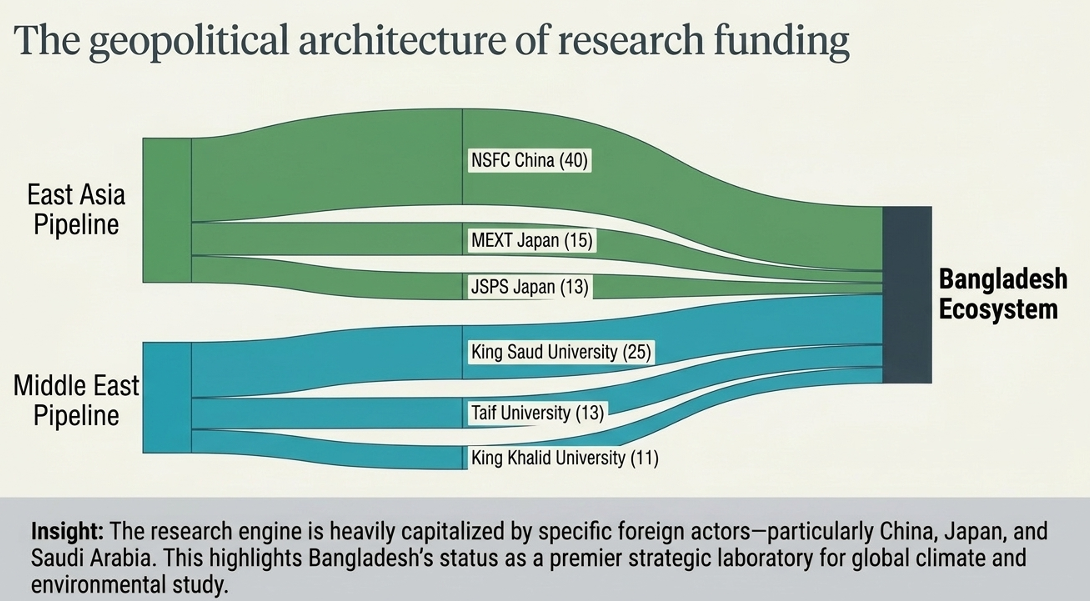
The funding structure demonstrates a strong international component. Considerable support was associated with Chinese, Saudi, Japanese, Indian, and Australian institutions, while national support was represented by the Ministry of Science and Technology, Government of Bangladesh.
Alignment with the Sustainable Development Goals
The environmental research portfolio showed particularly strong alignment with climate, marine, health, water, and sustainable-consumption objectives. SDG 13: Climate Action was associated with 435 records, making it the most frequently represented SDG in the dataset. SDG 14: Life Below Water followed with 381 records, reflecting the importance of marine and coastal ecosystems to Bangladesh.
Top ten SDGs represented in the research
| Rank | SDG | Focus | Records |
|---|---|---|---|
| 1 | SDG 13 | Climate Action | 435 |
| 2 | SDG 14 | Life Below Water | 381 |
| 3 | SDG 3 | Good Health and Well-Being | 313 |
| 4 | SDG 6 | Clean Water and Sanitation | 282 |
| 5 | SDG 11 | Sustainable Cities and Communities | 261 |
| 6 | SDG 12 | Responsible Consumption and Production | 226 |
| 7 | SDG 2 | Zero Hunger | 182 |
| 8 | SDG 15 | Life on Land | 181 |
| 9 | SDG 7 | Affordable and Clean Energy | 140 |
| 10 | SDG 9 | Industry, Innovation and Infrastructure | 125 |
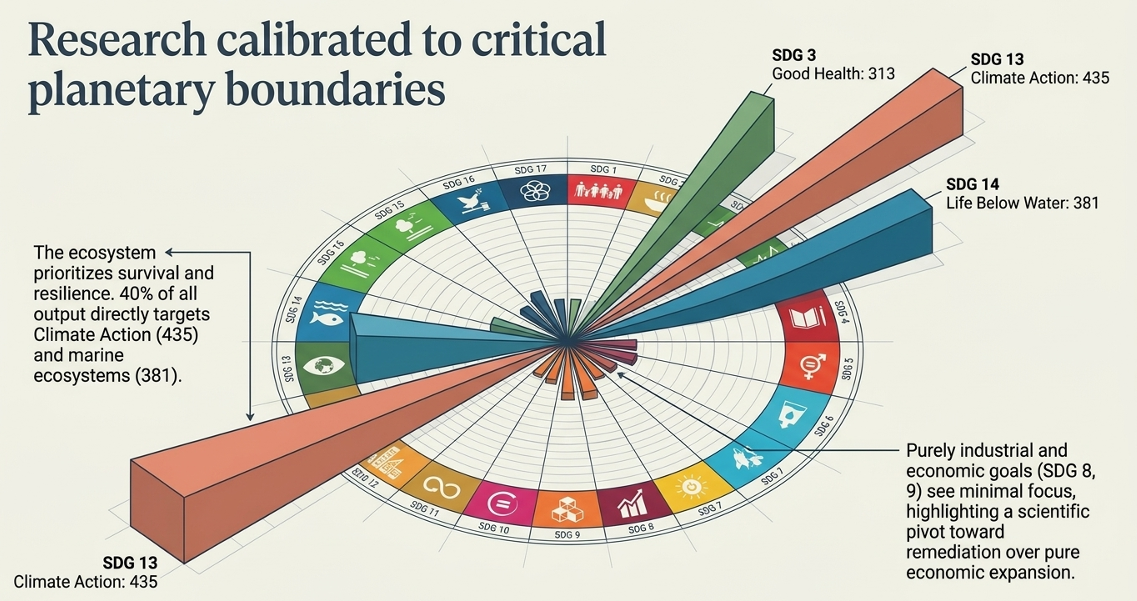
The distribution demonstrates that sustainability research extended beyond conventional environmental protection. Strong connections were also established with human health, food security, urban development, energy, infrastructure, and responsible production. The high representation of SDG 13 and SDG 14 is particularly relevant to Bangladesh because climate-related risks and coastal and marine ecosystem pressures are closely connected with the country’s geography and socioeconomic conditions.
Major Environmental Research Themes
Several research themes were prominent within the dataset. Sustainability science was represented through broad frameworks and analytical approaches, while more specific environmental challenges were addressed through pollution monitoring, remediation, agriculture, aquatic ecosystems, and climate-related research.
Major research areas included:
- Climate change and climate resilience
- Marine and coastal ecosystem protection
- Microplastic pollution
- Water and wastewater contamination
- Pesticide and herbicide contamination
- Soil pollution and environmental degradation
- Phytoremediation
- Carbon emissions and environmental sustainability
- Sustainable cities
- Agricultural sustainability
- Public health and environmental pollution
- Clean energy and resource efficiency
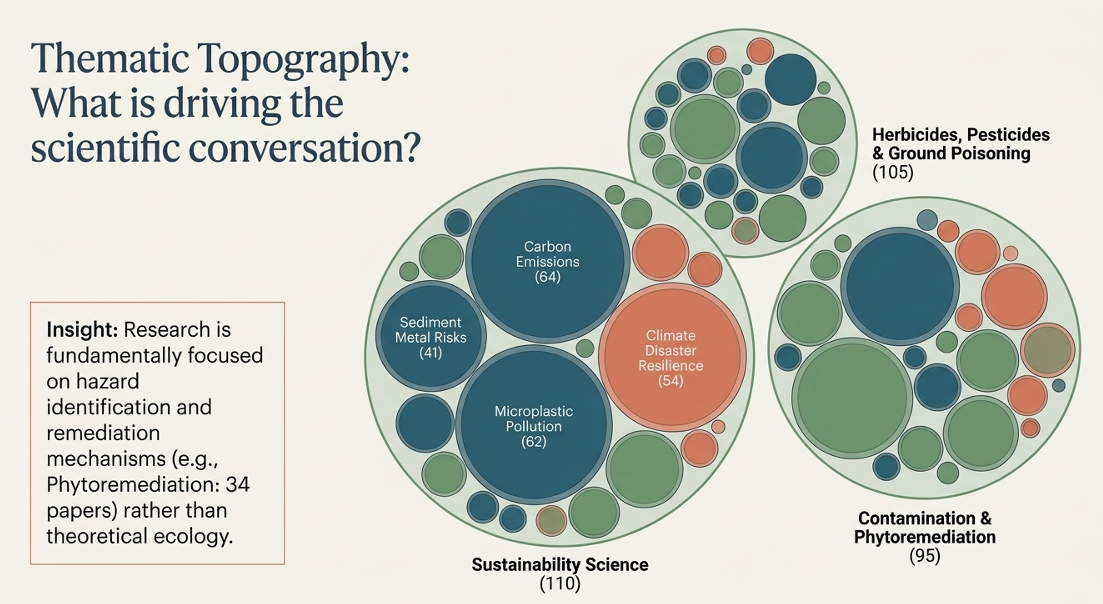
Microplastic pollution is particularly significant because research on plastics increasingly intersects with marine pollution, aquatic food webs, human exposure, and coastal ecosystem health. Similarly, phytoremediation represents an environmentally oriented approach in which plants are investigated for the removal or stabilization of contaminants in polluted environments.
Leading Academic Journals
Environmental and sustainability research from Bangladesh was distributed across a wide range of international journals. Discover Sustainability published the largest number of articles in the dataset, with 83 articles, followed by Sustainable Futures with 44 and Sustainability with 31.
Top ten journals
| Rank | Journal | Articles |
|---|---|---|
| 1 | Discover Sustainability | 83 |
| 2 | Sustainable Futures | 44 |
| 3 | Sustainability | 31 |
| 4 | Environmental Monitoring and Assessment | 30 |
| 5 | Journal of Genetic Engineering and Biotechnology | 28 |
| 6 | Earth Systems and Environment | 25 |
| 7 | Water, Air, & Soil Pollution | 24 |
| 8 | Marine Pollution Bulletin | 23 |
| 9 | Water | 23 |
| 10 | Cleaner Waste Systems | 20 |
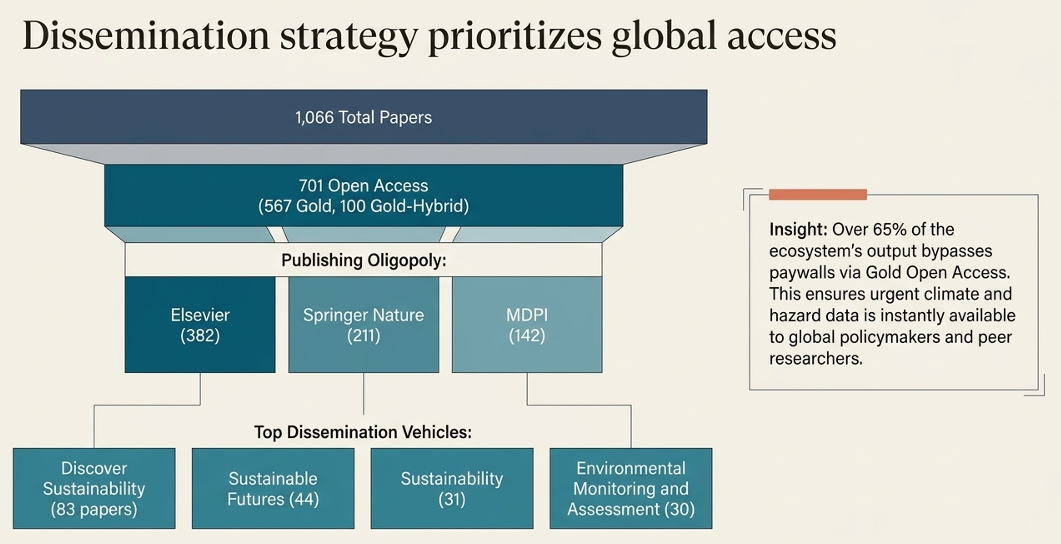
The journal distribution indicates that both broad sustainability journals and specialized environmental journals were utilized. Research was therefore disseminated through outlets covering sustainability science, environmental monitoring, marine pollution, water resources, waste management, and biotechnology.
Environmental Research Priorities
The publication profile suggests that several interconnected environmental problems were being prioritized.
Climate change
Climate-related research was strongly represented through 435 SDG 13-associated records. Research was directed toward climate impacts, adaptation, resilience, emissions, and sustainable development.
Marine and coastal environments
With 381 SDG 14-associated records, marine and aquatic environments constituted another major research domain. The emphasis is particularly relevant to Bangladesh because the country’s extensive river systems and coastal areas are connected to the Bay of Bengal.
Environmental pollution
Pollution research was represented through studies involving microplastics, pesticides, herbicides, heavy metals, contaminated water, and soil degradation. These topics connect environmental quality with ecological integrity and human health.
Environmental remediation
Phytoremediation and related biological approaches were represented as potential strategies for reducing environmental contamination. Such approaches are particularly relevant where low-cost and environmentally compatible remediation technologies are being investigated.
Water and sanitation
The 282 records associated with SDG 6 demonstrate substantial attention to water quality, sanitation, wastewater, aquatic contamination, and water-resource management.
Sustainable agriculture
The representation of SDG 2 with 182 records indicates that environmental research was also linked with food security and agricultural sustainability. Research involving pesticides, herbicides, soil quality, crop production, and environmental contamination can simultaneously address agricultural productivity and ecosystem protection.
Overall Research Structure
The 2025 dataset presents an environmental research system with several interconnected characteristics:
| Dimension | Main observation |
|---|---|
| National output | 1,056 Bangladesh-associated records |
| Leading institution | University of Dhaka |
| Leading researcher | Abu Reza Md. Towfiqul Islam |
| Major international collaborator | USA |
| Leading funding agency | National Natural Science Foundation of China |
| Leading SDG | SDG 13: Climate Action |
| Major environmental emphasis | Climate, marine ecosystems, pollution, water and sustainability |
| Leading journal | Discover Sustainability |
| Major international networks | USA, China, Australia, Saudi Arabia, Malaysia, India and Japan |
Conclusion
Environmental science and sustainability research from Bangladesh in 2025 was characterized by high research activity, extensive institutional participation, international collaboration, and strong SDG alignment. More than 1,000 Bangladesh-associated records were represented in the dataset, with the University of Dhaka serving as the largest institutional contributor and Abu Reza Md. Towfiqul Islam being identified as the most prolific researcher. The research agenda was strongly oriented toward climate action, marine and coastal ecosystems, human health, water security, sustainable cities, responsible consumption, agriculture, and terrestrial ecosystem protection. The prominence of SDG 13 and SDG 14 demonstrated that climate and aquatic environmental challenges were central components of the national research portfolio.