
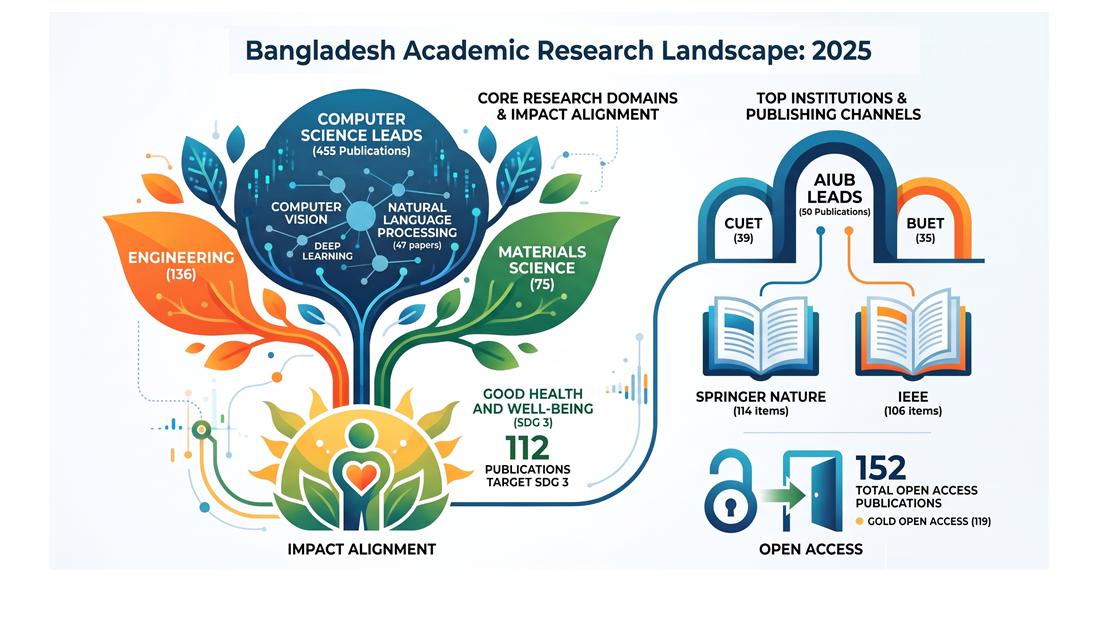
Bangladesh-affiliated researchers produced 455 Web of Science-indexed publications in Computer Science during 2025, reflecting a research landscape strongly oriented toward artificial intelligence, computer vision, natural language processing, information systems, and interdisciplinary applications. The publication profile also shows substantial engagement with engineering, healthcare, sustainable cities, climate action, and other Sustainable Development Goals (SDGs). The research was distributed across universities, engineering institutions, and interdisciplinary research groups. Both journal articles and conference proceedings contributed substantially to the overall output, while international collaboration connected Bangladeshi researchers with institutions in the United States, Australia, Malaysia, China, India, Saudi Arabia, Canada, Japan, England, and South Korea. Web of Science
Research Output and Major Web of Science Categories
The largest category was Computer Science, Interdisciplinary Applications, accounting for all 455 publications in the supplied dataset. Artificial Intelligence and Computer Science Theory & Methods were also prominent, with 188 and 116 publications, respectively.
| Rank | Web of Science Category / Research Area | Publications |
|---|---|---|
| 1 | Computer Science, Interdisciplinary Applications | 455 |
| 2 | Computer Science, Artificial Intelligence | 188 |
| 3 | Engineering, General | 136 |
| 4 | Computer Science, Theory & Methods | 116 |
| 5 | Engineering, Electrical & Electronic | 58 |
| 6 | Computer Science, Information Systems | 56 |
| 7 | Engineering, Multidisciplinary | 46 |
| 8 | Linguistics | 45 |
| 9 | Materials Science, Multidisciplinary | 44 |
| 10 | Telecommunications | 42 |
The category distribution indicates that computer science research was not confined to traditional computing disciplines. Strong connections with engineering, linguistics, materials science, telecommunications, and other fields were evident.
Leading Researchers
A relatively concentrated group of researchers accounted for a substantial portion of the publication output. M. F. Mridha was listed with 27 publications, followed by Ahmed Wasif Reza with 21.
| Rank | Researcher | Publications | Main Research Context |
|---|---|---|---|
| 1 | M. F. Mridha | 27 | Computer vision, deep learning, AI applications |
| 2 | Ahmed Wasif Reza | 21 | Artificial intelligence and interdisciplinary CS |
| 3 | Jakir Hossen | 12 | Computer science theory, systems, intelligence |
| 4 | Mohammed Moshiul Hoque | 12 | NLP and computational linguistics |
| 5 | M. Ashraful Amin | 11 | Computer vision, machine learning, pattern recognition |
| 6 | Khaleque Md Aashiq Kamal | 10 | Information systems and engineering applications |
| 7 | Hasan Murad | 7 | Linguistics, transportation systems, data analytics |
| 8 | Azmine Toushik Wasi | 7 | Materials science, design, AI modeling |
| 9 | Nova Ahmed | 7 | Human-computer interaction, language, inclusion |
| 10 | Jawad Hossain | 7 | Cybernetics, healthcare technology, smart systems |
The leading authors indicate a strong concentration on AI, machine learning, computer vision, language technologies, and intelligent systems. At the same time, several researchers worked across disciplinary boundaries, particularly in healthcare, engineering, transportation, and materials-related applications.
Leading Academic Institutions
The institutional distribution demonstrates substantial participation by both private and public universities.
| Rank | Institution | Publications |
|---|---|---|
| 1 | American International University-Bangladesh (AIUB) | 50 |
| 2 | Chittagong University of Engineering & Technology (CUET) | 39 |
| 3 | Bangladesh University of Engineering & Technology (BUET) | 35 |
| 4 | Daffodil International University (DIU) | 33 |
| 5 | Independent University, Bangladesh (IUB) | 33 |
| 6 | East West University Bangladesh | 32 |
| 7 | North South University (NSU) | 31 |
| 8 | BRAC University / BRAC | 30 |
| 9 | University of Dhaka | 23 |
| 10 | United International University (UIU) | 21 |
The distribution suggests that computer science research was being produced through a broad institutional network rather than by a single university. AIUB, CUET, and BUET occupied prominent positions in the supplied publication dataset, while DIU, IUB, East West University, NSU, BRAC University, the University of Dhaka, and UIU also made substantial contributions.
Major Research Topics
The publication profile reveals several highly active specialized research areas.
| Research Level | Topic | Publications |
|---|---|---|
| Meso | Computer Vision & Graphics | 57 |
| Meso | Information Retrieval & Knowledge Systems | 52 |
| Meso | Security Systems | 23 |
| Meso | Artificial Intelligence & Machine Learning | 18 |
| Meso | Communication | 17 |
| Meso | Telecommunications | 12 |
| Micro | Natural Language Processing | 47 |
| Micro | Deep Learning for Image Recognition | 36 |
| Micro | Blockchain Applications | 12 |
| Micro | Ethical & Trustworthy AI | 11 |
| Micro | Intrusion Detection | 9 |
| Micro | Privacy Preservation in Machine Learning | 7 |
Computer vision and graphics formed the largest meso-level topic, while natural language processing represented the largest micro-level topic. Deep learning for image recognition was also highly visible, demonstrating the importance of image-based AI applications.
Security-related research was represented through intrusion detection, privacy-preserving machine learning, blockchain applications, and broader security systems. This indicates that cybersecurity and trustworthy computing formed an important component of the research portfolio.
Publication Types
The 455 publications were distributed across several Web of Science document types.
| Document Type | Publications | Approx. Share |
|---|---|---|
| Proceeding Papers | 260 | 57.1% |
| Journal Articles | 179 | 39.3% |
| Review Articles | 16 | 3.5% |
| Early Access | 3 | 0.7% |
Note: Early Access records may overlap with other document classifications, so the categories should not necessarily be interpreted as mutually exclusive.
The high number of proceeding papers highlights the importance of international computer science and engineering conferences in Bangladesh’s research dissemination. Journal articles nevertheless represented a substantial portion of the output.
Web of Science Index Distribution
| Web of Science Index | Publications |
|---|---|
| CPCI-S | 260 |
| ESCI | 97 |
| SCI-EXPANDED | 95 |
| CPCI-SSH | 49 |
| SSCI | 6 |
The strong presence of CPCI-S corresponds with the large number of conference proceedings. At the same time, substantial representation in ESCI and SCI-EXPANDED indicates that Bangladesh-affiliated computer science research was also appearing in indexed journals.
Publishers
The publications were distributed among several major international publishers and professional organizations.
| Rank | Publisher | Publications |
|---|---|---|
| 1 | Springer Nature | 114 |
| 2 | IEEE | 106 |
| 3 | Elsevier | 75 |
| 4 | Wiley | 45 |
| 5 | Association for Computational Linguistics (ACL) | 42 |
Springer Nature and IEEE represented the largest publication channels in the supplied dataset. The presence of IEEE was particularly consistent with the strong engineering, AI, telecommunications, and computer systems components of the research portfolio.
International Collaboration
International collaboration was an important feature of Bangladesh’s computer science research in 2025.
| Rank | Collaborating Country | Publications |
|---|---|---|
| 1 | USA | 117 |
| 2 | Australia | 37 |
| 3 | Malaysia | 35 |
| 4 | China | 32 |
| 5 | India | 24 |
| 6 | Saudi Arabia | 23 |
| 7 | Canada | 16 |
| 8 | Japan | 14 |
| 9 | England | 13 |
| 10 | South Korea | 12 |
The United States was the leading international collaboration partner, associated with 117 publications. Australia, Malaysia, China, India, and Saudi Arabia also represented important collaborative links.
The geographic distribution demonstrates that Bangladesh’s computer science research was connected to research networks spanning North America, Europe, Asia, and the Middle East.
Computer Science and the Sustainable Development Goals
The publications were also linked to a range of United Nations Sustainable Development Goals.
| Rank | Sustainable Development Goal | Publications |
|---|---|---|
| 1 | SDG 3 – Good Health and Well-Being | 112 |
| 2 | SDG 11 – Sustainable Cities and Communities | 27 |
| 3 | SDG 13 – Climate Action | 22 |
| 4 | SDG 7 – Affordable and Clean Energy | 16 |
| 5 | SDG 12 – Responsible Consumption and Production | 12 |
| 6 | SDG 4 – Quality Education | 11 |
| 7 | SDG 5 – Gender Equality | 10 |
| 8 | SDG 9 – Industry, Innovation and Infrastructure | 9 |
| 9 | SDG 14 – Life Below Water | 8 |
| 10 | SDG 6 – Clean Water and Sanitation | 6 |
SDG 3 was particularly prominent, with 112 publications. This indicates substantial application of computing and AI techniques to health-related problems.
Research associated with SDG 11 included smart-city and IoT applications, while SDG 13 was connected with climate modelling, environmental monitoring, and related computational approaches. Other publications extended computer science applications into energy, education, gender equality, industrial innovation, marine environments, and water management.
Major Research Themes
Three broad characteristics emerge from the 2025 publication profile.
First, applied artificial intelligence was a major research driver. Computer vision, deep learning, NLP, information retrieval, and machine learning constituted important parts of the research landscape.
Second, interdisciplinary research was highly visible. Computer science was connected with healthcare, engineering, linguistics, materials science, telecommunications, transportation, and environmental applications.
Third, computer science research was increasingly connected with societal challenges. The prominence of SDG 3, followed by SDGs related to cities, climate, energy, education, and infrastructure, demonstrates the broad application of computational methods beyond conventional computer science problems.
Overall Research Profile
| Indicator | 2025 Output |
|---|---|
| Total Computer Science publications | 455 |
| Leading researcher | M. F. Mridha – 27 |
| Leading institution | AIUB – 50 |
| Leading research category | Computer Science, Interdisciplinary Applications – 455 |
| AI publications | 188 |
| Theory & Methods | 116 |
| Leading meso-level topic | Computer Vision & Graphics – 57 |
| Leading micro-level topic | Natural Language Processing – 47 |
| Proceeding papers | 260 |
| Journal articles | 179 |
| Leading publisher | Springer Nature – 114 |
| Leading international collaborator | USA – 117 |
| Leading SDG | SDG 3 – 112 |
Conclusion
The 2025 Web of Science publication profile presents Bangladesh’s computer science research as highly interdisciplinary and strongly oriented toward artificial intelligence and practical applications. A total of 455 publications were identified, with major contributions in computer vision, NLP, information retrieval, machine learning, security, and intelligent systems. A diverse institutional base was represented, led by AIUB, CUET, BUET, DIU, IUB, East West University, NSU, BRAC University, the University of Dhaka, and UIU. Researchers such as M. F. Mridha and Ahmed Wasif Reza were among the most prolific contributors in the supplied dataset.