
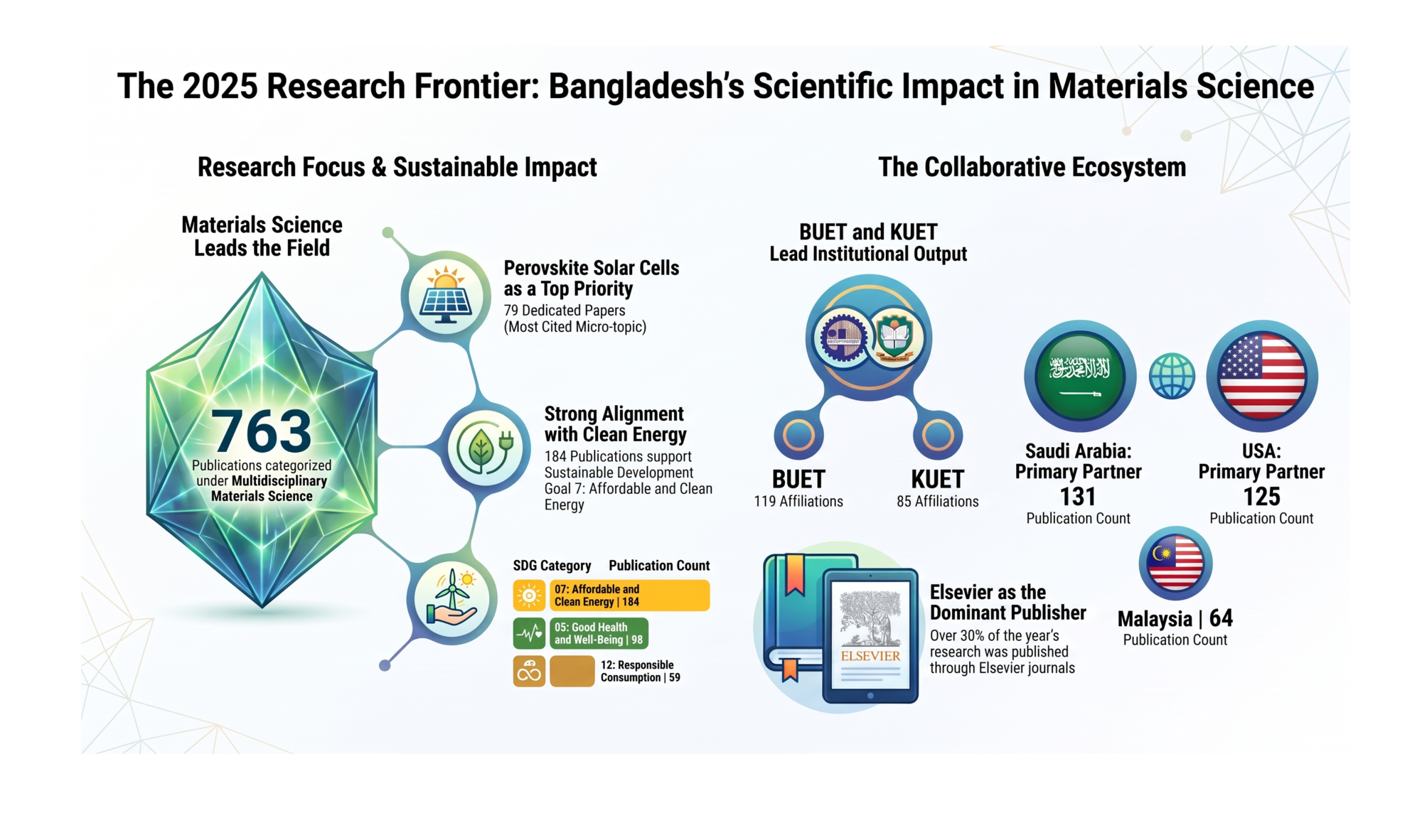
In 2025, Bangladesh recorded substantial research activity in materials science in Web of Science-indexed journals. A total of 763 publications were identified in the field, demonstrating a broad research portfolio encompassing advanced materials, nanotechnology, applied physics, energy materials, photocatalysis, concrete science, and emerging functional materials. The research placed a strong emphasis on materials associated with renewable energy and technological applications, particularly perovskite solar cells, nanoparticles, advanced concrete, photocatalysts, and two-dimensional materials. The research landscape was supported by a network of universities, research organizations, international collaborators, publishers, and funding agencies. Major contributions were recorded from the Bangladesh University of Engineering and Technology (BUET), Khulna University of Engineering & Technology (KUET), Bangladesh Council of Scientific and Industrial Research (BCSIR), and the University of Dhaka. Strong international research connections were also established with Saudi Arabia, the United States, Malaysia, India, Japan, China, Australia, South Korea, and Egypt. The research output was further associated with several United Nations Sustainable Development Goals (SDGs), with the strongest alignment being observed with SDG 7: Affordable and Clean Energy, followed by SDG 3: Good Health and Well-Being. Web of Science
Overall Publication Output
A total of 763 Web of Science-indexed publications were recorded for Materials Science research from Bangladesh in 2025. The publication portfolio was dominated by original research articles, while substantial contributions were also made through review articles.
| Publication Type | Publications |
|---|---|
| Articles | 652 |
| Review Articles | 91 |
| Proceeding Papers | 12 |
| Corrections | 6 |
| Early Access | 6 |
| Editorial Materials | 2 |
| Total | 763 |
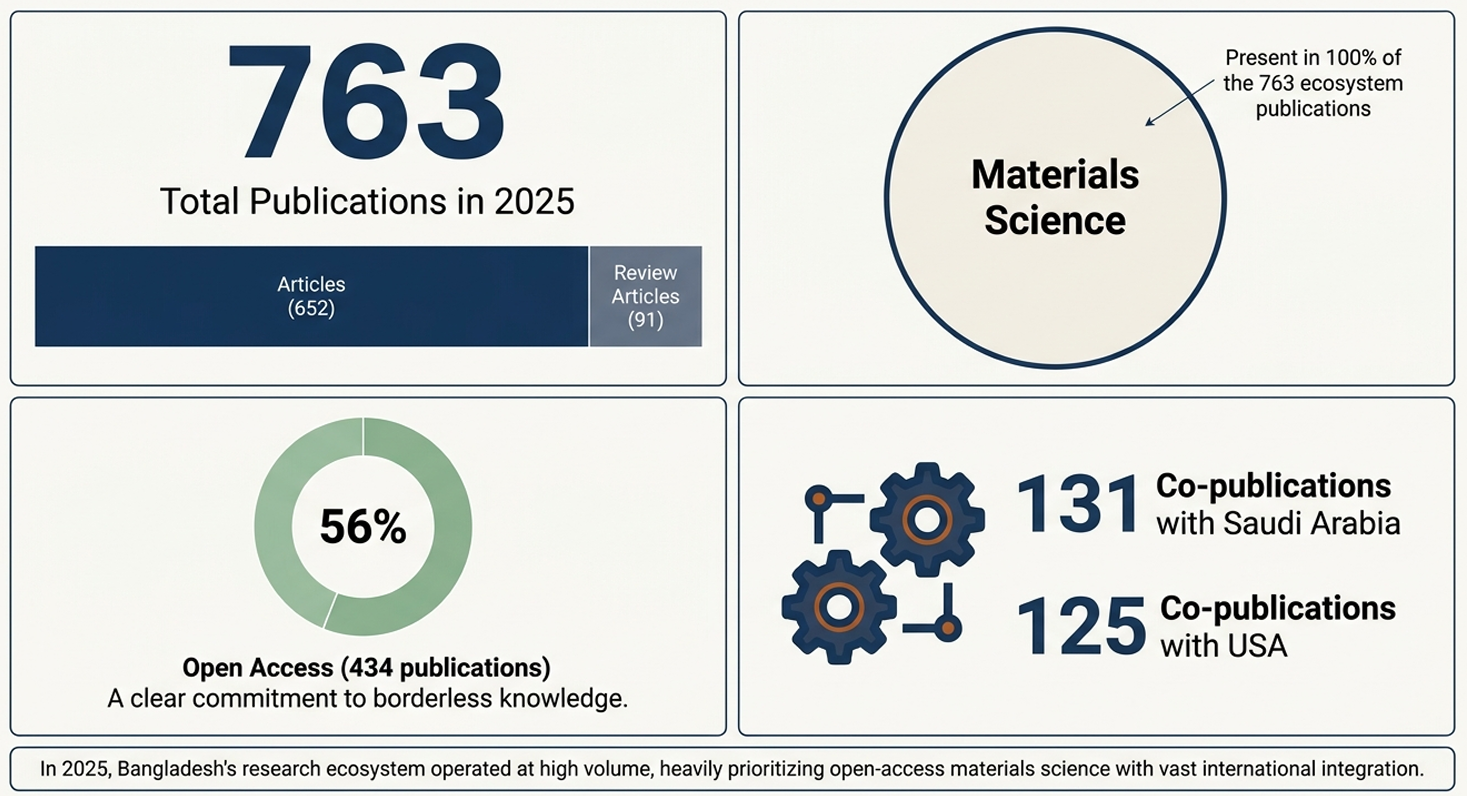
Approximately 85.5% of the output consisted of research articles, while approximately 11.9% consisted of review articles. The distribution indicates that strong emphasis was placed on original experimental, computational, and applied materials research.
Dominant Web of Science Research Categories
The research portfolio was overwhelmingly classified under Materials Science Multidisciplinary, where all 763 publications were represented. Considerable overlap with nanotechnology, applied physics, chemistry, engineering, and energy research was also observed.
| Rank | Web of Science Category | Publications |
|---|---|---|
| 1 | Materials Science Multidisciplinary | 763 |
| 2 | Nanoscience Nanotechnology | 198 |
| 3 | Physics Applied | 189 |
| 4 | Chemistry Multidisciplinary | 121 |
| 5 | Chemistry Physical | 103 |
| 6 | Physics Condensed Matter | 67 |
| 7 | Engineering Multidisciplinary | 57 |
| 8 | Engineering Electrical Electronic | 49 |
| 9 | Computer Science Interdisciplinary Applications | 41 |
| 10 | Energy Fuels / Metallurgy Metallurgical Engineering | 32 each |
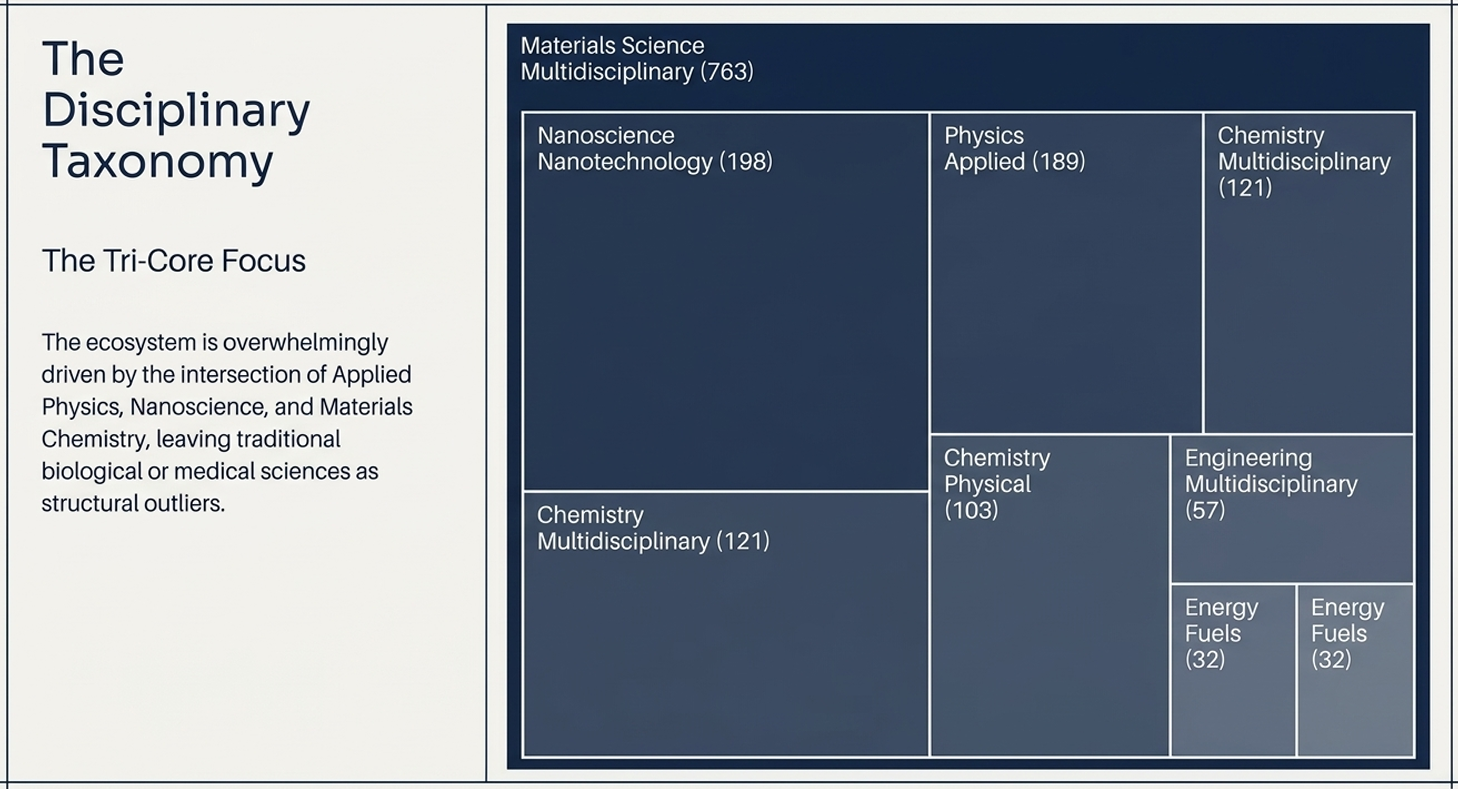
The strong representation of nanotechnology, applied physics, chemistry, and energy-related categories demonstrates the interdisciplinary character of materials science research in Bangladesh.
Major Research Topics and Focus Areas
A diverse range of specialized research topics was addressed. Advanced concrete represented the most frequently recorded specialized topic, followed by electronic structures, photonic crystal fibers, nanotoxicology, and multiferroics.
| Rank | Research Topic | Publications |
|---|---|---|
| 1 | Advanced Concrete | 39 |
| 2 | Electronic Structures | 28 |
| 3 | Photonic Crystal Fibers | 27 |
| 4 | Nanotoxicology | 25 |
| 5 | Multiferroics | 24 |
| 6 | Cellulose Composites | 23 |
| 7 | Electrode Materials | 21 |
| 8 | TiO₂ Photocatalysis | 18 |
| 9 | Metasurfaces | 17 |
| 10 | Soliton Dynamics | 16 |
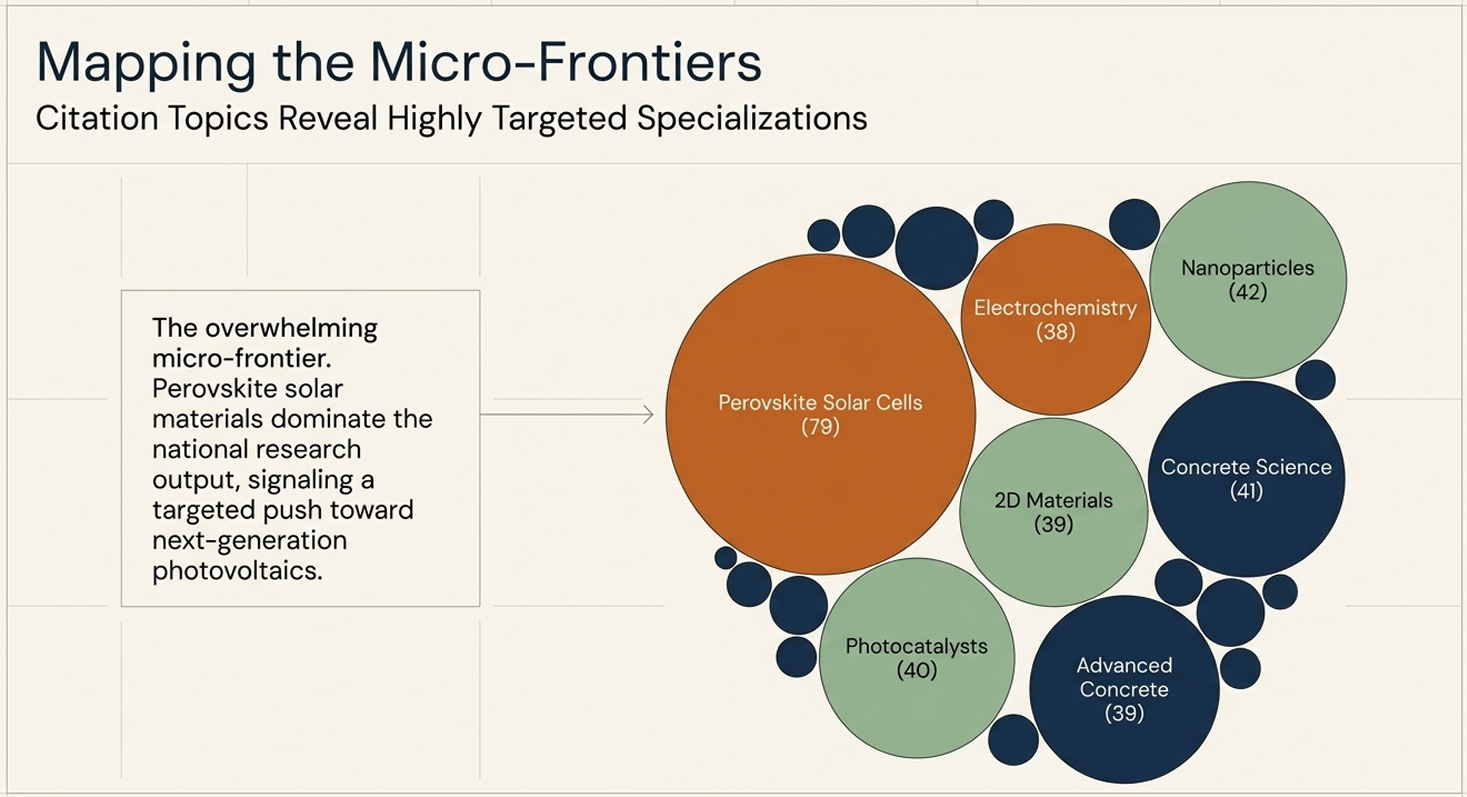
Particular attention was also given to perovskite solar cells, for which 79 publications were recorded. This research area represents an important component of the country’s work on emerging photovoltaic materials and next-generation renewable-energy technologies. Research on nanoparticles, photocatalysts, graphene and other two-dimensional materials, electrode materials, and functional composites was also prominently represented.
Top Ten Researchers
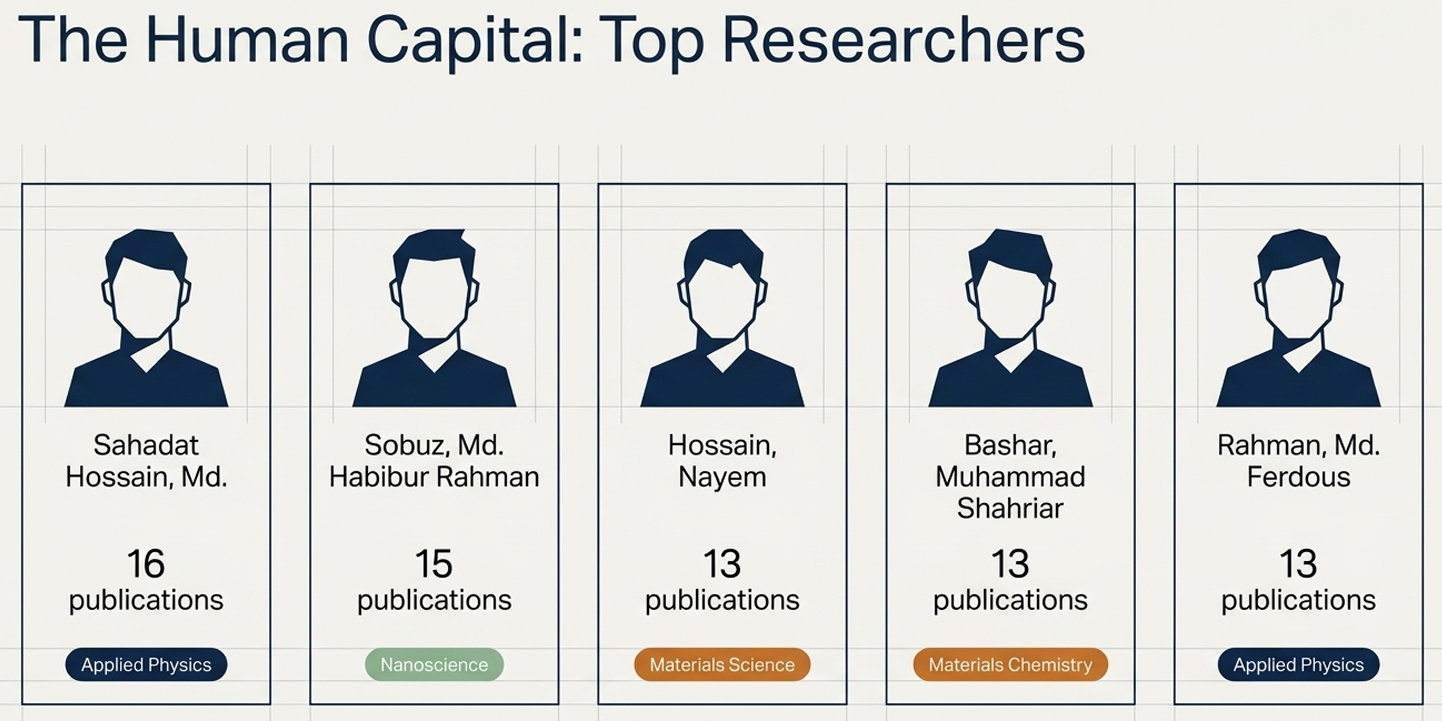
The highest individual publication counts were recorded among researchers working across materials science, nanotechnology, physics, engineering, and related interdisciplinary areas.
| Rank | Researcher | Publications |
|---|---|---|
| 1 | Md. Sahadat Hossain | 16 |
| 2 | Md. Habibur Rahman Sobuz | 15 |
| 3 | Nayem Hossain | 13 |
| 4 | Muhammad Shahriar Bashar | 13 |
| 5 | Md. Ferdous Rahman | 13 |
| 6 | Avijit Ghosh | 13 |
| 7 | Samina Ahmed | 11 |
| 8 | Mayeen Uddin Khandaker | 11 |
| 9 | Ahmed Nabih Zaki Rashed | 10 |
| 10 | Shirin Akter Jahan | 10 |
The publication records indicate that research leadership was distributed among multiple investigators rather than being concentrated in a single researcher. Contributions were made across experimental materials science, nanotechnology, engineering, applied physics, and computational research.
Leading Research Institutions
The institutional output was dominated by engineering and science-oriented universities and national research organizations.
| Rank | Institution | Publications |
|---|---|---|
| 1 | Bangladesh University of Engineering and Technology (BUET) | 119 |
| 2 | Khulna University of Engineering & Technology (KUET) | 85 |
| 3 | Bangladesh Council of Scientific & Industrial Research (BCSIR) | 71 |
| 4 | University of Dhaka | 58 |
| 5 | Begum Rokeya University | 45 |
| 6 | Rajshahi University of Engineering & Technology (RUET) | 45 |
| 7 | Chittagong University of Engineering & Technology (CUET) | 38 |
| 8 | Ahsanullah University of Science and Technology (AUST) | 37 |
| 9 | International University of Business Agriculture and Technology (IUBAT) | 36 |
| 10 | University of Rajshahi | 36 |
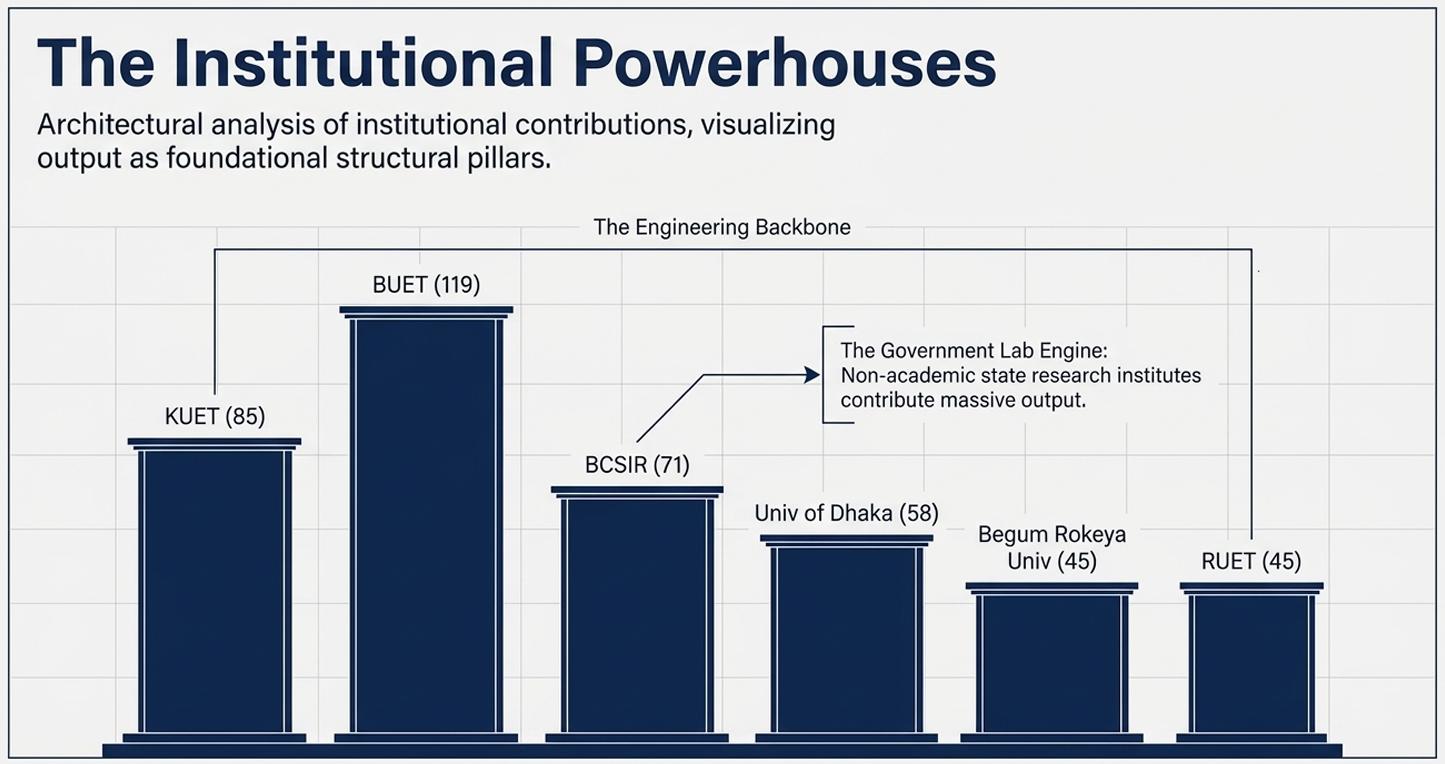
BUET was the largest institutional contributor, with 119 publications, followed by KUET with 85 and BCSIR with 71. Strong representation was also provided by the country’s major public universities and engineering universities.
Major Funding Agencies
Financial support was reported from both Bangladeshi and international funding organizations. The largest number of funded publications was associated with the University Grants Commission of India.
| Rank | Funding Agency | Publications |
|---|---|---|
| 1 | University Grants Commission India | 21 |
| 2 | Princess Nourah bint Abdulrahman University | 17 |
| 3 | Bangladesh University of Engineering and Technology (BUET) | 16 |
| 4 | Bangladesh Council of Scientific and Industrial Research (BCSIR) | 15 |
| 5 | Taif University | 13 |
| 6 | Bangladesh Council of Scientific and Industrial Research* | 13 |
| 7 | Deanship of Research and Graduate Studies at King Khalid University | 12 |
| 8 | King Saud University | 12 |
| 9 | King Khalid University | 11 |
| 10 | National Natural Science Foundation of China (NSFC) | 11 |
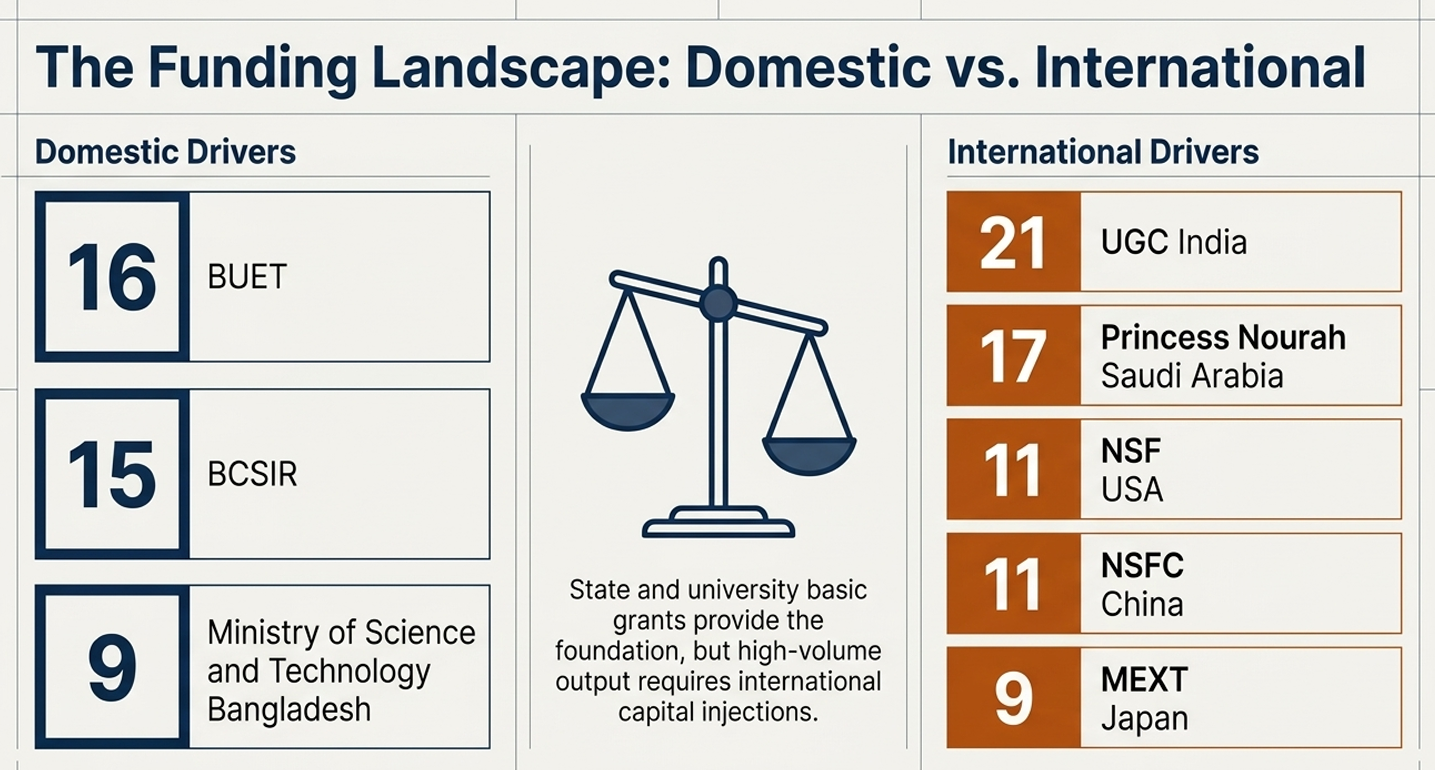
The supplied dataset contains BCSIR under two separate funding-agency entries. These may represent different indexed funding-name variants and should be standardized before aggregate funding analysis. The National Science Foundation (NSF) was also reported with 11 funded publications. The funding profile demonstrates considerable international involvement, particularly from institutions in Saudi Arabia, India, and China, alongside substantial institutional support from Bangladeshi organizations.
Major Publishers
The 763 publications were distributed among numerous international publishing houses. Elsevier was the leading publisher, followed by Springer Nature and Wiley.
| Rank | Publisher | Publications |
|---|---|---|
| 1 | Elsevier | 244 |
| 2 | Springer Nature | 105 |
| 3 | Wiley | 104 |
| 4 | Royal Society of Chemistry | 76 |
| 5 | AIP Publishing | 63 |
| 6 | American Chemical Society | 49 |
Together, these publishers accounted for a substantial proportion of the indexed Materials Science output, indicating extensive participation in internationally established scientific publishing platforms.
Leading Journals
Several journals served as major publication outlets for Bangladesh’s Materials Science research.
| Rank | Journal | Publications |
|---|---|---|
| 1 | AIP Advances | 60 |
| 2 | Next Materials | 49 |
| 3 | Engineering Reports | 41 |
| 4 | Materials Advances | 35 |
| 5 | Plasmonics | 29 |
| 6 | Materials Today Communications | 23 |
| 7 | Nanoscale Advances | 22 |
| 8 | Results in Surfaces and Interfaces | 19 |
| 9 | Materials Science and Engineering B: Advanced Functional Solid-State Materials | 15 |
| 10 | Nano Select | 14 |
The distribution demonstrates that research was published across materials science, nanotechnology, engineering, photonics, and functional-materials journals.
International Research Collaboration
Strong international collaboration was recorded in the 2025 Materials Science publication portfolio. Saudi Arabia and the United States represented the two largest international collaborative partners.
| Rank | Country | Publications |
|---|---|---|
| 1 | Bangladesh | 763 |
| 2 | Saudi Arabia | 131 |
| 3 | United States | 125 |
| 4 | Malaysia | 64 |
| 5 | India | 52 |
| 6 | Japan | 46 |
| 7 | People’s Republic of China | 41 |
| 8 | Australia | 40 |
| 9 | South Korea | 38 |
| 10 | Egypt | 20 |
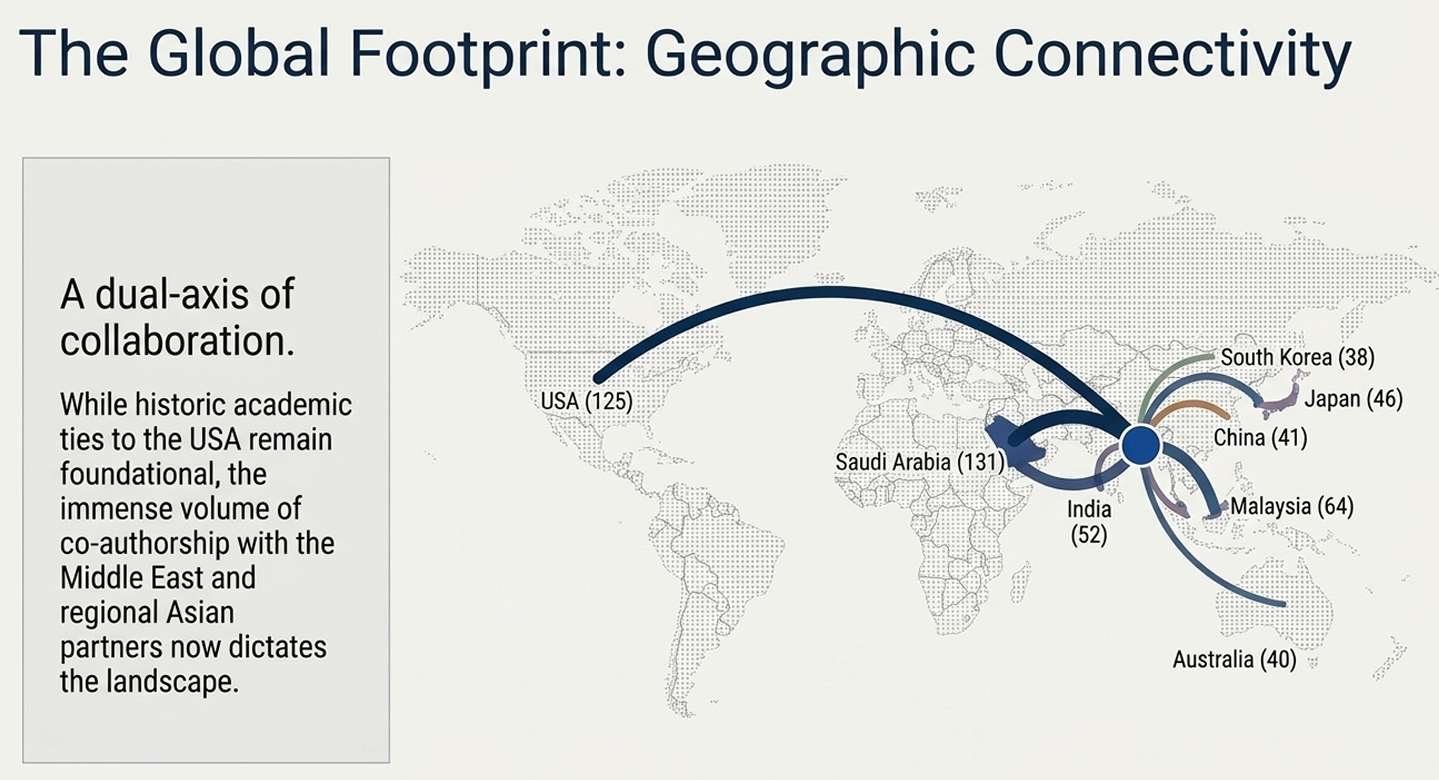
A particularly strong connection with Saudi Arabia was evident, with 131 collaborative publications, while 125 publications involved collaboration with the United States. Additional partnerships were established across Asia, Oceania, and Africa.
Sustainable Development Goal Alignment
The research was strongly associated with several United Nations Sustainable Development Goals. The largest alignment was observed with SDG 7: Affordable and Clean Energy, consistent with the substantial attention given to solar cells, photovoltaic materials, photocatalysis, and energy-related functional materials.
| Rank | Sustainable Development Goal | Publications |
|---|---|---|
| 1 | SDG 07 – Affordable and Clean Energy | 184 |
| 2 | SDG 03 – Good Health and Well-Being | 98 |
| 3 | SDG 12 – Responsible Consumption and Production | 59 |
| 4 | SDG 11 – Sustainable Cities and Communities | 26 |
| 5 | SDG 06 – Clean Water and Sanitation | 20 |
| 6 | SDG 13 – Climate Action | 12 |
| 7 | SDG 09 – Industry, Innovation and Infrastructure | 9 |
| 8 | SDG 02 – Zero Hunger | 6 |
| 9 | SDG 05 – Gender Equality | 2 |
| 10 | SDG 14 – Life Below Water / SDG 15 – Life on Land | 1 each |
The strong association with SDG 7 reflects the importance of renewable-energy materials within the national research portfolio. The substantial number of publications linked to SDG 3 also indicates applications of materials science in health-related technologies, nanomedicine, nanotoxicology, and biomedical materials.
Perovskites, Nanotechnology, and Emerging Materials
One of the most visible research directions was represented by perovskite solar cells, with 79 publications. Perovskite materials have been extensively investigated because of their light-absorbing and photovoltaic properties and their potential applications in next-generation solar technologies. Nanoparticles, graphene and other two-dimensional materials, photocatalysts, electrode materials, cellulose composites, and metasurfaces were also extensively studied. Through these research directions, materials science was connected with renewable energy, environmental remediation, electronics, photonics, healthcare, and advanced engineering. The presence of TiO₂ photocatalysis, nanotoxicology, electrode materials, and cellulose composites further demonstrates that the research portfolio was not restricted to energy generation. Environmental applications, functional materials, biomedical applications, and sustainable materials were also represented.
Overall Research Ecosystem
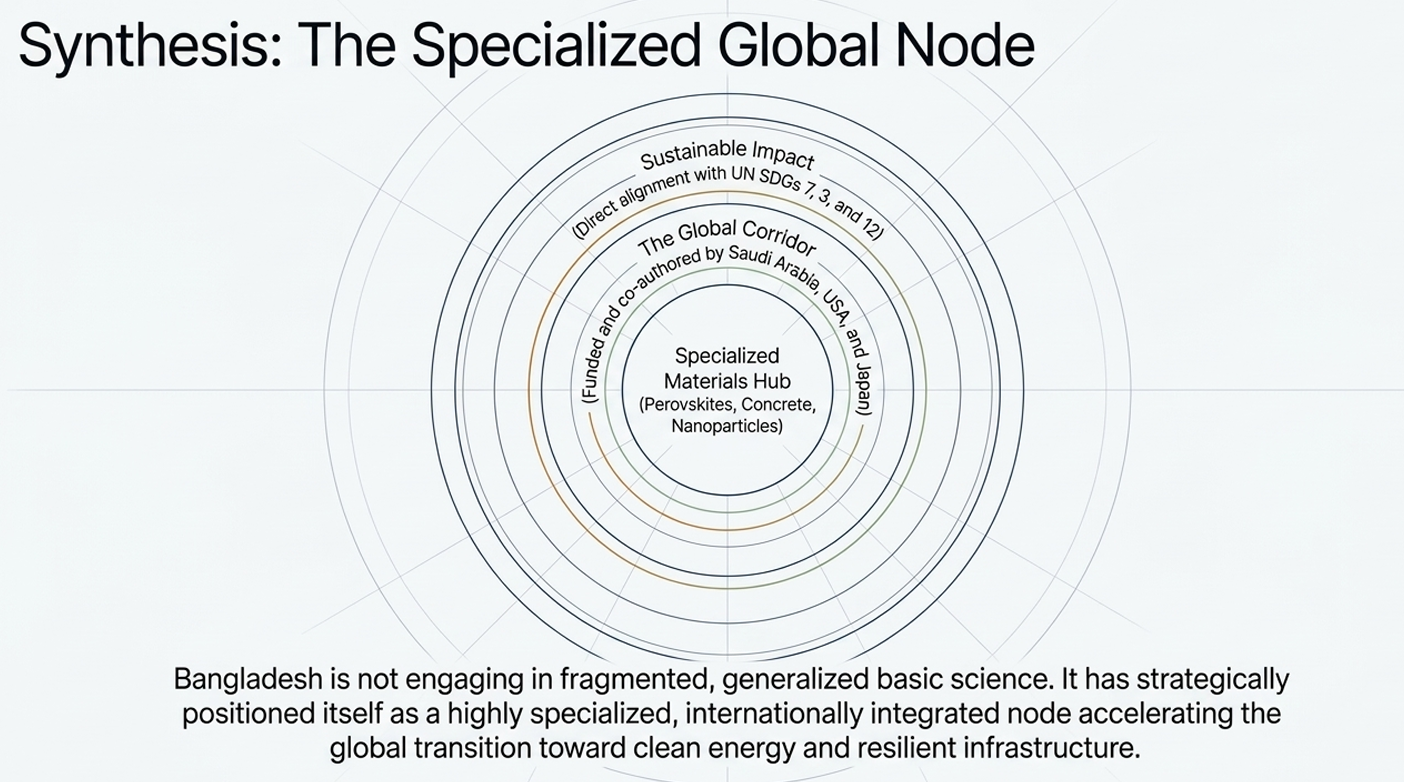
The 2025 research profile can be summarized as an interconnected ecosystem:
| Component | Major Contributors/Features |
|---|---|
| Core discipline | Materials Science Multidisciplinary |
| Major secondary fields | Nanotechnology, Applied Physics, Chemistry, Engineering |
| Major research theme | Perovskite solar cells |
| Leading institution | BUET |
| Second-largest institution | KUET |
| Major research organization | BCSIR |
| Leading publisher | Elsevier |
| Major international partner | Saudi Arabia |
| Major funding source in dataset | University Grants Commission India |
| Major SDG | SDG 7 – Affordable and Clean Energy |
| Major publication type | Research Article |
| Leading journal | AIP Advances |
This ecosystem shows that materials science research in Bangladesh was being developed through a combination of domestic institutional capacity, international collaboration, external funding, and publication in internationally recognized scientific journals.
Conclusion
In 2025, 763 Web of Science-indexed publications were recorded for Materials Science research from Bangladesh. The research was overwhelmingly classified under Materials Science Multidisciplinary, while substantial activity was also recorded in nanotechnology, applied physics, chemistry, engineering, and energy-related fields. A significant research emphasis was placed on perovskite solar cells, advanced concrete, electronic structures, photonic crystal fibers, nanotoxicology, multiferroics, cellulose composites, electrode materials, TiO₂ photocatalysis, metasurfaces, and soliton dynamics. BUET, KUET, BCSIR, and other major Bangladeshi universities constituted the principal institutional contributors.