
Introduction: The Meeting Trap
We have all sat in meetings that feel less like collaborative sessions and more like organizational hostage situations. You watch the clock tick past the scheduled end time while participants stare blankly out the window, quietly check out on their phones, or mentally surrender to the depressing reality that they will leave without a single resolution. The inevitable kicker? Another follow-up meeting gets scheduled to re-hash the exact same agenda.
Where do leaders go wrong? In technical, scientific, and high-expertise environments, team leaders routinely fail because they step into the room wearing the wrong hat. They assume their job is to be the smartest person in the room—the fount of knowledge, the primary problem-solver, or the final arbiter of complex technical disputes. But effective meeting leadership requires a fundamental shift in posture: you must stop acting as the technical authority and start operating as a process facilitator whose sole mission is guiding the team smoothly from “problem” to “solution.”
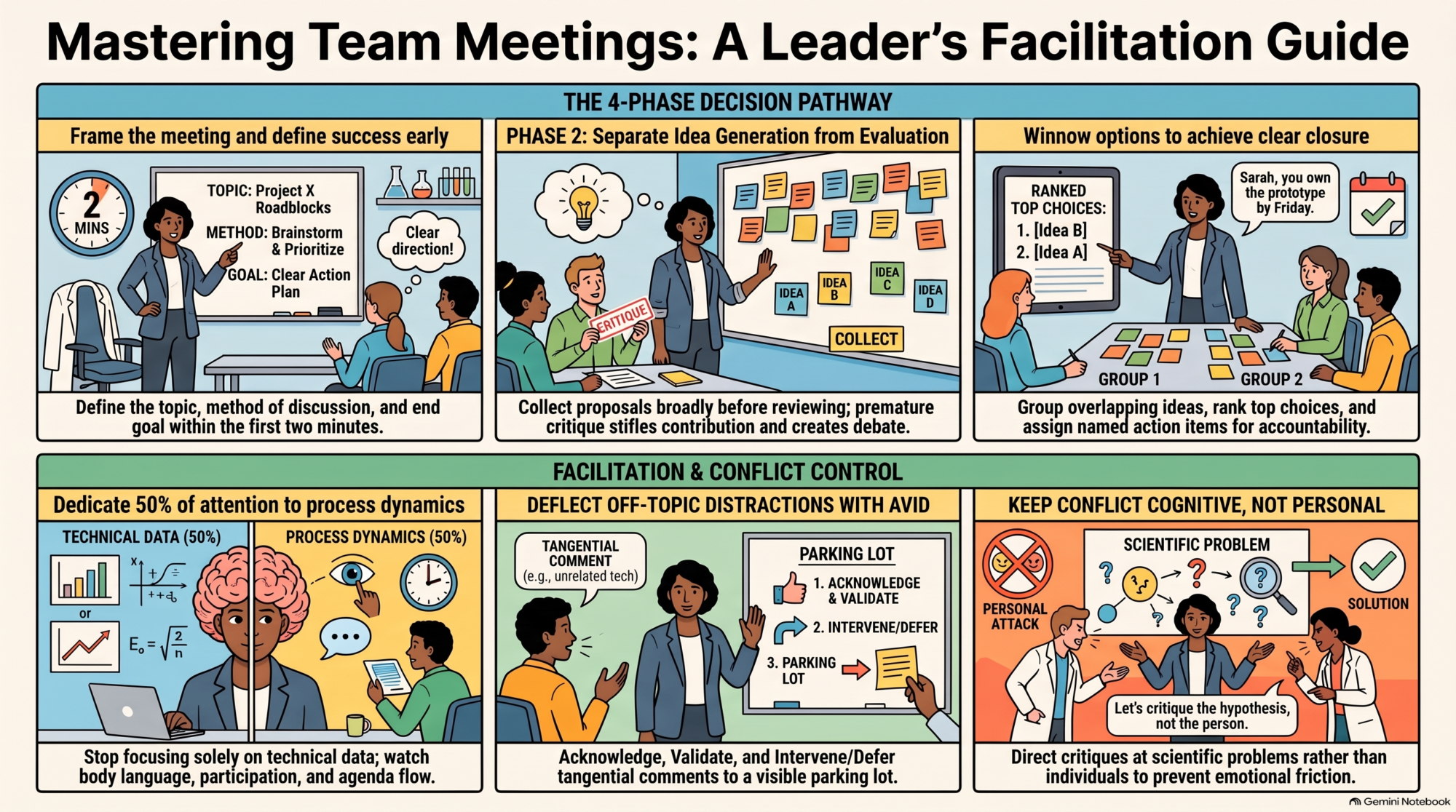
Takeaway 1: The 50/50 Rule — If You’re Focusing on Data, You’re Not Leading
If your whiteboard is covered in your own handwriting and you are locked in a granular argument over technical details, you have already lost control of the room. To lead a meeting effectively, you must divide your attention equally between the content of the discussion and the process governing it.
“If you are focusing more than 50% of your attention on content or data during a meeting, you aren’t doing your job as leader.”
Here is a candid secret from the source text behind this rule: that 50% threshold was plucked out of thin air. In practice and leadership workshops, co-author Carl routinely advises leaders not to devote more than 33% of their focus to content—primarily because keeping your eyes on the operational process is the only way to maintain group engagement and prevent participant fatigue.
When leaders become overly immersed in technical disputes, they miss the visual cues of a dying meeting: anxiety spikes, quieter team members disengage, and time evaporates. To maintain real leadership oversight, a facilitator must actively monitor three distinct domains of meeting dynamics simultaneously:
- Personal / Self: Am I feeling uncomfortable or anxious? Am I dominating the conversation or trying to force my preferred outcome?
- Interpersonal: Are specific team members shutting down? Are subtle “you” statements or defensive postures creeping into the dialogue?
- Group-as-a-Whole: Is the collective team falling prey to cognitive traps, rushing to premature agreement, or avoiding the hard questions?
By stepping back to manage the “meta-meeting”—tracking time, enforcing agendas, reading body language, and balancing participation—you dramatically elevate the quality of your team’s ultimate decisions.
Takeaway 2: Weaponize Awkward Silence to Force Group Ownership
Ask a difficult, ambiguous question in a meeting, and an agonizing silence inevitably follows. For most leaders, that silence feels intolerable. Internal anxiety spikes, and the instinctual reaction is to jump in, fill the void, and offer a solution.
Rushing to eliminate silence, however, fundamentally sabotages team ownership.
Consider the dynamic revealed in the case study “The Power of Silence in Groups.” Carl, a research laboratory director, attended a weekend group dynamics workshop in Boston facilitated by a psychotherapist named Suzanne. The exercise was deceptively simple: small groups sat in a circle of chairs, and the facilitator sat down and said absolutely nothing. As the silence stretched on, Carl’s internal anxiety reached a fever pitch. Driven by a desperate need to eliminate ambiguity and regain control, he grabbed a whiteboard marker, leapt to his feet, and began dictating objectives for the group.
It took days of intense reflection for Carl to recognize that his knee-jerk habit of taking charge in lab meetings was simply a mechanism to soothe his own internal discomfort with silence. When he returned to his laboratory and consciously forced himself to let uncomfortable silences persist, the group dynamic transformed. Team members stepped up, took responsibility for the work, and introduced novel ideas that would have otherwise been suffocated under his dominant leadership.
Silence creates necessary psychological space. When a leader manages their own anxiety and refuses to fill every pause, passive attendees are forced to transform into active problem-solvers.
Takeaway 3: Separate “Cognitive Conflict” from “Affective Conflict”
Healthy team problem-solving requires friction. Discussion temperature (T_d) functions much like chemical activation energy: just as a chemical reaction requires a critical level of heat to start, a discussion needs a moderate degree of “heat”—rigorous cognitive conflict over ideas, interpretations, and data—to stimulate deep mental engagement. Too little heat, and your team sits in a soporific daze staring out the window.
However, if discussion temperature rises unchecked, a dangerous dynamic called “affective generalization” occurs. This happens when content-based debate (“cognitive conflict”) devolves into personal hostility (“affective conflict”). Instead of attacking the problem, participants begin lunging across the table at one another.
To keep cognitive debate productive, leaders must actively model and enforce problem-centered communication over person-centered critique:
- Person-Centered: “What is your problem, Koshi? … Just figure it out.”
- Problem-Centered: “The lack of progress in this assay is really holding us back, Koshi. Let’s talk about how we can address this together.”
When you spot personal defensiveness or hear “you” statements taking over, step in immediately. Reframe the interpersonal tension into a shared challenge against the external problem, maintaining the critical intellectual heat without allowing it to burn down team trust.
Takeaway 4: Cohesive Teams are Vulnerable to Hidden Decision Biases
We tend to assume that close-knit, highly cohesive teams make the best choices. In reality, tight working relationships often harbor dangerous cognitive blind spots. Chief among these are Sharedness Bias—the strong group tendency to discuss only information that everyone already knows while ignoring critical data held by a single member—and Groupthink, where members rush to a quick, frictionless consensus to preserve harmony.
This trap was clearly illustrated in the “Contaminated” case study. A research laboratory run by a scientist named Hanah was suffering from persistent cell culture contamination. Four postdocs formed a pre-meeting consensus in the lunchroom, deciding that cell culture technician Juan was simply exhibiting sloppy technique. During the all-lab meeting, Juan introduced novel, unshared data: a neighboring lab had solved an identical contamination problem by disinfecting primary eggs prior to culture. Because of status hierarchies (postdocs discounting a technician) and pre-meeting groupthink, the postdocs immediately dismissed Juan’s idea as “bogus.”
To protect your team from these hidden biases, deploy two concrete process interventions:
- Explicitly protect unshared minority data: Actively intervene when junior staff or technicians share unique insights, ensuring lower-status voices receive full consideration before dominant members dismiss them.
- Assign a “Devil’s Advocate”: When a group rapidly converges on an easy solution, explicitly task a specific team member with arguing against the preferred proposal or calling out potential confirmation bias.
Because close working relationships create intense psychological pressure against voicing dissent, leaders must establish explicit structural permission for critical evaluation.
Takeaway 5: Kill the Meeting Minutes — Use a Running “Action Item” List Instead
Traditional meeting minutes are an organizational sinkhole. Taking detailed prose notes prevents the recorder from participating fully in the meeting, administrative summaries frequently mangle technical nuance, and formal minutes are rarely read after distribution.
A far more effective alternative is maintaining a live, running list of action items and deliverables assigned directly to named individuals. This document should be distributed before the meeting, updated live during the discussion, and reviewed at the close of every session. Public visibility drives direct accountability—nothing sharpens a participant’s focus quite like seeing their name printed next to a clear list of assigned deliverables in plain view of their peers.
However, leaders must guard against a critical failure mode of action lists: stagnant items carried forward week after week. Allowing uncompleted tasks to roll over indefinitely transforms your action log into a “parking lot” for abandoned responsibilities, signaling to the team that tasks listed on the document aren’t actually expected to get done. If an item stalls across multiple meetings, intervene immediately: reevaluate whether the task is necessary, reassign it, or address the underlying roadblock preventing execution.
Conclusion: Leading the Process, Not the Expertise
At its core, running an effective meeting is not an exercise in proving that you are the smartest person in the room; it is the discipline of managing human process, protecting group dynamics, and stewarding collective intelligence. When you step out of the spotlight as the resident expert and step into your authority as a process facilitator, team engagement surges and superior decisions follow.
As you prepare for your next upcoming meeting, ask yourself: Will you act as the expert in the room trying to demonstrate your smarts, or as the facilitator of your team’s collective intelligence?
N. B: This is a NotebookLM generated article from the book Lab dynamics, Management and Leadership skills for scientists by Carl M Cohen and Suzanne L Cohen