
Contextual Foundations: The Unique Dynamics of Scientific Organizations
1.1 Structural Tensions and Managerial Realities in Discovery Science
Managing discovery-driven research environments presents operational challenges that render conventional corporate management models ineffective. In discovery science, progress cannot be forced into linear pipelines or rigid schedules. When traditional “command and control” corporate structures are imposed onto scientific environments, the result is severe operational friction, diminished research productivity, and organizational cynicism. Designing an effective leadership development framework requires acknowledging these distinct structural realities and building management strategies tailored to the operational realities of research settings.
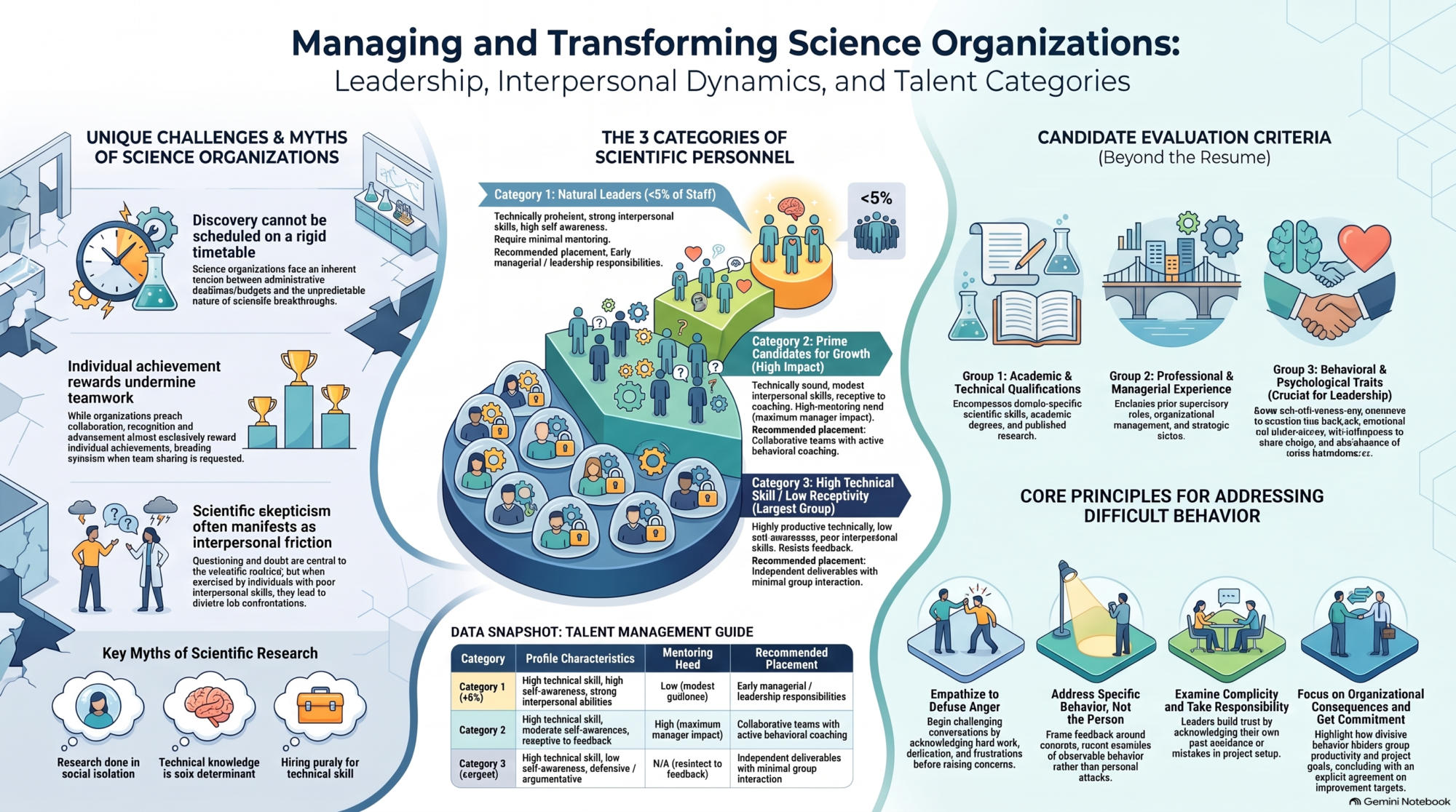
Research organizations operate under distinct systemic tensions and cognitive biases that set them apart from standard corporate entities:
| Science Organizations | Standard Corporate Organizations |
| Unpredictable Discovery Timetables: Research progress relies on non-linear discovery processes with inherently unpredictable timelines that resist rigid scheduling and standardized milestone targets. | Linear Execution Cycles: Operational workflows follow predictable execution cycles, structured delivery timelines, and standardized progress metrics. |
| Scientific Skepticism vs. Interpersonal Friction: Critical questioning and rigorous skepticism are essential to the scientific method, but can devolve into destructive interpersonal friction when paired with low emotional intelligence and poor self-awareness. | Standardized Communication Norms: Professional interactions are guided by standardized corporate communication norms and established workplace behavioral guidelines. |
| Individual Reward Structure vs. Team Collaboration: Systemic contradiction exists between rewarding individual achievement (publications, grants, primary authorship) and demanding team-based knowledge sharing across complex interdisciplinary initiatives. | Aligned Incentive Architecture: Incentive structures and performance evaluations are generally aligned with collective business unit goals and team performance. |
| Non-Scientific Executive Leadership Risks: Frequently led by executives with financial, legal, or business backgrounds who risk misapplying rigid bureaucratic controls due to a lack of scientific training. | Management-Trained Executive Leadership: Led by executives trained in general management, corporate governance, operational execution, and corporate administration. |
| Cognitive Bias – The “Fly Lab” Fixed Method Trap: Scientists frequently exhibit a cognitive tendency to rely strictly on familiar methodologies (e.g., insisting on Drosophila models simply because their postdoc was in a fly lab) rather than dispassionately evaluating alternative approaches. | Methodological Flexibility: Product development strategies are routinely re-evaluated and pivoted based on objective market feedback and comparative ROI analysis. |
| Cognitive Bias – The “Nobel Laureate / Advisory Board” Trap: Organizations often over-rely on scientific advisory board prestige and Nobel laureate endorsements to judge technical viability, conflating academic distinction with operational execution. | Operational Evaluation: Organizational viability is evaluated through objective performance benchmarks, operational capabilities, and execution metrics rather than advisory prestige. |
Understanding these organizational tensions and cognitive biases demonstrates why research facilities cannot rely on standard corporate recruitment practices, necessitating a fundamental shift in how scientific talent is hired, evaluated, and developed.
1.2 Deconstructing Scientific Research Myths
💡 Myth vs. Reality in Scientific Work
- Myth: Research occurs in mental and social isolation.
- Operational Reality: Modern scientific progress depends on interdisciplinary collaboration, open data sharing, and cross-functional team dynamics.
- Myth: Technical domain knowledge is the sole predictor of scientific success.
- Operational Reality: Technical expertise is ineffective without the interpersonal capabilities required to communicate discoveries, secure resources, and align with institutional goals.
- Myth: Scientific success requires single-minded devotion to research above all else.
- Operational Reality: Sustainable research output requires actively managing workplace relationships, regulating emotional responses under stress, and navigating organizational structures.
- Myth: Hiring the most technically qualified talent supersedes behavioral considerations.
- Operational Reality: Technical brilliance paired with defensive or toxic behavior disrupts research teams, delays critical deliverables, and drives away high-performing junior talent.
2. Comprehensive Hiring & Evaluation Architecture: The Three Qualification Domains
2.1 The Tri-Domain Qualification Matrix
Building resilient, high-performing research labs requires evaluating candidate talent far beyond academic credentials. While technical pedigree and publication histories dominate standard resumes, they fail to predict an individual’s capacity to lead teams, resolve conflicts, or adapt to organizational change. A rigorous hiring architecture evaluates candidates across three distinct qualification domains to ensure technical competence is supported by interpersonal capability.
| Qualification Domain Group | Focus Area & Key Indicators | Resume Visibility | Predictive Value for Leadership |
| Group 1: Academic & Technical Qualifications | Specific technical skills, scientific methodology, academic degrees, peer-reviewed publication record, grant funding history.<br>• Indicators: Ph.D./postdoctoral credentials, specialized assay or methodology mastery, h-index, lead-author publications in high-impact journals. | High<br>(Primary focus of traditional screening) | Low<br>(Predicts individual technical competence, not leadership effectiveness) |
| Group 2: Professional & Managerial Experience | Prior institutional experience, supervisory history, project management, strategic planning.<br>• Indicators: Years in principal investigator or supervisory roles, lab budget administration, cross-functional project management, strategic research vision. | Moderate<br>(Documented via job titles and scope) | Moderate<br>(Reflects past organizational exposure, but not necessarily interpersonal competence) |
| Group 3: Behavioral & Psychological Characteristics | Self-awareness, emotional regulation, receptivity to feedback, non-defensive communication, collaborative capacity.<br>• Indicators: Ability to comment on own behavior, intellectual humility, non-dominant engagement, principled negotiation, active listening, knowledge sharing. | Low<br>(Absent from traditional resumes) | High<br>(Primary determinant of long-term managerial and leadership capability) |
While Group 1 and Group 2 criteria serve as necessary baseline entry requirements, relying on them exclusively creates severe operational risks. Candidates who excel in technical domain knowledge but lack Group 3 competencies frequently exhibit defensiveness, conflict avoidance, and poor team communication—ultimately stalling complex scientific programs.
2.2 Cataloging Behavioral and Psychological Competencies (Group 3)
To evaluate Group 3 characteristics objectively, research organizations must organize these behaviors into a clear taxonomy of core leadership capability sub-domains:
- Self-Awareness & Ownership
- Self-Observation: Ability to step back, observe, and comment objectively on one’s own behavior and leadership style.
- Personal Accountability: Willingness to take personal ownership of actions, errors, and project outcomes rather than blaming external circumstances or subordinates.
- Emotional Literacy: Ability to identify and describe feelings experienced during tense or high-stakes scientific disagreements.
- Intellectual Humility: Willingness to admit ignorance, acknowledge the limits of one’s domain expertise, and actively seek advice when stuck.
- Feedback & Conflict Receptivity
- Openness to Criticism: Receptivity to constructive criticism regarding behavior without escalating into defensiveness, hostility, or denial.
- Stress Regulation: Ability to maintain self-control, composure, and emotional regulation under high-stress or deadline-driven conditions.
- Direct & Collegial Disagreement: Capability to address scientific or operational differences directly while maintaining professional respect.
- Resilience to Affronts: Ability to respond productively to implied or direct slights in group settings without retaliating.
- Relational & Team Dynamics
- Constructive Communication: Ability to provide actionable, non-hostile feedback to colleagues, postdocs, and research assistants.
- Group Dynamics Assessment: Skill in reading interpersonal dynamics to sense which personnel will work effectively together in collaborative lab settings.
- Non-Dominant Engagement: Collaboration without a need to dominate conversations, dismiss alternative hypotheses, or belittle peers.
- Principled Negotiation: Ability to negotiate equitable agreements when differences of scientific opinion arise.
- Transparent Knowledge Sharing: Willingness to share data, preliminary findings, and research tools transparently across departments.
- Organizational Alignment
- Strategic Orientation: Deep understanding of macro institutional objectives and the alignment of lab deliverables to support them.
- Managing Ambiguity: Comfort with ambiguous experimental outcomes or organizational shifts without rushing into premature or ill-advised decisions.
- Focus & Scope Control: Ability to maintain project momentum, manage resources prudently, and avoid unproductive research tangents.
Establishing this catalog of behavioral competencies provides research managers with an operational taxonomy to categorize existing scientific personnel and deploy targeted management interventions.
3. The Three-Tier Scientist Classification & Role Assignment Taxonomy
3.1 Comparative Taxonomy of Scientific Personnel
To optimize coaching investments, deploy managerial bandwidth effectively, and shield research operations from interpersonal dysfunction, organizations must classify scientific staff based on their technical proficiency, self-awareness, and interpersonal capabilities.
| Scientist Category | Behavioral Profile & Population Share | Primary Management Strategy |
| Category 1: Fast-Track Scientific Leaders | High technical proficiency combined with strong interpersonal skills, high self-awareness, and emotional regulation. Represents < 5% of scientific staff. | Fast-Track Leadership Development. Provide early managerial exposure, assign cross-functional strategic initiatives, and offer high-level executive mentoring with minimal supervisory overhead. |
| Category 2: High-Potential Coaching Candidates | High technical proficiency with moderate or indeterminate interpersonal skills, but possessing high self-awareness, intellectual humility, and receptivity to feedback. Represent the prime growth population. | Targeted Developmental Coaching (Maximum ROI). Focus intensive coaching here. Deploy specific “I” statement feedback techniques (e.g., “I noticed that you seem to be having a hard time working with Farid”) to probe gently for empathy and motivation, helping them gain self-awareness and refine relational habits. |
| Category 3: Single-Contributor Technical Specialists | High technical proficiency paired with poor interpersonal skills, low self-awareness, and resistance to behavioral change. Represents the largest group of scientific staff. Behavioral spectrum includes both active hostility (confrontational, argumentative, devaluing others) and passive withdrawal (passive, uncommunicative, evasive, isolated). | Risk Mitigation & Structural Isolation. Harness specialized technical brilliance while shielding teams from interpersonal friction. Avoid line-management or supervisory assignments; enforce clear single-contributor boundaries. |
3.2 Strategic Placement and Risk Mitigation for Category 3 Scientists
Category 3 scientists often possess rare, highly specialized technical skills vital to discovery programs. However, forcing them into highly interactive team settings or line-management positions without structural safeguards invites severe organizational disruption. To maximize their scientific output while protecting lab cohesion, research leaders must execute the following protocol:
- Structure Independent Single-Contributor Deliverables: Assign discrete scientific tasks and technical deliverables that can be executed independently, limiting the requirement for daily group coordination.
- Define Unambiguous Project Boundaries: Establish explicit, concrete project targets, reporting protocols, and timelines, catering to concrete thinking styles and eliminating ambiguous operational handoffs.
- Restrict Line-Management and Supervisory Roles: Bar Category 3 scientists from direct supervisory roles over junior scientists, postdocs, or technicians to preserve team morale and protect junior talent.
- Establish Formal Liaison Buffer Mechanisms: Appoint a designated liaison scientist (a Category 1 or high-functioning Category 2 researcher) to manage cross-functional communication and mediate interdepartmental requests, insulating team members from direct interpersonal friction.
Categorizing scientific staff enables research managers to apply structured diagnostic tools to systematically assess individual team members.
4. Diagnostic Assessment & Structured Intervention Protocols
4.1 The 19-Point Leadership Potential Diagnostic Assessment
To eliminate managerial bias and establish an objective baseline, research managers utilize a standardized 19-point diagnostic rating form. This instrument evaluates self-awareness, interpersonal skills, and leadership readiness on a 1-to-5 scale (5 = Strongly Agree, 1 = Disagree).
| Diagnostic Evaluation Statement | Rating Scale (1 – 5) |
| 1. Will spontaneously step back, observe, and comment on her/his own behavior. [Key Self-Awareness Indicator] | [ ] 1 [ ] 2 [ ] 3 [ ] 4 [ ] 5 |
| 2. When prompted to observe and comment on own behavior, is open and willing. [Key Self-Awareness Indicator] | [ ] 1 [ ] 2 [ ] 3 [ ] 4 [ ] 5 |
| 3. Takes personal ownership for behavior. | [ ] 1 [ ] 2 [ ] 3 [ ] 4 [ ] 5 |
| 4. Does not seek to blame others or external circumstances for mistakes or failings. | [ ] 1 [ ] 2 [ ] 3 [ ] 4 [ ] 5 |
| 5. Able to describe feelings or experiences in difficult situations. [Key Self-Awareness Indicator] | [ ] 1 [ ] 2 [ ] 3 [ ] 4 [ ] 5 |
| 6. Open to constructive criticism and observations. [Key Self-Awareness Indicator] | [ ] 1 [ ] 2 [ ] 3 [ ] 4 [ ] 5 |
| 7. Does not become defensive or uneasy during such conversations. [Key Self-Awareness Indicator] | [ ] 1 [ ] 2 [ ] 3 [ ] 4 [ ] 5 |
| 8. Able to control behavior under tense or stressful circumstances. | [ ] 1 [ ] 2 [ ] 3 [ ] 4 [ ] 5 |
| 9. Can deal with implied or direct affronts in a group setting. | [ ] 1 [ ] 2 [ ] 3 [ ] 4 [ ] 5 |
| 10. Can provide constructive feedback to others. | [ ] 1 [ ] 2 [ ] 3 [ ] 4 [ ] 5 |
| 11. Does not dominate or belittle others. | [ ] 1 [ ] 2 [ ] 3 [ ] 4 [ ] 5 |
| 12. Able to negotiate and arrive at equitable agreements when parties hold differences of opinion. | [ ] 1 [ ] 2 [ ] 3 [ ] 4 [ ] 5 |
| 13. Understands organizational objectives and how to help meet them. | [ ] 1 [ ] 2 [ ] 3 [ ] 4 [ ] 5 |
| 14. Can see the big picture associated with a project. | [ ] 1 [ ] 2 [ ] 3 [ ] 4 [ ] 5 |
| 15. Willingly seeks the advice of others when stuck. | [ ] 1 [ ] 2 [ ] 3 [ ] 4 [ ] 5 |
| 16. Has little difficulty admitting ignorance. | [ ] 1 [ ] 2 [ ] 3 [ ] 4 [ ] 5 |
| 17. Is not overly confident of own knowledge. | [ ] 1 [ ] 2 [ ] 3 [ ] 4 [ ] 5 |
| 18. Does not avoid or withdraw from disagreements or difficult conversations. | [ ] 1 [ ] 2 [ ] 3 [ ] 4 [ ] 5 |
| 19. Willing to share knowledge and data transparently. | [ ] 1 [ ] 2 [ ] 3 [ ] 4 [ ] 5 |
Key Psychological Insight Markers Analysis
Traits 1, 2, 5, 6, and 7 represent essential psychological insight markers within the evaluation framework. These items measure an individual’s capacity to listen, reflect dispassionately on personal behavior, and participate in open dialogue without becoming defensive. Consistently low scores across these five specific indicators reveal a fundamental lack of self-awareness. Candidates demonstrating this profile will resist behavioral coaching, rendering standard executive development interventions ineffective.
4.2 The Non-Confrontational Feedback & Dialogue Framework
The strategic necessity of mastering structured feedback is illustrated by the real-world case of USA Pharma, where unmanaged interpersonal friction between senior scientists (Susan, Athan, Mohan, and Ralph) over structural biology data directly caused a two-year delay in developing a promising pancreatic cancer therapy. Frame this for research leadership: behavioral mismanagement isn’t merely an administrative inconvenience—it incurs massive financial burn rates, delays commercialization, and deprives patients of life-saving oncology therapeutics.
When executing corrective interventions with technically brilliant but interpersonally difficult scientists, managers must structure dialogue to de-escalate defensiveness while asserting firm operational boundaries.
| Conversational Principle / Goal | Practical Managerial Script / Execution Example | “What NOT to Say” (Common Anti-Pattern) |
| 1. Preparation & Interest Alignment<br>Clarify managerial priorities (protecting productivity, retaining key technical talent). | Internal Preparation: “My core interest is group productivity and advancing our oncology deliverables. I must retain Susan’s crystallography expertise while ending the divisive lab climate.” | “I need to fix Susan’s personality and make sure everyone in the structural biology unit likes each other.” |
| 2. Empathy & Validation<br>De-escalate defensiveness by recognizing technical impact and validating frustration. | “Susan, I know how hard you have worked on the PAN project and how important it is to you. Although I can empathize with your frustration, I am troubled by the divisive atmosphere in the department.” | “You’re acting paranoid about your PAN data, and your constant complaining is ruining lab morale.” |
| 3. Behavioral Specificity<br>Focus strictly on observable actions and operational impacts rather than personal attacks. | “I know you get along with many people, but are you aware that you have a tendency to be confrontational? For example, in the team meeting last week, you told Athan his sample preparation technique was naive and amateurish.” | “You have a terrible attitude, you’re impossible to work with, and you aren’t a team player.” |
| 4. Self-Awareness & Complicity<br>Acknowledge managerial role and past conflict avoidance to establish trust. | “Frankly, I had difficulty deciding to discuss this with you because I was afraid you would get angry. I’ve avoided being honest with you in the past, and as department head, I take responsibility for not giving you the feedback needed to grow.” | “I’ve been letting this slide for two years because you’re volatile, but now senior executive leadership is complaining.” |
| 5. Active Observation & Body Language<br>Monitor non-verbal cues to verify emotional regulation and receptivity. | Observation Strategy: Watch facial expressions and body language carefully. Notice subtle cues—such as a slight nod—before granting the employee an opportunity to speak. | Ignoring body language, talking over visible signs of rage, or escalating tension by matching defensive tone. |
| 6. Clear Boundaries & Explicit Commitment<br>Assert organizational standards and secure commitment to concrete developmental goals. | “Difficulties in working productively with others slow our research programs, and I cannot let that continue. I value your contributions and want to work with you to improve professional relationships. Are you willing to work on this with me?” | “You need to shape up or ship out, because HR will terminate your contract if you cause another incident.” |
Individual behavioral interventions must be backed by institutional training infrastructure to embed lasting organizational capabilities.
5. Institutional Implementation & Capability Building
5.1 Pedagogy and Skills Development Mechanisms
Transforming a research organization requires a long-term institutional commitment tailored to the analytical orientation of scientific professionals. Relational capabilities cannot be taught through passive lectures; they require active modeling, experiential exercises, and structural alignment.
- Targeted Skill-Building Workshops: Design short, high-utility modules focusing on practical, high-value capabilities like principled negotiation and structured conflict resolution. One-day formats demonstrating immediate scientific applicability build strong engagement among analytical staff.
- Case Study Didactics (“Rewriting History Protocol”): Utilize retrospective case analyses to examine how minor behavioral shifts prevent catastrophic project delays. Implement the structured 4-step reflection process:
- Summarize the Incident: Document a real project failure or inter-lab conflict, detailing its operational impact, resource costs, and timeline delays.
- Analyze Missed Behavioral Interventions: Examine how acquiring or exercising specific communication and negotiation skills by key participants would have altered the outcome.
- Examine Self-Complicity: Require leaders to evaluate their own involvement, conflict avoidance, or managerial missteps using “Lab Dynamics” principles.
- Formulate Operational Safeguards: Establish concrete preventive protocols and conversational frameworks to avert similar organizational failures in future research programs.
- Active Leadership Modeling: Require senior leaders, Division Directors, and Principal Investigators (PIs) to actively model emotional intelligence, non-defensive communication, and active listening in daily lab operations. Scientific staff adopt relational habits primarily by observing respected scientific leaders.
- Psychological Safety & Facilitation Safeguards: Strictly enforce guidelines prohibiting forced group discussions about personal vulnerabilities, emotional traits, or interpersonal shortcomings. Forcing scientists who lack self-awareness into public emotional disclosures without professional facilitation can trigger intense defensiveness, acute embarrassment, or psychological trauma—severely damaging trust across the lab environment.
5.2 Strategic Rollout and Human Resources Alignment
Human Resources-driven soft-skills programs frequently encounter cynicism in scientific environments if they lack vocal scientific leadership endorsement. To achieve organizational integration, behavioral initiatives must be led, modeled, and institutionalized by scientific authority.
[Phase 1: Executive Scientific Consensus] ➔ [Phase 2: High-Utility Negotiation Modules] ➔ [Phase 3: PI-Led Lab Modeling] ➔ [Phase 4: Institutional Promotion Standards]
Executive Action Plan for Organizational Rollout
- Build Scientific Leadership Consensus: Secure explicit alignment among Executive Directors, Department Heads, and senior PIs before program launch. The drive for capability development must originate from scientific leadership rather than as a top-down HR mandate.
- Deploy High-Utility Skill Modules: Roll out practical skill-building workshops centered on principled negotiation. Demonstrating immediate utility in securing grant alignment and managing cross-functional resources establishes framework credibility.
- Engage Principal Investigators as Operational Coaches: Train senior PIs to embed the 19-point diagnostic assessment and structured feedback frameworks directly into routine lab management, annual reviews, and project retrospectives.
- Institutionalize Behavioral Criteria in Advancement Policy: Embed Group 3 behavioral competencies directly into formal hiring criteria, performance appraisals, tenure considerations, and promotional pathways alongside traditional technical metrics.
N. B: This is a NotebookLM generated article from the “Shape the future of Science and Technology” of the book “Lab Dynamics: Management and Leadership Skills for Scientists” by Carl M Cohen and Suzanne L Cohen