

In 2024, Bangladeshi researchers demonstrated remarkable global engagement through 1,728 research publications indexed by Springer Nature. Nearly all papers (99.94%) involved Bangladeshi affiliations, with strong international collaboration evident: the USA (18.06%), India (15.45%), Australia (12.27%), and Saudi Arabia (11.57%) were leading partner countries. The research spanned diverse fields, led by Environmental Sciences (15.5%), followed by Public Environmental and Occupational Health (6.77%), and Materials Science Multidisciplinary (6.54%). Articles dominated document types (79.69%), while Review Articles (9.84%) and Proceedings Papers (6.25%) added depth. Key individual contributors included Rashed Ahmed Nabih Zaki (28 papers) and M. Khalid Hossain (23). This output highlights Bangladesh’s growing influence in interdisciplinary research, environmental sustainability, and international cooperation. Web of Science
The areas of research publication categories in the TreeMap:
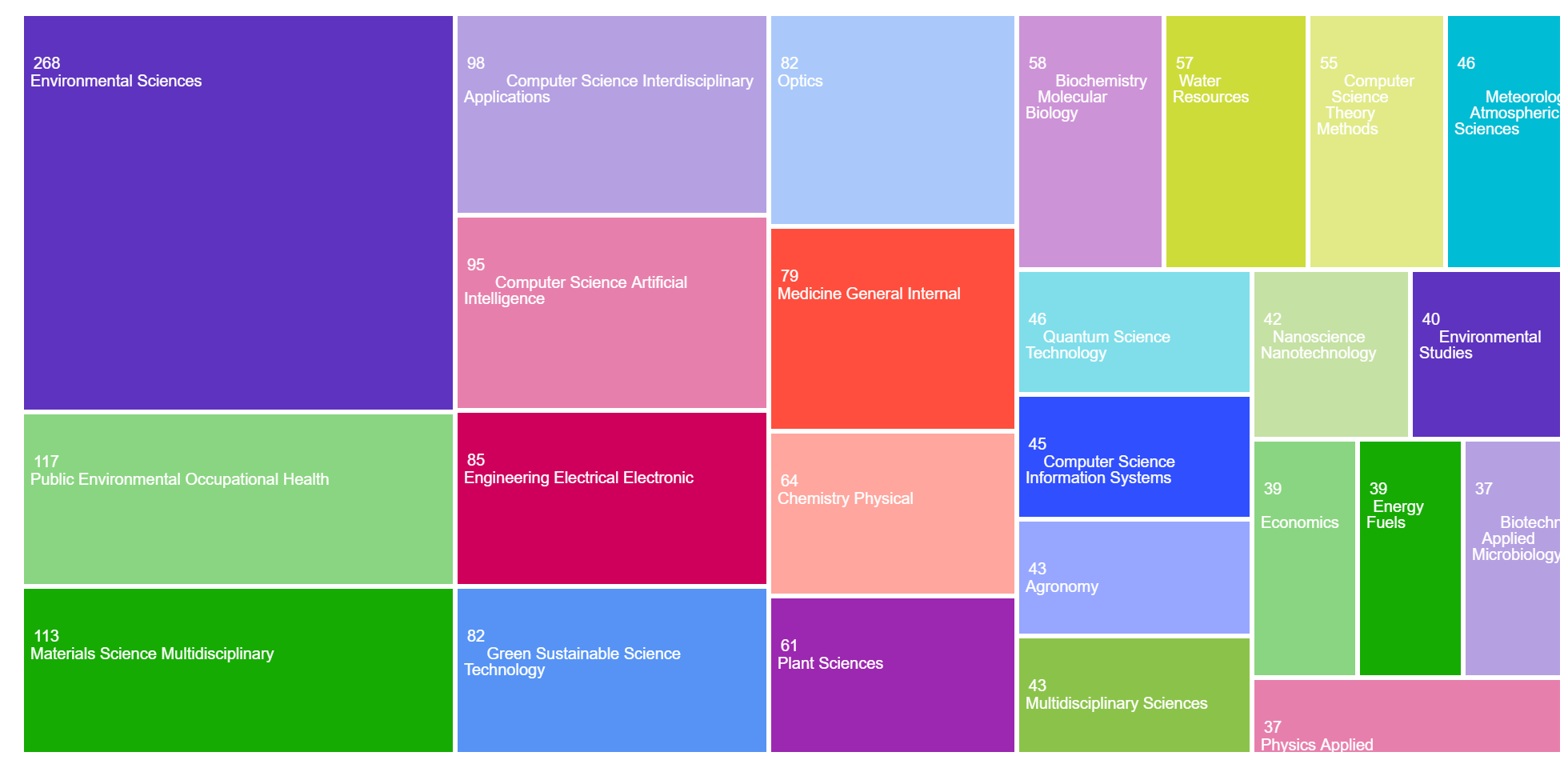
Research contributions in the field:
| Web of Science Categories | Record Count | % of 1,728 |
|---|---|---|
| Environmental Sciences | 268 | 15.509% |
| Public Environmental Occupational Health | 117 | 6.771% |
| Materials Science Multidisciplinary | 113 | 6.539% |
| Computer Science Interdisciplinary Applications | 98 | 5.671% |
| Computer Science Artificial Intelligence | 95 | 5.498% |
| Engineering Electrical Electronic | 85 | 4.919% |
| Green Sustainable Science Technology | 82 | 4.745% |
| Optics | 82 | 4.745% |
| Medicine General Internal | 79 | 4.572% |
| Chemistry Physical | 64 | 3.704% |
| Plant Sciences | 61 | 3.530% |
| Biochemistry Molecular Biology | 58 | 3.356% |
| Water Resources | 57 | 3.299% |
| Computer Science Theory Methods | 55 | 3.183% |
| Meteorology Atmospheric Sciences | 46 | 2.662% |
| Quantum Science Technology | 46 | 2.662% |
| Computer Science Information Systems | 45 | 2.604% |
| Agronomy | 43 | 2.488% |
| Multidisciplinary Sciences | 43 | 2.488% |
| Nanoscience Nanotechnology | 42 | 2.431% |
| Environmental Studies | 40 | 2.315% |
| Economics | 39 | 2.257% |
| Energy Fuels | 39 | 2.257% |
| Biotechnology Applied Microbiology | 37 | 2.141% |
| Physics Applied | 37 | 2.141% |
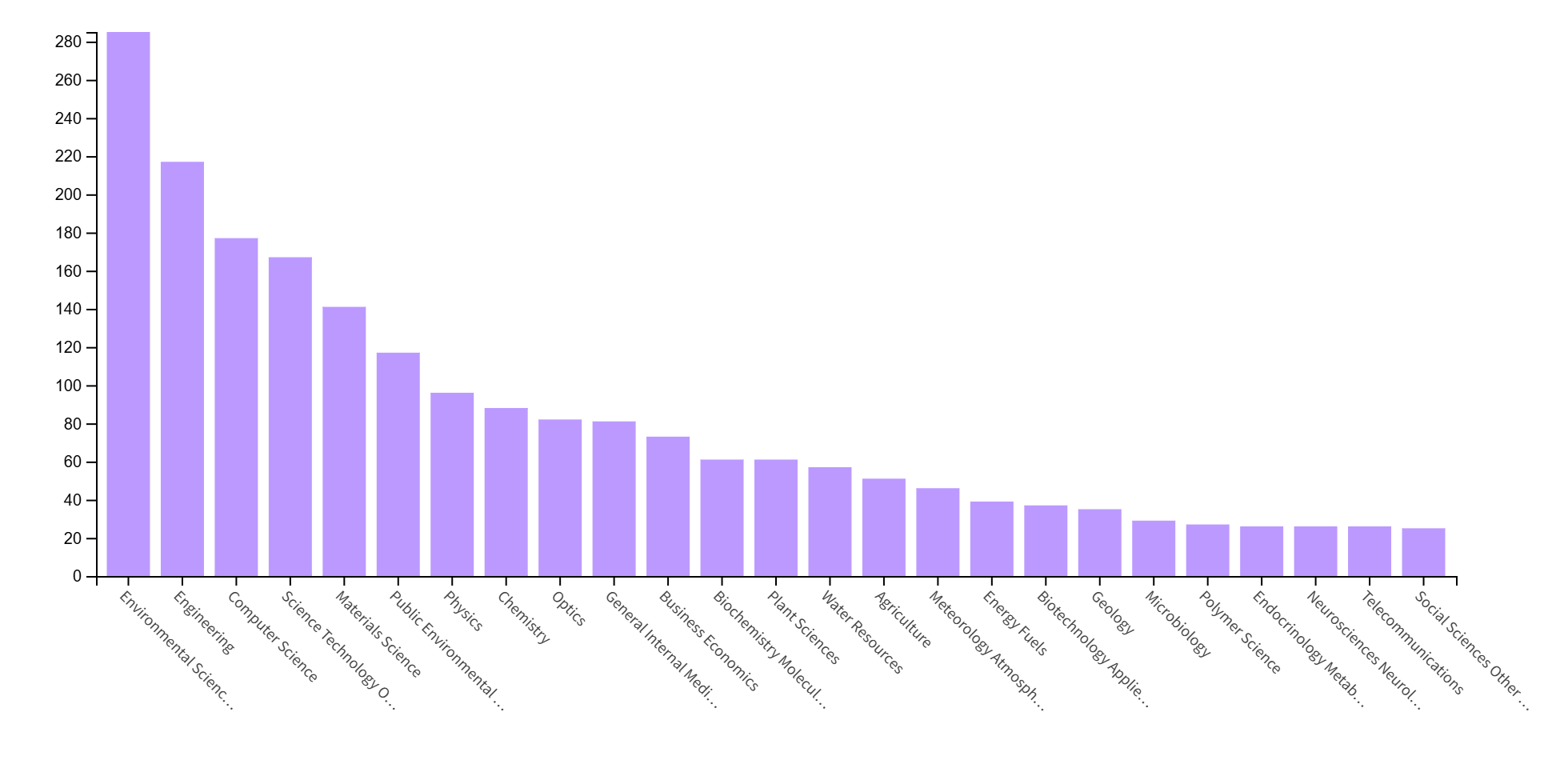
Research areas:
Types of published documents:
| Document Type | Record Count | % of 1,728 |
|---|---|---|
| Article | 1,377 | 79.688% |
| Review Article | 170 | 9.838% |
| Proceeding Paper | 108 | 6.250% |
| Early Access | 81 | 4.688% |
| Correction | 40 | 2.315% |
| Meeting Abstract | 13 | 0.752% |
| Retraction | 8 | 0.463% |
| Book Chapters | 7 | 0.405% |
| Editorial Material | 6 | 0.347% |
| Retracted Publication | 5 | 0.289% |
| Letter | 4 | 0.231% |
| Book Review | 1 | 0.058% |
| News Item | 1 | 0.058% |
Authors’ infographic:
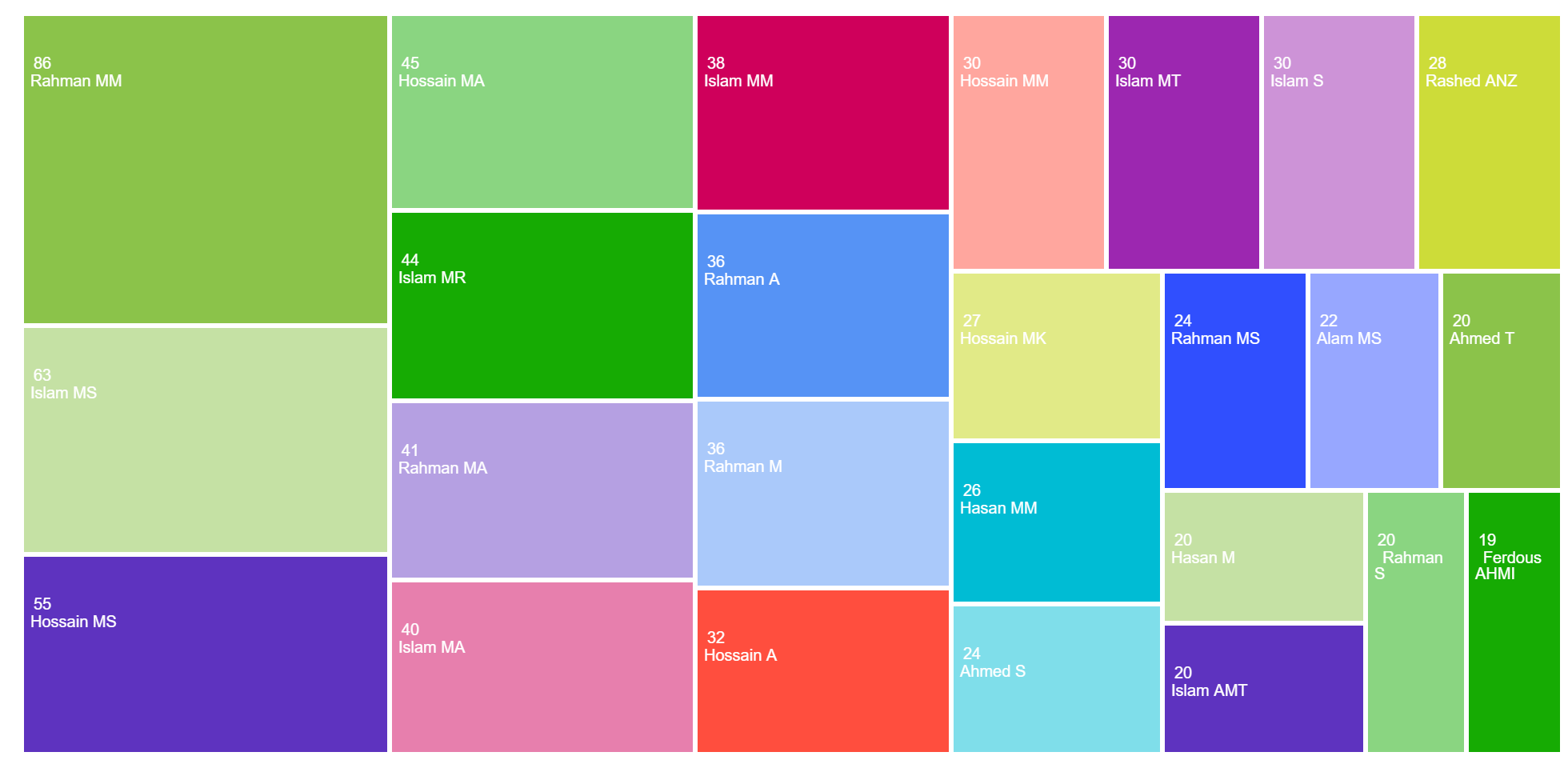
Researcher profiles:
| Researcher | Record Count | % of 1,728 |
|---|---|---|
| Rashed, Ahmed Nabih Zaki | 28 | 1.620% |
| Hossain, M. Khalid | 23 | 1.331% |
| Ferdous, A. H. M. Iftekharul | 19 | 1.100% |
| Islam, Abu | 15 | 0.868% |
| Hasane | 14 | 0.810% |
| Hossain, Amzad | 13 | 0.752% |
| Haque, Mainul | 13 | 0.752% |
| Rahman, Md. Ferdous | 13 | 0.752% |
| Kumar, Santosh | 12 | 0.694% |
| Rahman, Rahimi A. | 11 | 0.637% |
| Akbar, Prof. Ali | 11 | 0.637% |
| Sinha, Susmita | 11 | 0.637% |
| Shaikh, Md. Aftab Ali | 11 | 0.637% |
| Lohia, Pooja | 10 | 0.579% |
| Hossain, Akbar | 10 | 0.579% |
| Dwivedi, D. K. | 10 | 0.579% |
| Emran, Talha Bin | 9 | 0.521% |
| Ahmad, Rahnuma | 9 | 0.521% |
| RAMACHANDRAN, THANDAIAH PRABU | 9 | 0.521% |
| Ramkumar, G | 8 | 0.463% |
| Al Mamun, Firoj | 8 | 0.463% |
| Kaiser, M. Shamim | 8 | 0.463% |
| Shidujaman, Mohammad | 8 | 0.463% |
| Islam, Abu Reza Md. Towfiqul | 8 | 0.463% |
| Khandaker, Mayeen Uddin | 8 | 0.463% |
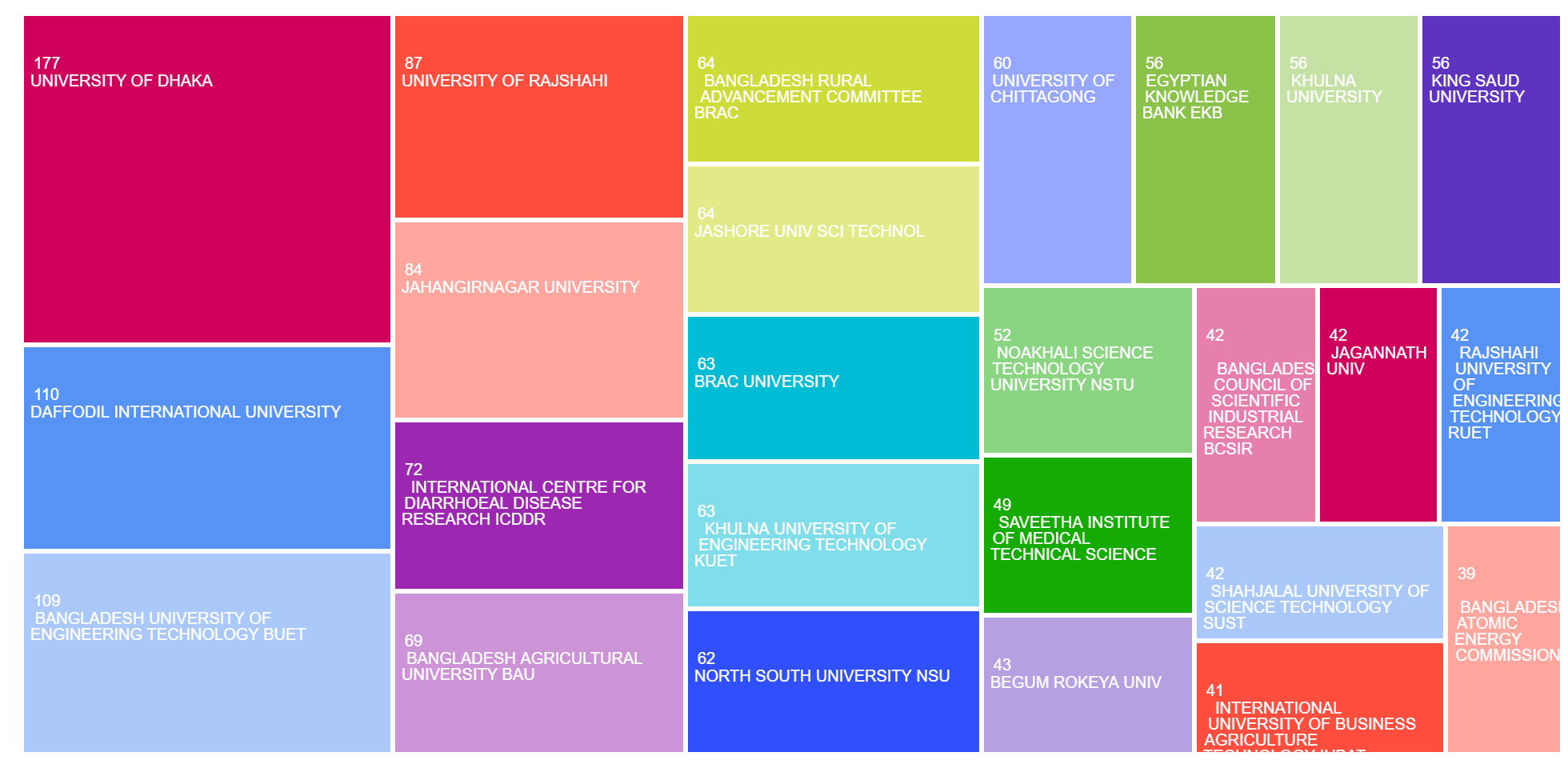
Research-affiliated institutes:
Research collaboration countries:
| Countries | Record Count | % of 1,728 |
|---|---|---|
| BANGLADESH | 1,727 | 99.942% |
| USA | 312 | 18.056% |
| INDIA | 267 | 15.451% |
| AUSTRALIA | 212 | 12.269% |
| SAUDI ARABIA | 200 | 11.574% |
| MALAYSIA | 172 | 9.954% |
| PEOPLES R CHINA | 170 | 9.838% |
| ENGLAND | 131 | 7.581% |
| JAPAN | 124 | 7.176% |
| CANADA | 90 | 5.208% |
| PAKISTAN | 86 | 4.977% |
| SOUTH KOREA | 70 | 4.051% |
| EGYPT | 62 | 3.588% |
| GERMANY | 60 | 3.472% |
| THAILAND | 44 | 2.546% |
| ITALY | 43 | 2.488% |
| INDONESIA | 42 | 2.431% |
| SWEDEN | 42 | 2.431% |
| TURKIYE | 40 | 2.315% |
| U ARAB EMIRATES | 38 | 2.199% |
| IRAQ | 32 | 1.852% |
| TAIWAN | 32 | 1.852% |
| BRAZIL | 31 | 1.794% |
| NEPAL | 31 | 1.794% |
| SWITZERLAND | 29 | 1.678% |
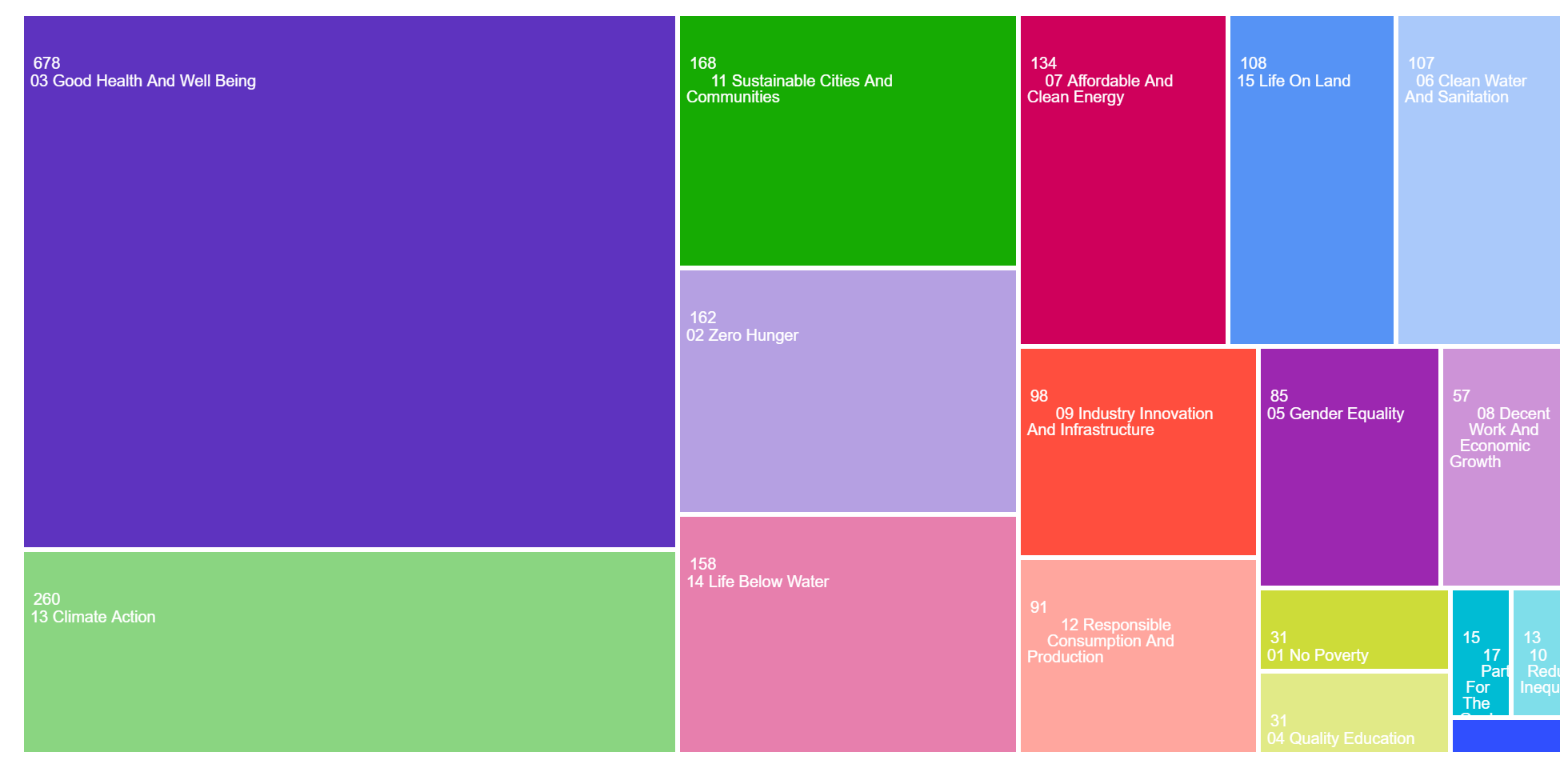
Sustainable Development Goals:
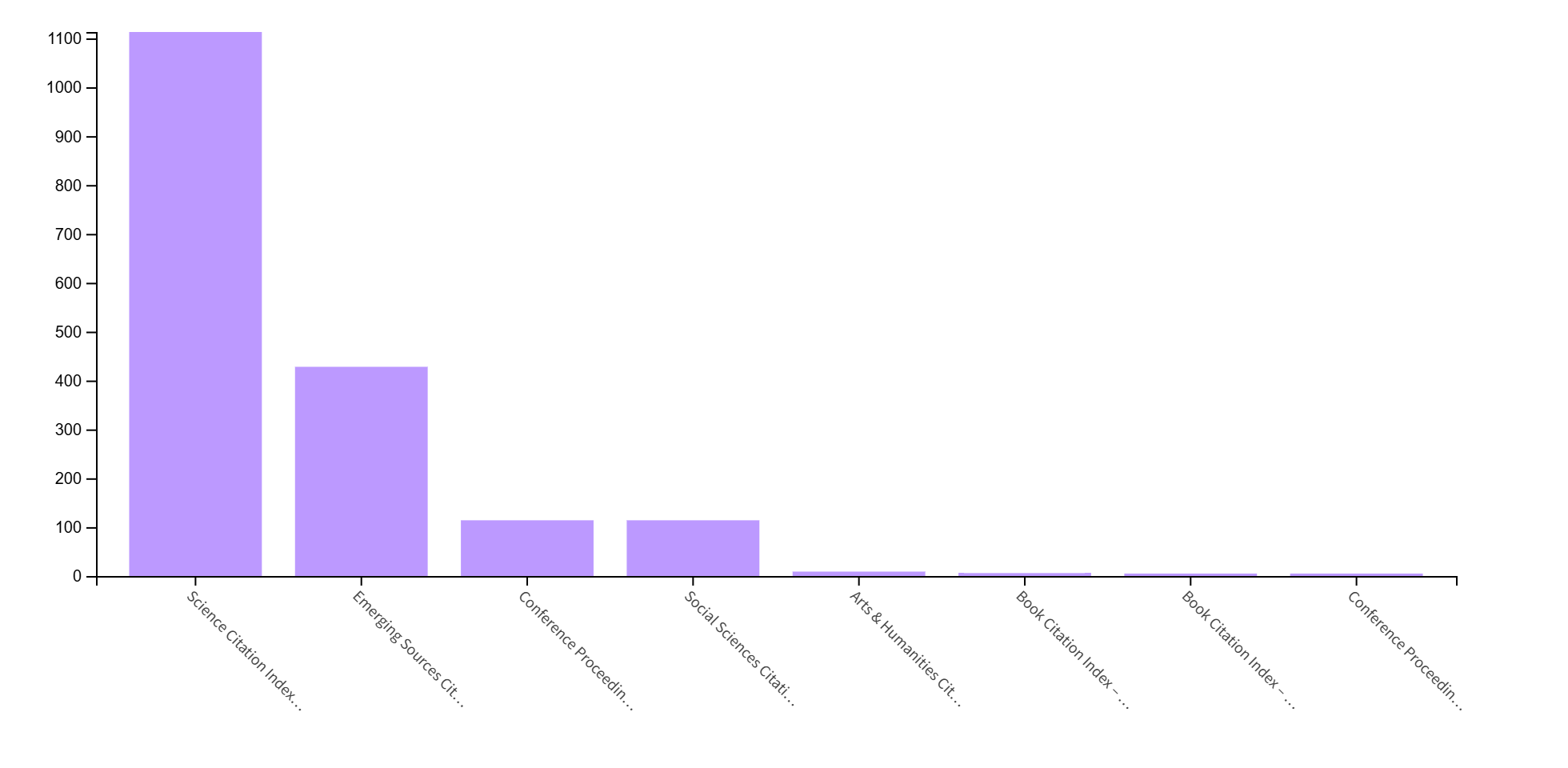
Web of Science Index:
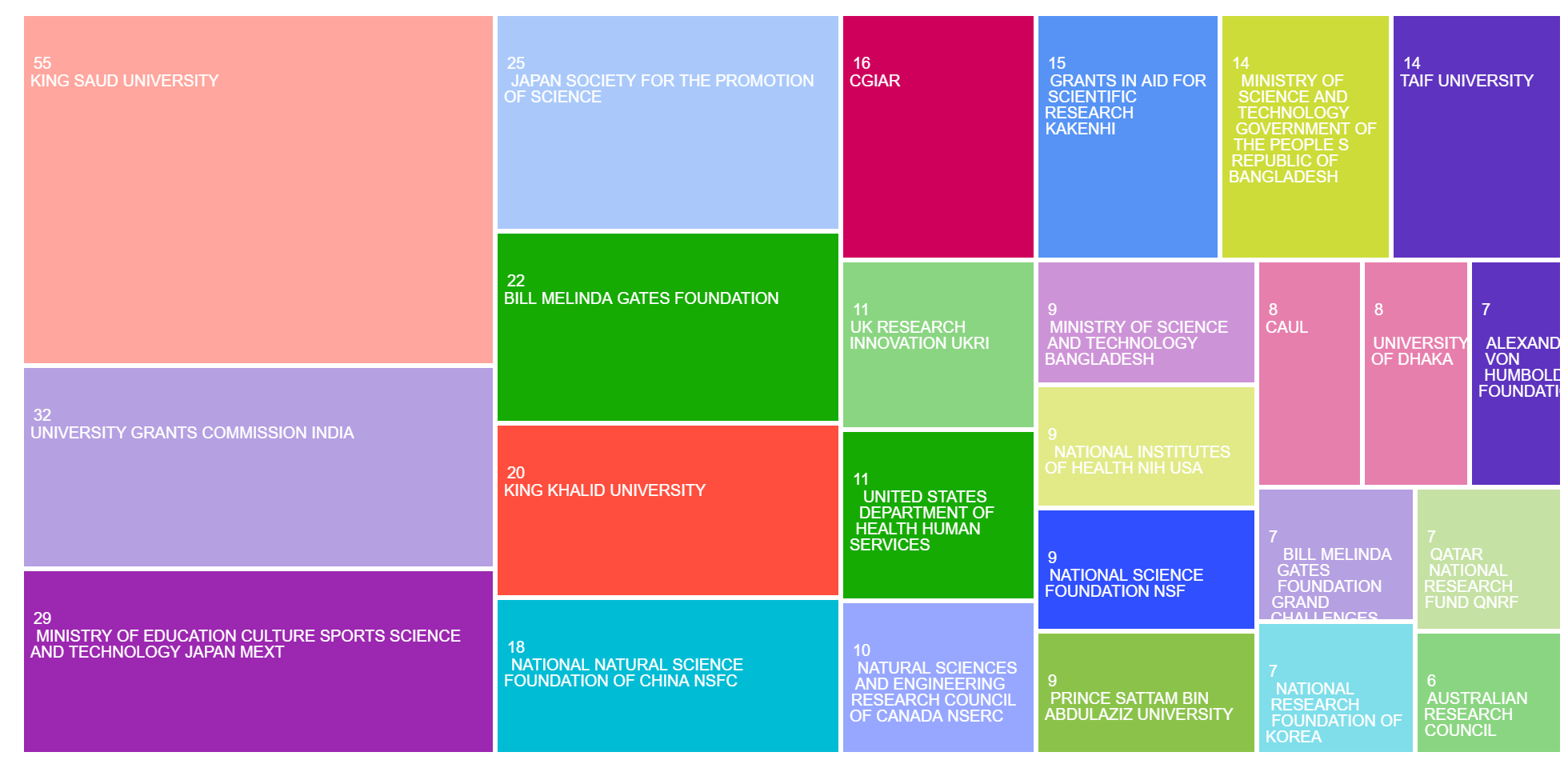
Funding Agencies:
Research highlights of Springer Nature publications from Bangladesh:
| Type | Result |
|---|---|
| Review Article | 170 |
| Early Access | 81 |
| Open Access | 640 |
| Enriched Cited References | 1,080 |
Observations:
-
Environmental and health-related fields form the core of Bangladeshi research priorities.
-
A high percentage of co-authorship with countries like the USA and India shows strong international networks.
-
Articles significantly outweigh other document types, indicating a focus on full-length, peer-reviewed research rather than shorter communications.
Questions:
-
What funding sources or national policies supported this substantial international collaboration?
-
How does the 2024 output compare to previous years in terms of growth and subject diversification?
-
Which institutions within Bangladesh contributed most to these publications?
The data reflect an impressive trajectory for Bangladeshi science, where global partnerships and a focus on pressing environmental and health challenges signal both maturity and ambition in research activities.