
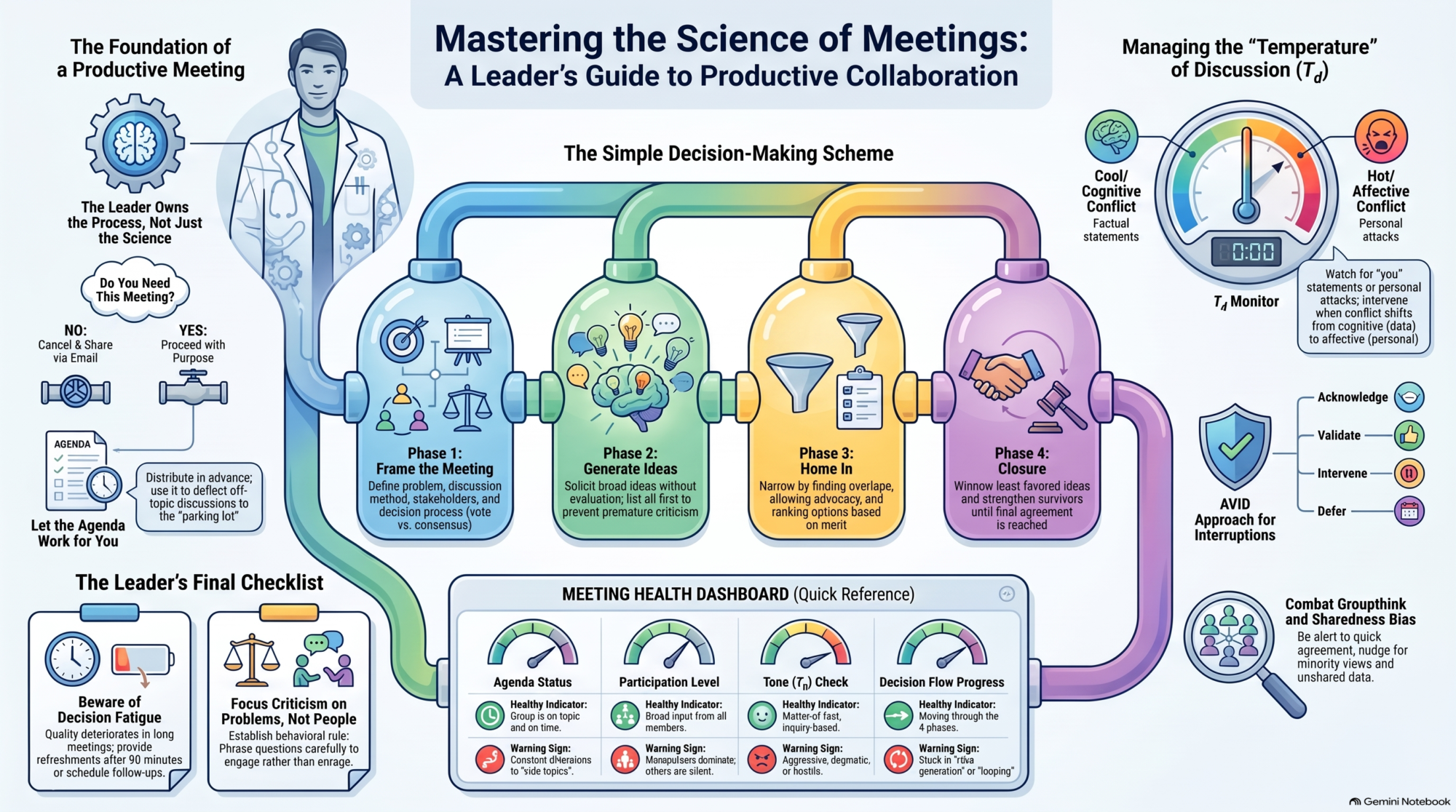
1. The Mandate of Process Ownership
In the scientific community, meeting failure is frequently misdiagnosed as a deficit in technical expertise. In reality, such failures are almost exclusively the result of poor process management. As a Principal Investigator or strategist, your technical brilliance is secondary to your ability to govern the environment in which that brilliance is applied. You must transition from the “Expert Role”—serving as a fount of knowledge or arbiter of data—to the “Leader Role,” where you serve as the absolute Process Owner.
The role of the leader is to navigate the group from a problem or agenda to a concrete solution or objective. Without active governance, the “Process” follows a chaotic “wiggle”—a disorganized path of technical tangents and interpersonal friction that fails to reach its destination. To maintain a structured path, the PI must adhere to the 50% Rule for Leadership Focus: If you are dedicating more than 50% of your cognitive bandwidth to the technical data or content during a meeting, you are neglecting your primary duties as leader. Indeed, professional governance standards often suggest that this figure should be as low as 33%, with the remaining attention focused entirely on monitoring participation, timing, and group dynamics.
Failure to maintain this boundary invites systemic risk:
- The Affective Spiral: In the absence of process control, content-based disagreements (Cognitive Conflict) rapidly devolve into “Affective Conflict.” Witness the dispute between postdocs Ramesh and Linda: because the leader remained passive, a technical critique turned into an interpersonal clash that permanently damaged their collaborative potential.
- The Multiphoton Failure: A leader who permits unscheduled technical appeals—such as the core laboratory head’s 45-minute pitch for a multiphoton imaging system—without prior notice or agenda placement ensures a “lost” meeting. Participants, having no advance knowledge and limited familiarity, will quickly lose interest, and no decision will be reached.
2. Pre-Meeting Logistics and Strategic Groundwork
Meeting preparation is a strategic mandate to protect the team’s most valuable resource: time. High-level governance requires a “Go/No-Go” assessment before any session is convened.
The Governance Checklist
A meeting must only proceed if:
- New Data Exists: Actual updates are ready for review.
- Decision is Required: A collective conclusion is the necessary output.
- Informational Alternatives are Exhausted: The goal cannot be achieved via a summary email.
- Stakeholder Availability: Key decision-makers are present; if not, the meeting is cancelled to prevent unproductivity.
Mitigating the “Deer-in-the-Headlights” Phenomenon
For contentious topics, the PI must conduct “heads-up” discussions with key stakeholders in advance. Blindsiding a scientist with an important decision triggers defensive, resentful, or “deer-in-the-headlights” reactions. Advance groundwork decreases the likelihood of “Affective Generalization” during the formal session and allows the leader to identify potential “active worriers” early.
Strategic Agenda Architecture and Decision Fatigue
To combat Decision Fatigue—the deterioration of choice quality over time—the PI must manage the group’s glucose and cognitive levels. For meetings exceeding 90 minutes, refreshments are mandated to maintain brain function. Complex or divisive items must be placed early in the session. Utilize the “Sandwich Method”:
- Opening Wins: Start with noncontentious items to build shared momentum.
- The Core Challenge: Place the most difficult items in the middle when latecomers have arrived and energy is highest.
- The Accomplishment Summary: End by reviewing deliverables and achievements to close on a productive trajectory.
3. The Four-Phase Decision-Making Framework
A structured framework ensures all voices are weighted and prevents the leader from “sucking the air out of the room.”
Phase 1: Framing the Meeting
The leader must explicitly define the preliminaries to prevent false starts down the wrong procedural path.
| Action | Description | Leader Script Example |
| Buy-in | Agreement on the problem to be discussed. | “We’re here to discuss the integration of preclinical services; is everyone clear on that?” |
| Define Method | Agreement on the mode of attack. | “How about we start with some brainstorming (list ideas with no evaluation)?” |
| Stakeholders | Clarify to whom the group is responsible. | “As you know, we’ve been tasked by the Merger Integration Committee with developing a recommendation.” |
| End Game | Define the final decision-making process. | “Once we’ve reviewed the ideas, we’ll vote,” or “We’ll take our three best ideas to the review committee.” |
Phase 2: Generating Ideas
The PI must resist the urge to make the initial proposal. When the “boss” speaks first, junior members feel an implicit pressure to agree, killing novel input. Use a hierarchy of solicitation: move from wide brainstorming (no evaluation) to specific proposals.
Phase 3: Homing In (Evaluation)
Transition from generation to evaluation by winnowing.
- Look for Overlaps: “Are any of these similar or substantially identical to one another?”
- Rank Relative Merits: “Let’s see a show of hands for the ones we like best. Just vote for three.”
Phase 4: Closure
Finalize the decision while maintaining the leader’s prerogative to break a stalemate.
- Strengthen Survivors: Combine or modify ideas to give them wider appeal: “Is there some way we could make numbers two and three into one idea?”
- Review for Agreement: “Let’s review our final list for recommendation. Are we in agreement?”
4. Intervention Protocols for Meeting Impediments
The PI must monitor the Three Domains of Meeting Dynamics: You (the leader), The People (individual behaviors), and The Group (systemic biases).
The AVID Interruption Management Tool
When a participant “torpedoes” an idea too early or introduces off-topic tangents, the PI must intervene using the AVID script. For example, during a brainstorming session where “Richard” attempts to dismiss an idea:
- Acknowledge behavior: “That may be a very good point, Richard…”
- Validate the individual: “…and I appreciate you bringing it up…”
- Intervene/Defer: “…but right now we’re just listing ideas. You’ll get your chance to shoot this one down once we’ve completed the list.”
Taxonomy of Individual Impediments
| Impediment | Behavior | Leader Response |
| The Naysayer | Negativity that saps group energy. | “Ariel, good point. Let’s ask the recorder to put that in the parking lot list.” |
| The Monopolizer | Dominating the discussion/speaking first. | “Thanks, Alexi. Let’s hear some ideas from other group members first.” |
| The Interrupter | Cutting off others’ technical explanations. | “Joanne, please let Sam finish what he had to say, then we’ll get to your point.” |
| The Cynic | Claiming efforts will not make a difference. | “Let’s not be cynical. We have a job to do. Let’s discuss this further after the meeting.” |
| The Know-it-all | Forcing their “answer” on the group. | Acknowledge their expertise, but remind them this is a group decision requiring all input. |
| The Latecomer | Disrupting flow upon arrival. | Suggest they sit down and try to come up to speed; deal with the behavior privately later. |
Managing Group Biases
The PI must actively counter Confirmation Bias (ignoring data that contradicts a preference) and Sharedness Bias (focusing only on what everyone already knows while ignoring minority expert data). In cases like Hanah’s lab, where postdocs ignored a technician’s vital information about contamination, the PI must appoint a Devil’s Advocate to force critical thinking or explicitly pause the meeting to give minority views due consideration.
5. Conflict Regulation and Discussion Temperature (T_d)
In scientific discourse, the Discussion Temperature (T_d) is the primary metric of meeting health. The leader must distinguish between productive “Cognitive Conflict” and destructive “Affective Conflict.”
Affective Generalization and Rising T_d
When a group gets stuck on a challenging topic, they often unconsciously transfer their cognitive frustration into interpersonal hostility. This Affective Generalization is marked by:
- “You” Statements: “You’re not making sense” or “You don’t understand the importance of this.”
- Personalization of Data: Reacting to a critique of an assay as if it were a personal assault.
- Body Language: Tense posture, vibrating legs, or “soporific daze” from disengagement.
Behavioral Rule #2 and its Corollary
Mandate: “Always expect that a criticism or attack of an idea or data will be felt as a personal attack.” The Corollary: “Expect that you, the leader, will react this way too.” The PI must model “Problem-Centered” language (“This assay progress is holding us back”) rather than “Person-Centered” language (“What is your problem, Koshi?”).
High-Temperature Interventions
- The Time-Out: “This is a tough problem and we’re all frustrated. Let’s put this aside for ten minutes and come back to it.”
- Strategic Humor: Use levity to blunt tension, provided it does not minimize the technical issue.
- The Power of Silence: Allow periods of silence to force the group to process their own discomfort rather than rushing to a suboptimal, “easy” solution.
6. Accountability and Post-Meeting Governance
Traditional narrative minutes are the bane of the meeting organizer; they are rarely read and often fail to capture the essence of technical decisions. Effective governance replaces narrative with a Running List of Action Items.
Deliverables and Accountability
Every meeting must conclude with a visible list of Deliverables assigned to specific names with explicit deadlines. This list is distributed before the next meeting and serves as the primary tool for accountability. If items are carried forward week after week without resolution, the PI must reevaluate if the task was assigned correctly or if it has become a “parking lot” for dead-end ideas.
Leader’s Self-Evaluation
Following the session, the PI must evaluate the meeting against the Three Domains:
- You: Did I spend more than 33-50% on content? Did I ignore important input because I was uncomfortable?
- The People: Did I intervene when a monopolizer dominated? Was T_d managed?
- The Group: Did I allow Groupthink or Sharedness Bias to derail the decision quality?
Final Directive: The Art of Letting Go
The ultimate success of a scientific strategist is measured by the group’s collective output, not the leader’s individual “correctness.” You must let go of the need to have the only solution and the need to control every technical detail. Your role is to build a culture where junior team members feel authorized to contribute, ensuring the science produced is of the highest possible quality.
N. B: This is a NotebookLM generated article from the book LAb dynamics, Management and Leadershipskills for scientists by Carl M Cohen and Suzanne L Cohen