
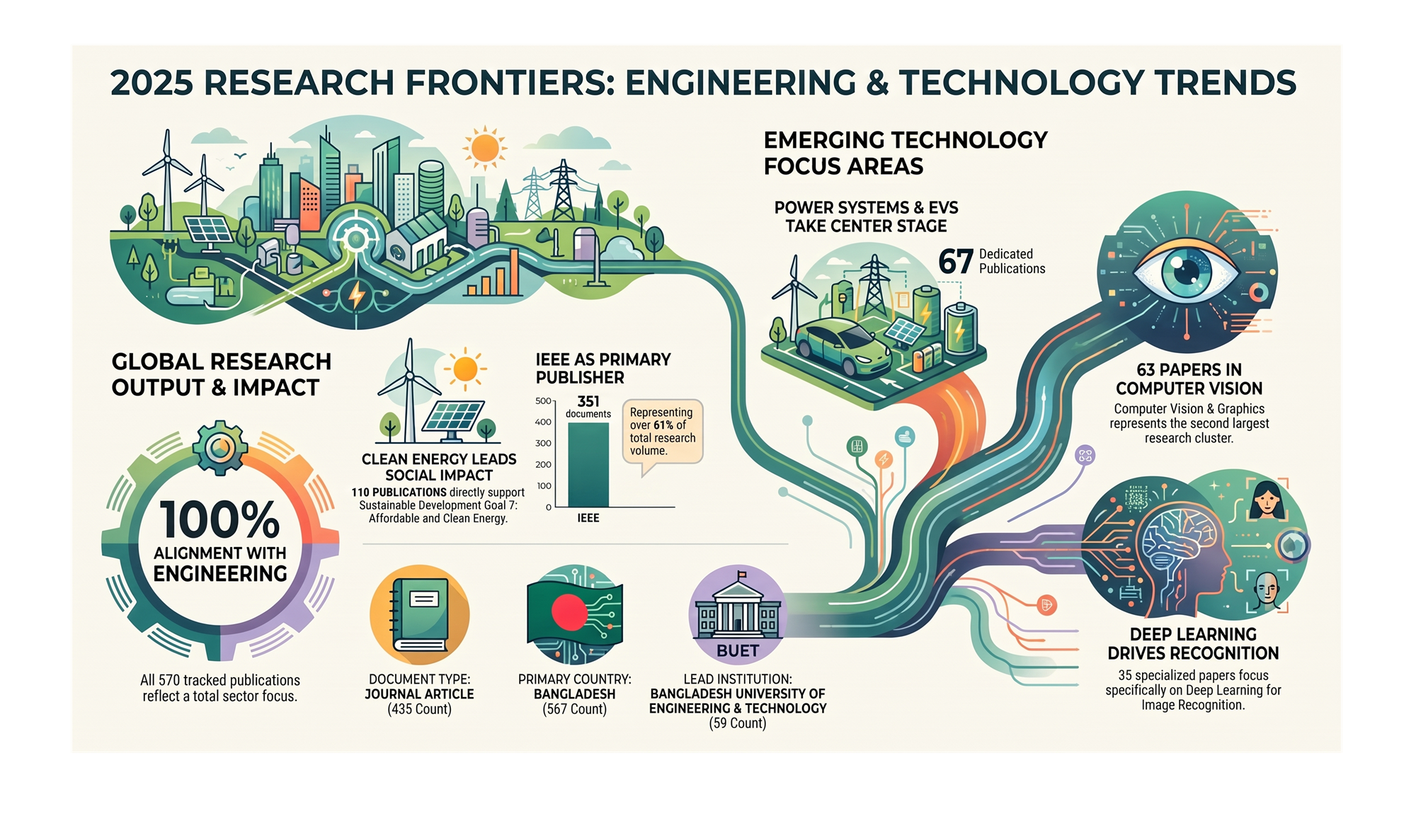
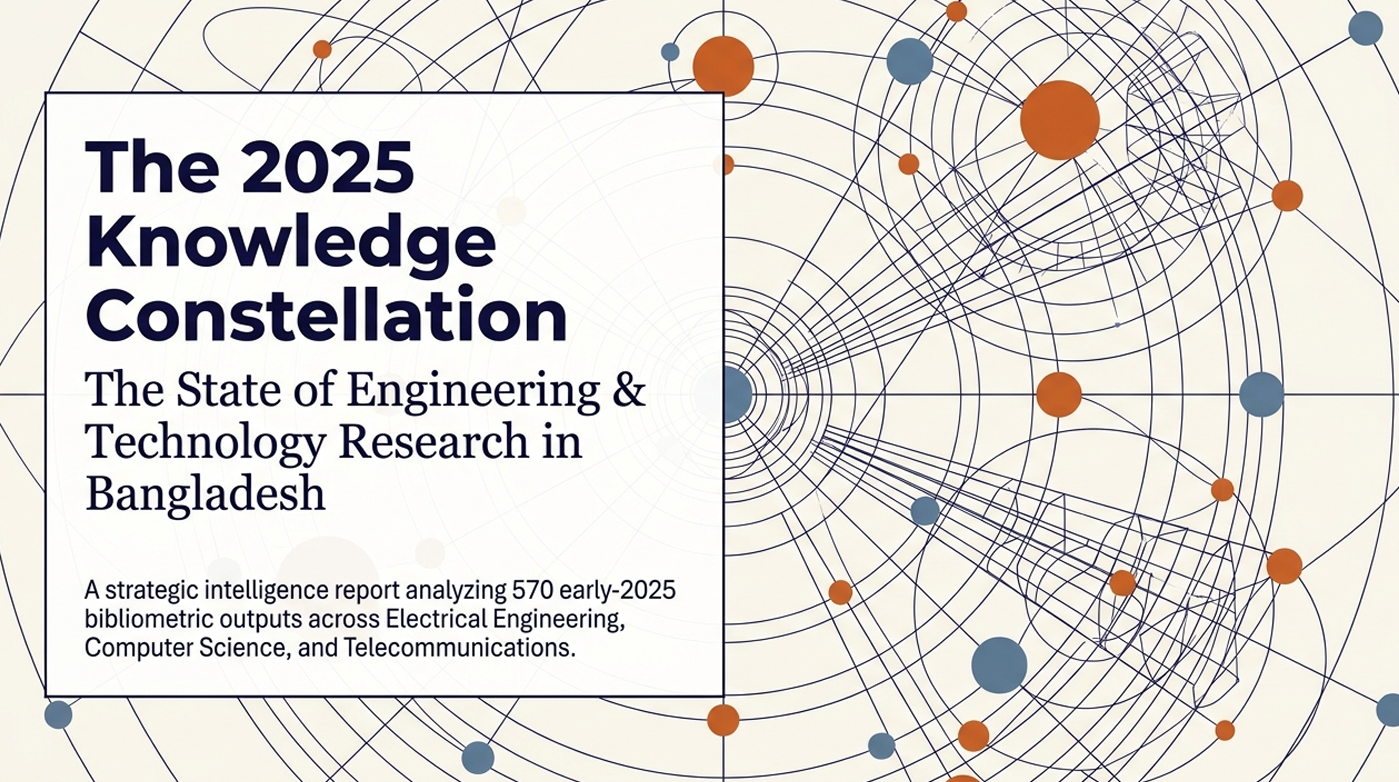
A substantial body of research in Electrical & Electronic Engineering (EEE) was produced by Bangladeshi researchers and their international collaborators in Web of Science-indexed publications during 2025. A total of 570 publications were recorded across the relevant Web of Science indexes. The research portfolio was characterized by strong representation in the Science Citation Index Expanded (SCI-EXPANDED), extensive article-based publishing, substantial international collaboration, and a strong concentration in electrical power systems, electric vehicles, wireless technologies, computer vision, and security systems. The research landscape was also marked by the participation of both public and private universities. Although Bangladesh University of Engineering & Technology (BUET) was associated with the largest institutional output, considerable contributions were also recorded from American International University-Bangladesh (AIUB), Rajshahi University of Engineering & Technology (RUET), Daffodil International University (DIU), and United International University (UIU). Web of Science
Top 10 Researchers
The highest individual publication output was recorded for M. F. Mridha, with 26 publications. Jakir Hossen was placed second with 13 publications, while Abu Shufian was associated with 10 publications. International researchers, including Tetsuya Shimamura and Yutaka Watanobe, were also included among the ten most productive researchers.
| Rank | Researcher | Publications |
|---|---|---|
| 1 | M. F. Mridha | 26 |
| 2 | Jakir Hossen | 13 |
| 3 | Abu Shufian | 10 |
| 4 | Tetsuya Shimamura | 9 |
| 5 | Shekh Md Mahmudul Islam | 8 |
| 6 | Mohammad Tariqul Islam | 6 |
| 7 | Yutaka Watanobe | 6 |
| 8 | Sourav Kumar Pramanik | 6 |
| 9 | Hasanur Zaman Anonto | 6 |
| 10 | Muhammad E.H. Chowdhury | 6 |
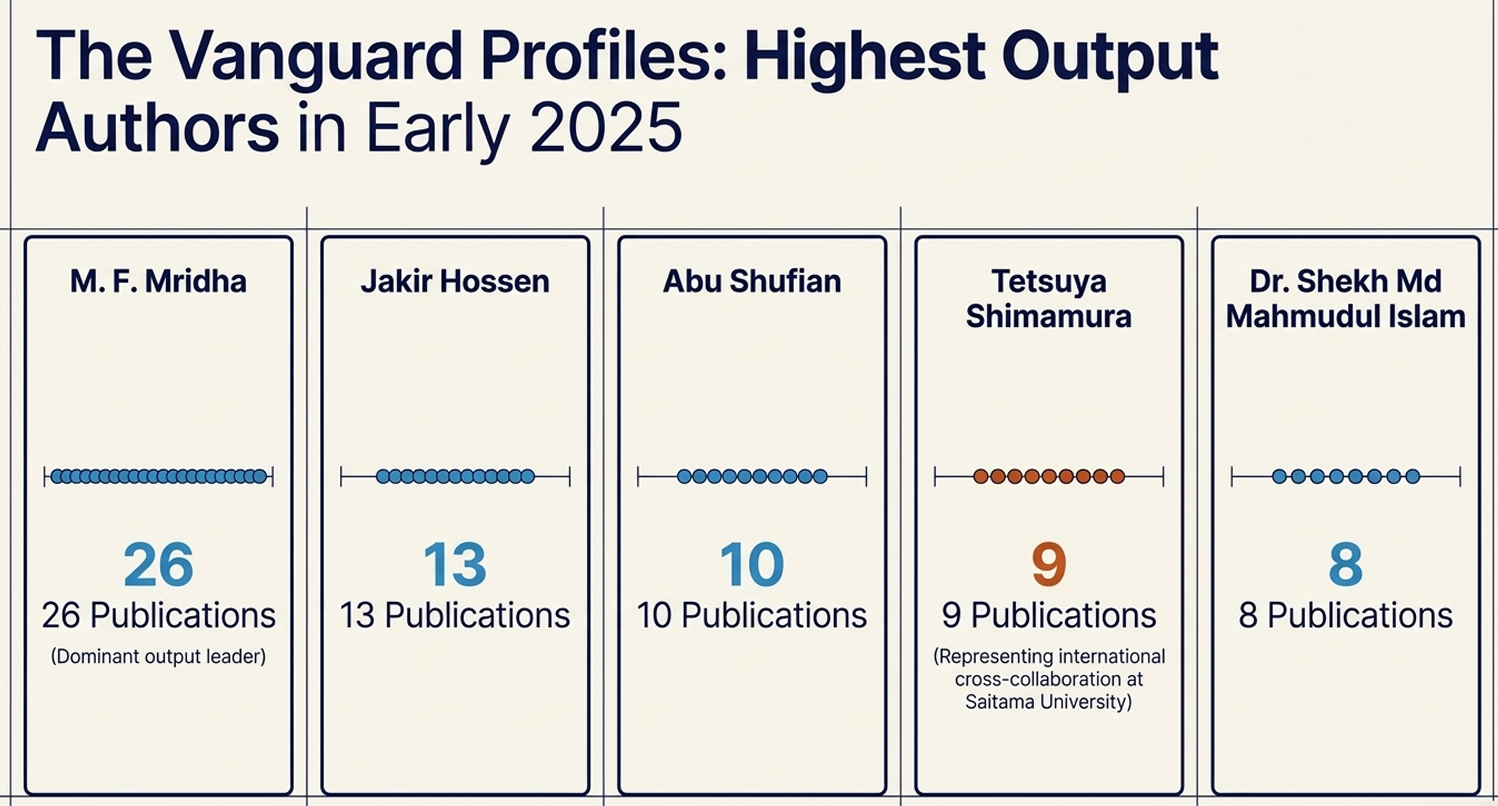
A substantial concentration of publications was therefore associated with a relatively small group of highly productive researchers. The inclusion of Japanese researchers among the leading contributors also reflects the international character of the research network.
Top 10 Research Institutions
The largest institutional contribution was associated with BUET, from which 59 publications were recorded. AIUB followed with 48 publications, while RUET and DIU were associated with 39 and 36 publications, respectively.
| Rank | Institution | Publications |
|---|---|---|
| 1 | Bangladesh University of Engineering & Technology (BUET) | 59 |
| 2 | American International University-Bangladesh (AIUB) | 48 |
| 3 | Rajshahi University of Engineering & Technology (RUET) | 39 |
| 4 | Daffodil International University (DIU) | 36 |
| 5 | United International University (UIU) | 32 |
| 6 | BRAC University | 29 |
| 7 | Chittagong University of Engineering & Technology (CUET) | 27 |
| 8 | Bangladesh University of Business & Technology (BUBT) | 25 |
| 9 | North South University (NSU) | 25 |
| 10 | Khulna University of Engineering & Technology (KUET) | 24 |
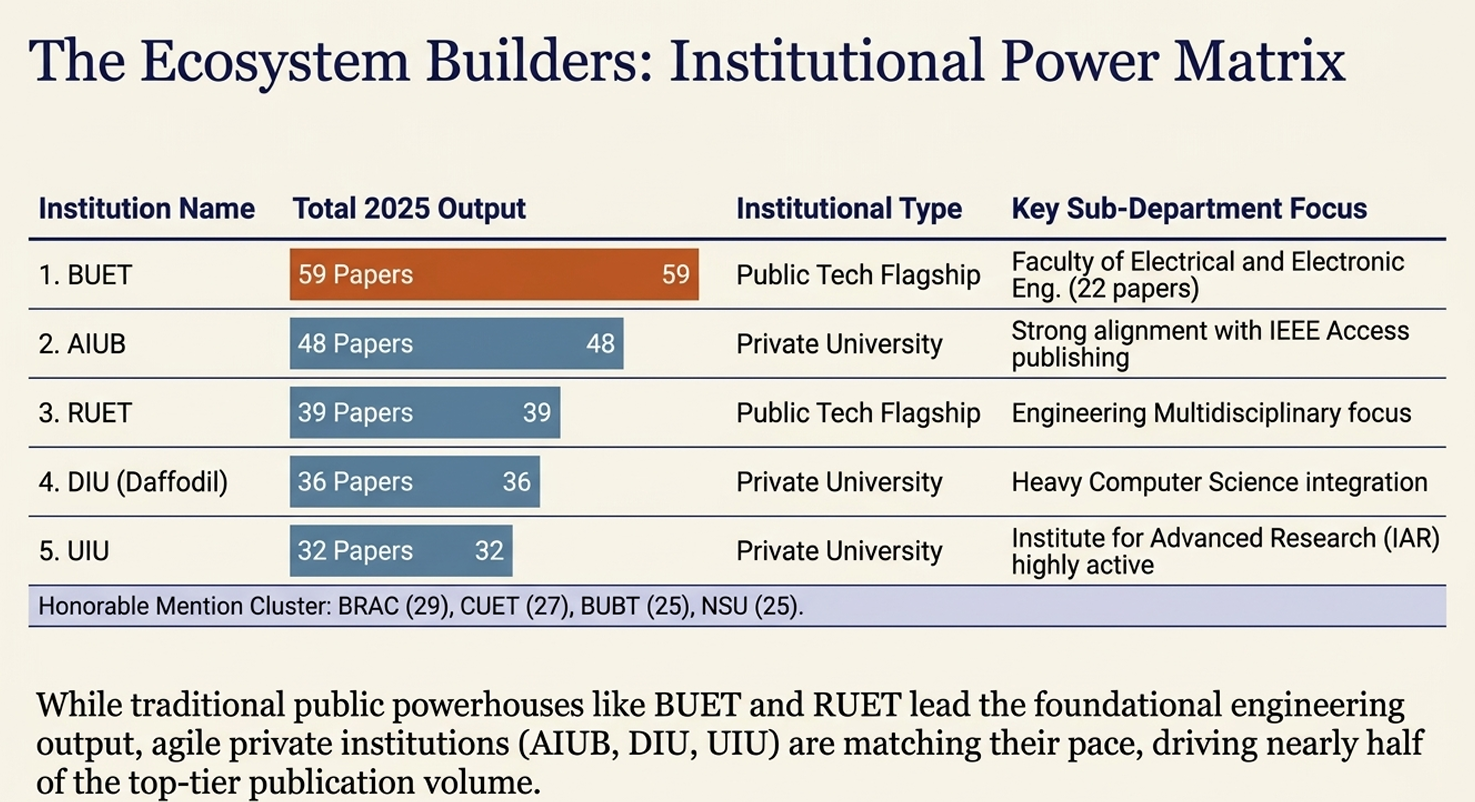
A notable representation of private universities was observed. AIUB, DIU, UIU, BRAC University, BUBT, and NSU were all included among the ten leading institutional affiliations. At the same time, major public engineering universities such as BUET, RUET, CUET, and KUET remained strongly represented.
Web of Science Indexing
Of the 570 publications, 411 were indexed in SCI-EXPANDED, representing more than 72% of the total. A further 105 publications were indexed in the Conference Proceedings Citation Index–Science (CPCI-S), while 54 publications were indexed in the Emerging Sources Citation Index (ESCI).
| Web of Science index | Publications | Share of total |
|---|---|---|
| SCI-EXPANDED | 411 | 72.1% |
| CPCI-S | 105 | 18.4% |
| ESCI | 54 | 9.5% |
| Total | 570 | 100% |
A strong presence in SCI-EXPANDED was therefore observed, while conference proceedings and emerging-index publications constituted smaller portions of the overall output.
Types of Publications
Research articles constituted the dominant publication format. 435 articles were recorded, compared with 105 proceeding papers and 18 review articles. Smaller numbers of corrections, editorial materials, retractions, early-access records, and retracted publications were also identified.
| Document type | Publications |
|---|---|
| Articles | 435 |
| Proceeding Papers | 105 |
| Review Articles | 18 |
| Corrections | 7 |
| Editorial Material | 3 |
| Retractions | 2 |
| Early Access | 1 |
| Retracted Publication | 1 |
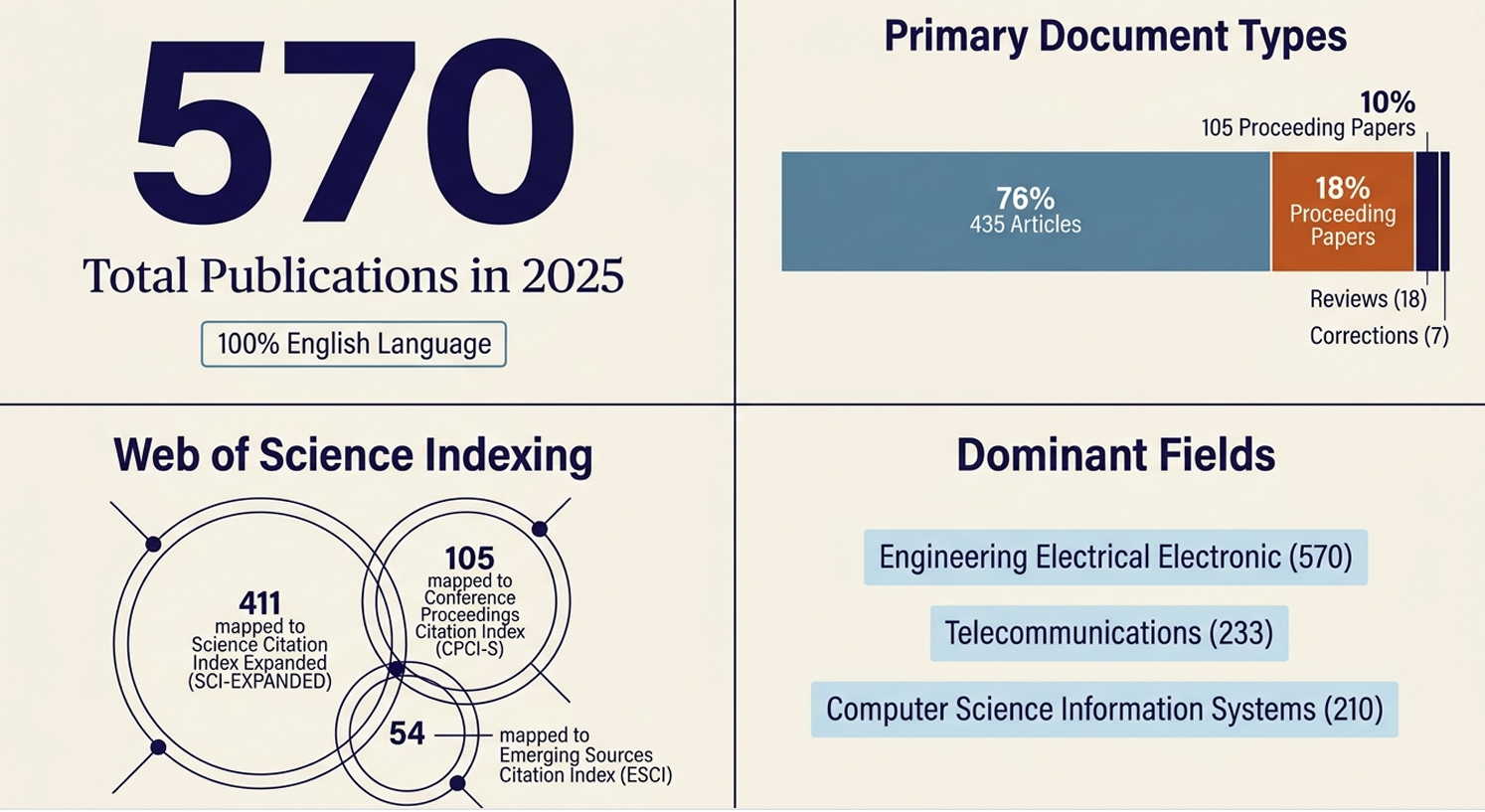
Thus, approximately three-quarters of the recorded output was represented by research articles, indicating a strong emphasis on primary research and technical investigations.
Funding Agencies
A substantial portion of the research was supported through international funding agencies and institutional grants. The National Natural Science Foundation of China (NSFC) was associated with the largest number of funded publications among the listed agencies, followed by the National Research Foundation of Korea (NRF) and the UIU IAR Grant.
| Rank | Funding agency | Publications |
|---|---|---|
| 1 | National Natural Science Foundation of China (NSFC) | 15 |
| 2 | National Research Foundation of Korea (NRF) | 10 |
| 3 | United International University IAR Grant | 8 |
| 4 | Qatar National Research Fund (QNRF) | 7 |
| 5 | King Saud University | 6 |
| 6 | National Science Foundation (NSF), USA | 6 |
| 7 | Natural Sciences and Engineering Research Council (NSERC) | 6 |
| 8 | Research Centre for Green Energy (REGED) | 6 |
| 9 | Grants-in-Aid for Scientific Research (KAKENHI) | 5 |
| 10 | Japan Society for the Promotion of Science (JSPS) | 5 |
The funding profile indicates that international research partnerships played an important role in supporting Bangladesh-associated EEE research. Funding support was particularly represented by organizations from China, South Korea, Qatar, Saudi Arabia, the United States, Canada, and Japan.
International Collaboration
International collaboration was prominently represented in the 2025 publication profile. The United States was associated with 145 collaborative publications, followed by Saudi Arabia with 62 and Australia with 60.
| Collaboration country | Publications |
|---|---|
| United States | 145 |
| Saudi Arabia | 62 |
| Australia | 60 |
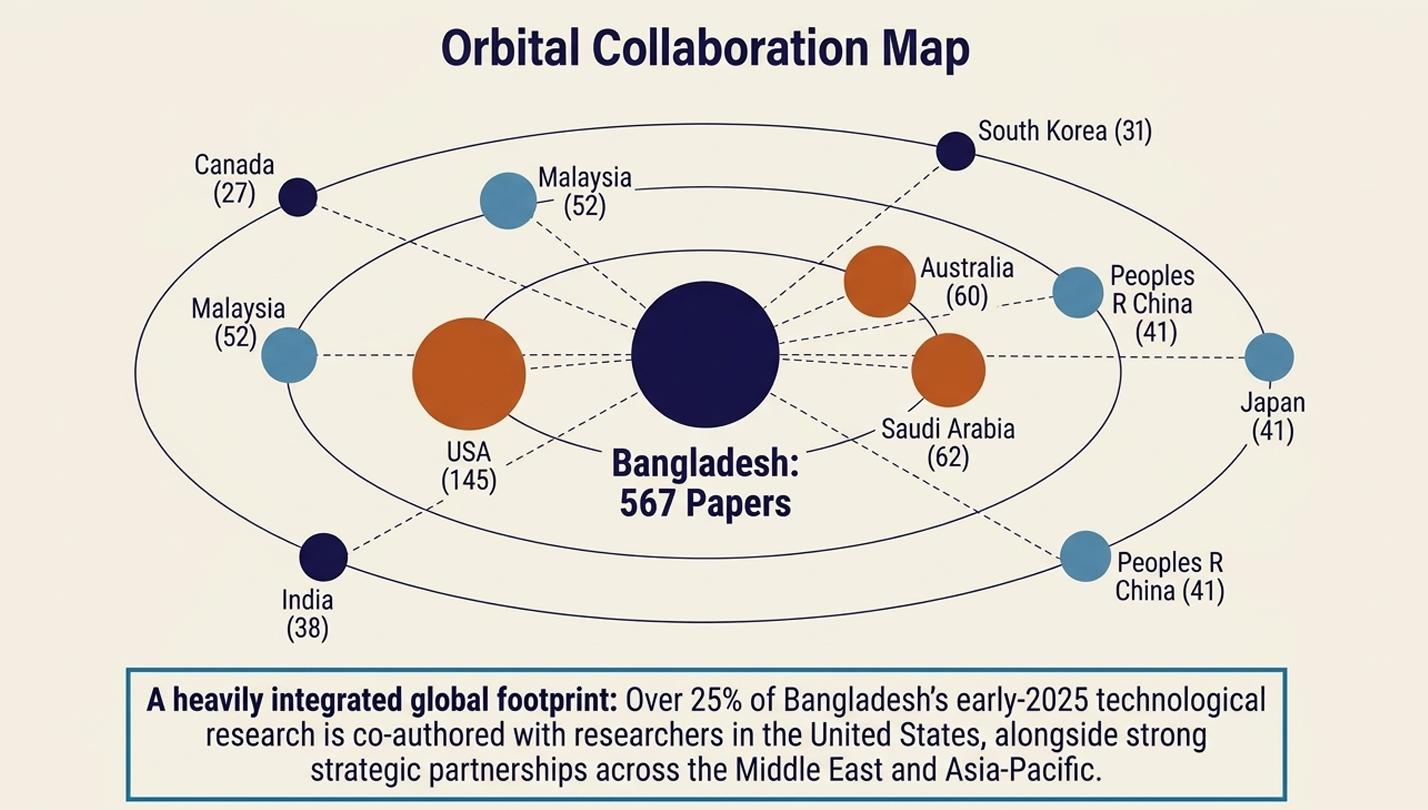
These collaborations indicate that Bangladesh-associated EEE research was embedded in broader international research networks, particularly involving North American, Middle Eastern, Australian, East Asian, and South Asian research communities.
Major Research Themes
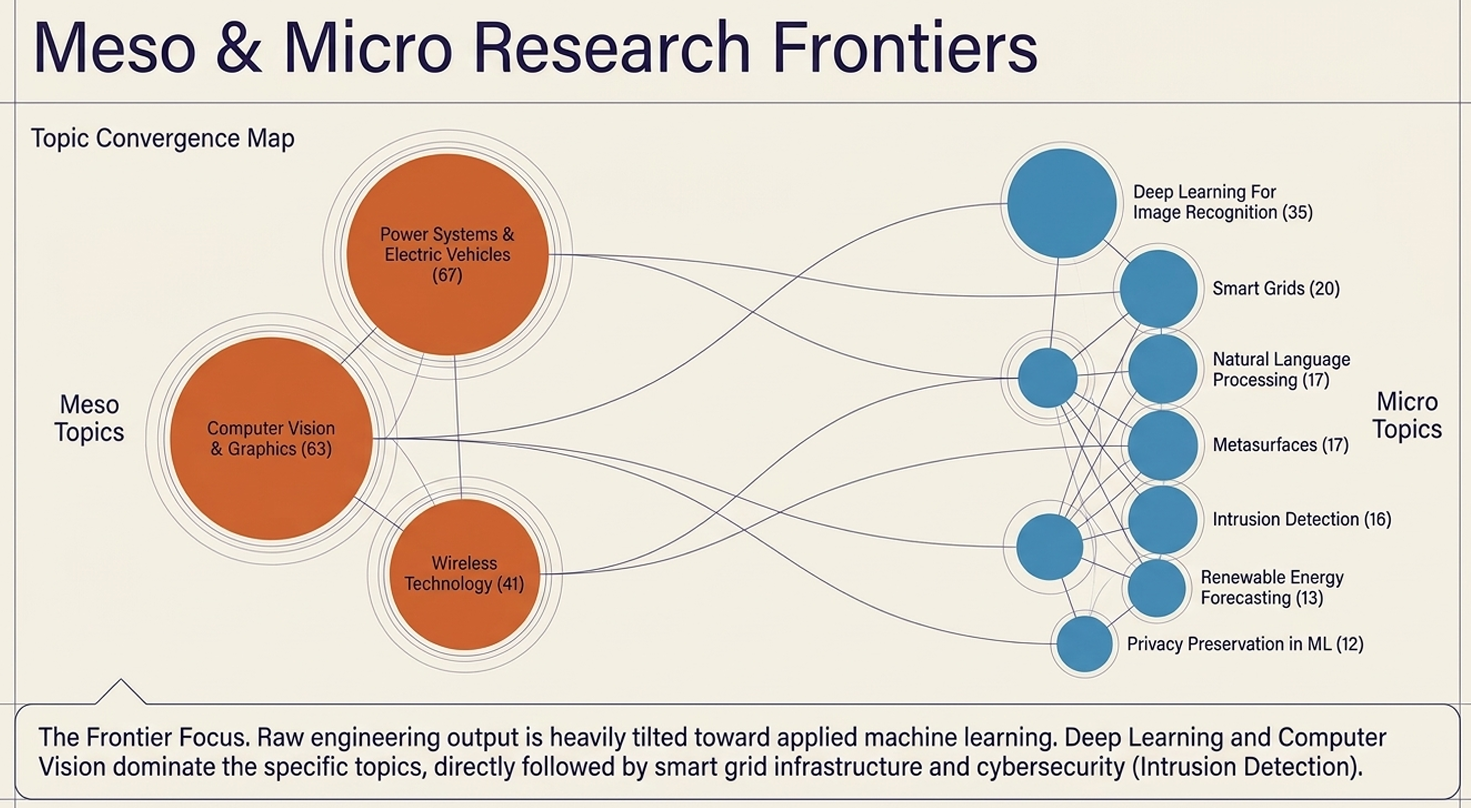
The research portfolio was concentrated around several technologically important areas. Four major meso-level research themes were identified: Power Systems & Electric Vehicles, Computer Vision & Graphics, Wireless Technology, and Security Systems.
| Research theme | Publications | Representative areas |
|---|---|---|
| Power Systems & Electric Vehicles | 67 | Smart grids, renewable-energy forecasting, photovoltaic systems |
| Computer Vision & Graphics | 63 | Deep learning, image recognition, human activity recognition |
| Wireless Technology | 41 | MIMO optimization, antenna design, metasurfaces |
| Security Systems | 29 | Intrusion detection, machine-learning privacy |
The strongest thematic concentration was therefore observed in power systems and electric vehicles, followed closely by computer vision and graphics. Wireless communication and security research were also substantially represented. The broader research portfolio was associated with 570 Engineering publications and 304 Computer Science publications in the reported topic profile.
Contribution to Sustainable Development Goals
Strong connections with the Sustainable Development Goals were identified. SDG 7—Affordable and Clean Energy was associated with 110 publications, while SDG 3—Good Health and Well-Being was associated with 90 publications.
| SDG | Publications |
|---|---|
| SDG 7: Affordable and Clean Energy | 110 |
| SDG 3: Good Health and Well-Being | 90 |
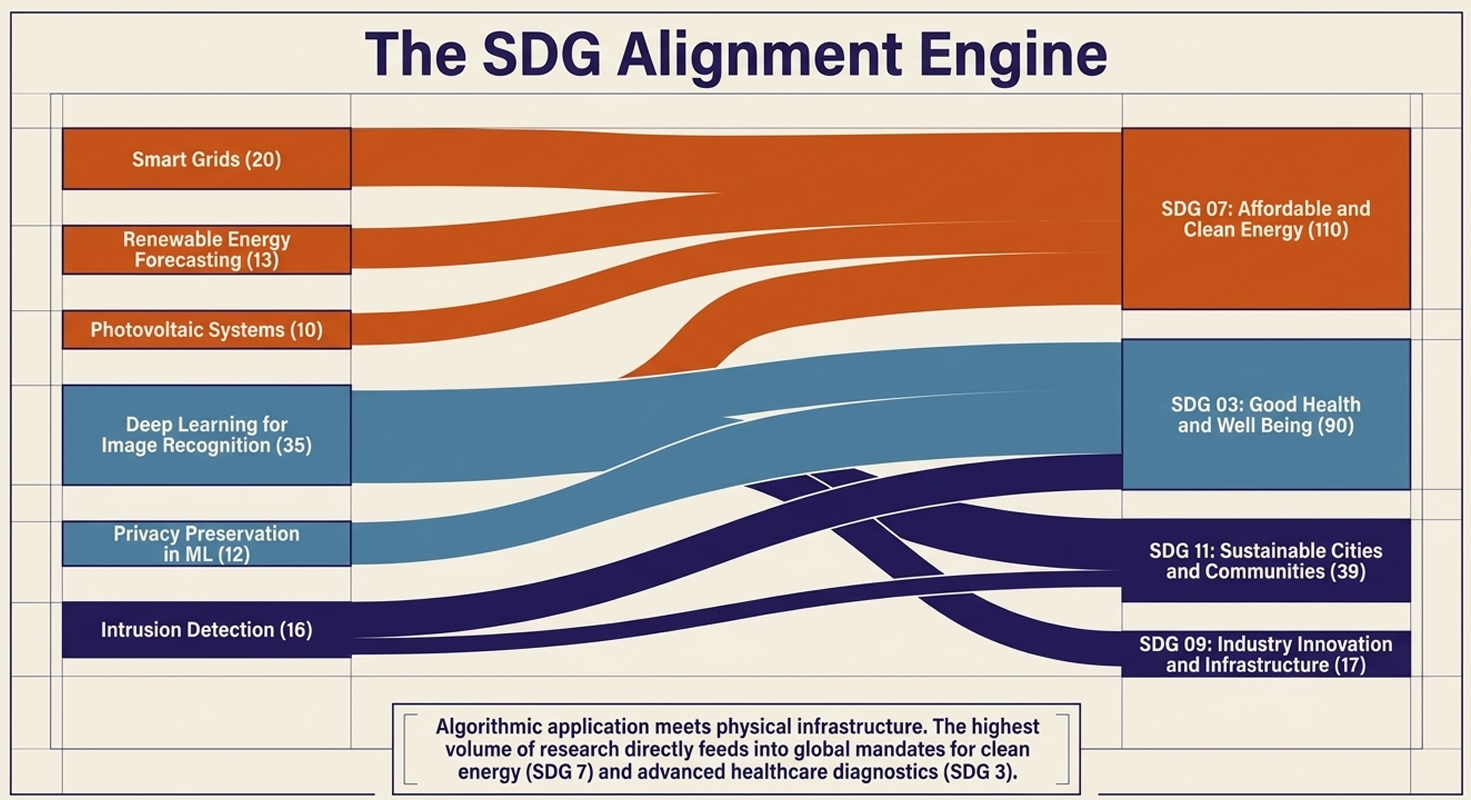
The prominence of SDG 7 was consistent with the strong representation of renewable energy, photovoltaic systems, power systems, smart grids, and electric vehicles.
Leading Journals and Publishers
The publication landscape was strongly concentrated within the IEEE publishing ecosystem. IEEE Access alone accounted for 157 publications, followed by the IEEE Open Journal of the Computer Society with 17 and IEEE Region 10 Symposium with 15.
| Leading journal/venue | Publications |
|---|---|
| IEEE Access | 157 |
| IEEE Open Journal of the Computer Society | 17 |
| IEEE Region 10 Symposium | 15 |
| IEEE Sensors Journal | 13 |
| Journal of Materials Science: Electronics | 12 |
Among publishers, IEEE was associated with 351 publications, followed by Elsevier (66), Springer Nature (47), Wiley (36), and MDPI (32).
| Publisher | Publications |
|---|---|
| IEEE | 351 |
| Elsevier | 66 |
| Springer Nature | 47 |
| Wiley | 36 |
| MDPI | 32 |
The strong concentration within IEEE venues reflects the close relationship between Bangladeshi EEE research and the principal international publishing ecosystem for electrical engineering, electronics, telecommunications, sensors, computing, and related technologies.
Open Access and Research Visibility
A considerable proportion of the publications was made available through open-access channels. 305 publications were identified as All Open Access, representing more than half of the reported 570 publications. This open-access presence would have facilitated wider access to Bangladesh-associated research, particularly in rapidly developing fields such as renewable energy, artificial intelligence, wireless communication, electric vehicles, and smart-grid technologies.
Overall Research Profile
The 2025 Web of Science profile indicates that Bangladesh’s Electrical & Electronic Engineering research was characterized by several major features:
| Indicator | 2025 profile |
|---|---|
| Total publications | 570 |
| SCI-EXPANDED publications | 411 |
| Articles | 435 |
| Top researcher | M. F. Mridha — 26 |
| Leading institution | BUET — 59 |
| Leading funding agency | NSFC — 15 |
| Leading collaboration country | USA — 145 |
| Major research theme | Power Systems & Electric Vehicles — 67 |
| SDG with highest reported association | SDG 7 — 110 |
| Leading journal | IEEE Access — 157 |
| Leading publisher | IEEE — 351 |
| All Open Access publications | 305 |
Conclusion
Bangladesh’s Electrical & Electronic Engineering research in 2025 was represented by a substantial Web of Science-indexed output of 570 publications, with more than 72% being indexed in SCI-EXPANDED. Research articles were strongly dominant, while a relatively smaller proportion was represented by reviews and conference proceedings. The highest individual output was recorded for M. F. Mridha, while BUET was identified as the leading institutional affiliation. Considerable contributions were also recorded from private universities, particularly AIUB, DIU, UIU, BRAC University, BUBT, and NSU. Research was substantially supported through international funding and collaboration. Strong links with the United States, Saudi Arabia, Australia, China, South Korea, Qatar, Canada, and Japan were reflected in the dataset. Major research attention was directed toward power systems, electric vehicles, renewable energy, computer vision, wireless technologies, and security systems, with considerable alignment with SDG 7 and SDG 3. Finally, a pronounced concentration within IEEE journals and publishing venues was observed, with IEEE accounting for 351 publications and IEEE Access alone accounting for 157. Overall, the 2025 profile portrays an increasingly internationalized and technology-oriented EEE research environment in Bangladesh, in which both public and private institutions were contributing to research on globally significant engineering and digital technologies.