
1. Strategic Rationale: The Knowledge-to-Impact Gap
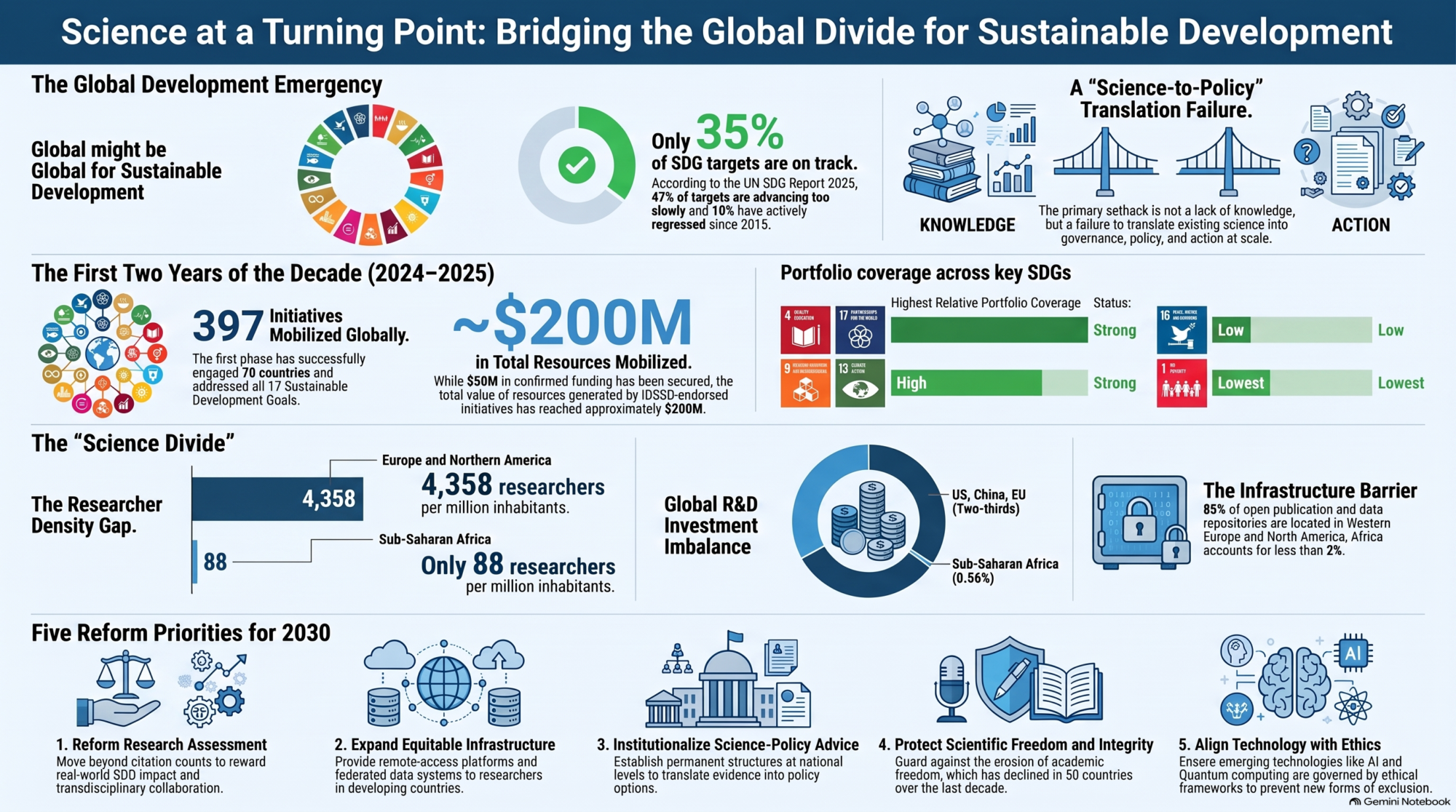
The global scientific community confronts a profound “crisis of progress” that is structural rather than purely cognitive. While humanity possesses unprecedented technological power and computing capacity, our advancement toward the 2030 Agenda has entered a period of stagnation and regression. Current data indicates that 47% of Sustainable Development Goal (SDG) targets are advancing too slowly, while 18% have actively regressed. This framework operates on the strategic premise that the primary bottleneck is not a scarcity of knowledge, but a systemic failure to translate science into policy and governance. Critically, we must acknowledge a darker strategic reality identified in the UNESCO analysis: knowledge is increasingly weaponized by those who own it as “power to destroy, manipulate, and exploit the planet and people.” The “knowledge-to-impact gap” is, therefore, not a passive void but a consequence of institutional architectures that prioritize extraction over equity.
The Global Turning Point
We have reached a moment of fundamental contradiction where scientific productivity is at its zenith, yet the denial of basic needs persists.
“In a world of unprecedented wealth, knowledge and technologies, the denial of basic needs for so many is outrageous and inexcusable. At the same time, we have what it takes to breakthrough to a better future.” — UN Secretary-General, SDG Report 2024
Evaluation of Structural Imbalances
The current research landscape is defined by profound asymmetries that limit the “cognitive sovereignty” of the Global South. These gaps are not merely static figures but represent a failure of historical trajectory.
Global Scientific Asymmetries
| Metric | Regional Disparity & Historical Trajectory |
| R&D Investment (% of GDP) | Sub-Saharan Africa: 0.38% (regional average) vs. Europe & North America: 2.55% |
| Researcher Density (per million) | Sub-Saharan Africa: 88 researchers vs. Europe & North America: 4,358 researchers |
| Global R&D Expenditure Share | Sub-Saharan Africa: Rose from 0.27% (2000) to only 0.56% (2024) |
| Concentration of Investment | US, China, and EU: Control ~66% of all global R&D spending |
The “So What?” Layer: The Climate-Inequality Nexus
These investment gaps function as “threat multipliers.” UNESCO data reveals a stark injustice: the top 10% of emitters per capita contribute a disproportionate share of global emissions, yet the most climate-vulnerable populations—disproportionately located in the Global South—have contributed the least. These same vulnerable regions are systematically the least equipped in research and innovation infrastructure to generate local adaptation solutions. Without local scientific capacity, the climate-inequality nexus becomes an inescapable cycle of technological dependence and “brain drain.”
Conclusion: The diagnostic findings of this global crisis necessitate immediate institutional reforms to research assessment and infrastructure to ensure science serves as a common good.
2. Reform Pillar I: Reimagining Research Assessment Systems
Strategic alignment requires a mandatory shift in the global reward structure. Current academic incentive systems, characterized by a systemic prioritization of publication velocity and bibliometric proxies, act as a primary barrier to the mission-oriented, transdisciplinary research required for the SDGs. To restore scholarly judgment, we must move beyond narrow indicators that undervalue the very work the 2030 Agenda demands.
Moving Beyond Bibliometrics
Governance of the scientific enterprise must mandate a transition away from journal impact factors toward the principles of the San Francisco Declaration on Research Assessment (DORA), the Leiden Manifesto, and the Coalition for Advancing Research Assessment (CoARA). The objective is to center assessment on the intrinsic merit and societal utility of research.
Standard-Setting for Mission-Oriented Science
- Mandatory SDG Impact Metrics: Incentivize real-world outcomes and solutions-oriented outputs over journal prestige.
- Recognition of Transdisciplinary Outputs: Formally value datasets, policy briefs, and community-validated interventions as equivalent to peer-reviewed articles.
- Structural Equity and Gender Inclusion: Assessment reform must dismantle the gendered barriers identified by UNESCO. Women are disproportionately engaged in community-oriented and applied SDG research; current metrics, which undervalue these contributions, act as a structural filter against female scientific leadership.
The “So What?” Layer: Restoring Integrity
The “reproducibility crisis”—where 70% of researchers failed to reproduce experiments—is a direct symptom of an incentive system that rewards novelty over verification. By institutionalizing a mission-oriented approach that values methodological rigor and real-world utility, we restore the scientific integrity essential for public trust and policy legitimacy.
Conclusion: Assessment reform is the critical engine that drives the physical and digital expansion of global research infrastructure.
3. Reform Pillar II: Equitable Expansion of Research Infrastructure
Research infrastructure must be governed as a global public good. Currently, “cognitive sovereignty” is threatened by the “dominance of an AI-mediated environment” and the concentration of data in high-income regions. Without local access to tools, nations cannot solve their own developmental challenges.
Closing the Physical and Digital Divide
We must institutionalize distributed facilities to shift the power dynamic from “knowledge extraction” to “knowledge production.” Key models include:
- Remote Access: UNESRALE (UNESCO Remote Access to Laboratory Equipment) for high-end instrumentation.
- Regional Hubs: SESAME in the Middle East and the African Light Source Foundation as models for shared, high-impact regional facilities.
- Open Science Repositories: Addressing the divide where 85% of repositories are in the West, while Africa (<2%) and the Arab region (<3%) remain marginalized.
The “So What?” Layer: From Extraction to Sovereignty
Reliance on “fragile relationships” with Northern facilities forces Southern researchers into a cycle of dependency. Institutionalizing local infrastructure allows for the production of locally relevant knowledge, preventing the “brain rot” caused by the colonization of the human mind by external research agendas and data models.
Conclusion: World-class infrastructure must be matched by robust science-policy interfaces to ensure knowledge is effectively applied to legislative and societal needs.
4. Reform Pillar III: Institutionalizing the Science-Policy-Society Interface
Scientific evidence only fulfills its potential as a public good when functional channels exist between laboratories and legislative halls. Functional interfaces require mandate, independence, and political will.
Benchmarking Science Advice
The global landscape remains underdeveloped: the “Chief Science Advisor” model is formally institutionalized in only seven countries (including the US, UK, and India). However, the International Network for Government Science Advice (INGSA) provides a global community of practice to assist the remaining 186 Member States in building these critical mechanisms.
Drivers of Trust and Outcomes
Trust in science is undermined by:
- Misinformation and disinformation.
- Perceived irrelevance to local lived experiences.
- A historical legacy of “colonial knowledge extraction” where research was conducted without local benefit or consent.
The “So What?” Layer: Public Empowerment
Institutionalizing interfaces, such as the Global Alliance on the Science of Learning for Education, allows for the translation of research into pedagogical practice. Science literacy (IDSSD Outcome 1) creates the political legitimacy necessary for evidence-based governance, empowering the public to participate in the scientific process.
Conclusion: Technological alignment and ethical governance complete the transition to a mission-oriented scientific model.
5. Reform Pillar IV: Ethical Governance of Emerging Technologies
In the post-industrial era, cognition has become the primary driver of growth. However, there is a dangerous strategic mismatch between the pace of innovation (AI, Quantum, Neurotechnology) and the pace of governance.
The Technology-Governance Gaps
- Data and AI Asymmetry: AI models trained on Western data (e.g., Iowa corn farms) fail smallholder farmers in Malawi, reinforcing global inequities.
- The Quantum Divide: While global investment reaches USD 55.7 billion, 150 countries lack a national quantum strategy. Furthermore, a severe gender gap exists, with women representing fewer than 2% of job applicants in the sector.
Normative Frameworks for Proactive Steering
Governance must not be a lagging indicator. We must utilize:
- Readiness Assessment Methodology (RAM): Already applied in over 60 countries to build national capacity for ethical AI.
- Global Quantum Initiative 2026–2028: Focusing on mapping and capacity building in the Global South.
The “So What?” Layer: Steering Innovation
Governance is a steering mechanism, not a barrier. Implementing ethical frameworks ensures that the primary drivers of future growth—cognition and AI—are aligned with sustainability rather than further stratification.
Conclusion: National technological alignment completes the structural transition to mission-oriented science.
6. Implementation Roadmap: Recommendations for Member States
The success of the International Decade of Sciences for Sustainable Development (2024–2033) depends on national-level ownership and a transition from diagnosis to action.
Strategic Directions for the Next Phase
Member States must align with the Five Strategic Directions identified in the Decade’s framework:
- Prioritize Mission-Oriented Science: Shifting focus to solutions for the 2030 Agenda.
- Strengthen AI and Digital Innovation: Closing the governance and data gap.
- Build Open Science and Shared Infrastructure: Ensuring equitable access to knowledge.
- Foster Science-Industry Collaboration: Accelerating the deployment of sustainable technologies.
- Reinforce Trusted Science-Policy-Society Interfaces: Stabilizing advisory mechanisms.
Strategic Action Plan for Governments
- Invest in National Capacity: Target the R&D gap by moving toward global investment benchmarks.
- Align Funding with SDGs: Mandate that national science funding prioritizes the most regressing goals (SDGs 1, 12, 14, and 16).
- Shift to a Decentralized Funding Model: Move away from “fragmented funding” toward a resilient, network-based model to ensure long-term sustainability.
- Protect Scientific Freedom: Adopt the UNESCO 2017 Recommendation as the baseline for researcher rights and scientific integrity.
Call to Action
The global community faces a stark choice. Knowledge is currently being used as “power to destroy,” but it contains the seeds of our “breakthrough to a better future.” The choice is no longer whether to act, but at what scale and speed the scientific revolution for sustainable development will be realized. We have the knowledge; we must now build the systems capable of using it.
Reference: Science at a Turning Point, International Decade of Sciences for Sustainable Development GLOBAL REPORT
Published in 2026 by the United Nations Educational, Scientific and Cultural Organization, 7, place de Fontenoy, 75352 Paris 07SP, France.
N.B: AI-generated report