
The Rising Tide of Bangladeshi Science
For aspiring researchers and students embarking on their educational journeys, the global scientific landscape is expanding in exciting new directions. Over recent years, Bangladesh has demonstrated an extraordinary surge in scientific research, establishing a powerful presence on the global academic stage. According to metrics from science-wide citation databases published in the Elsevier Data Repository and curated by TOPSCINET, Bangladeshi researchers are capturing international attention across major scientific disciplines.
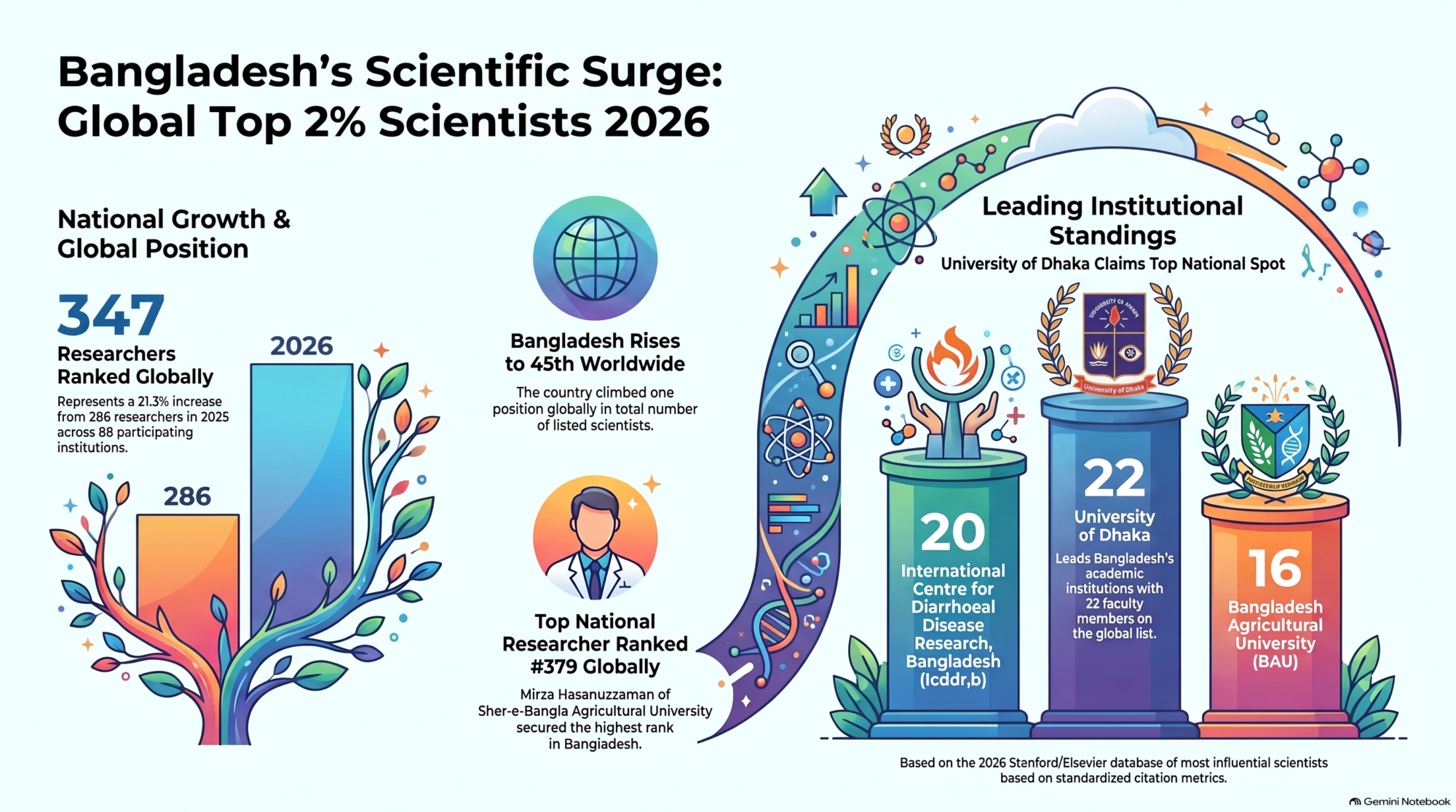
For an emerging scholar, this growth represents a transformative shift: high-impact scientific inquiry is thriving locally, offering unprecedented opportunities for mentorship, discovery, and global recognition right from home. In 2026, Bangladesh ranked 45th globally in its count of top-ranked scientists, advancing its international standing and proving that world-class innovation is flourishing across national universities and research institutes.
Between 2020 and 2026, Bangladesh experienced a remarkable +519.6% increase in top-ranked scientists on the single-year global list, expanding from just 56 scientists in 2020 to 347 in 2026.
This steady acceleration reflects an expanding ecosystem of research productivity and international collaboration. The timeline below highlights how the country’s representation among top global researchers has expanded year over year:
| Year | Single-Year Scientist Count | Annual Growth Rate (%) |
| 2020 | 56 | Base Year |
| 2021 | 97 | +73.2% |
| 2022 | 147 | +51.5% |
| 2023 | 177 | +20.4% |
| 2024 | 205 | +15.8% |
| 2025 | 286 | +39.5% |
| 2026 | 347 | +21.3% |
This national surge in scientific achievement is anchored in a vibrant, expanding network of academic institutions and specialized physical research centers distributed across the country.
2. Scientific Innovation Hubs: Leading Institutions
To understand where high-impact research takes place, prospective scholars must look at Bangladesh’s organizational academic landscape. World-class research in Bangladesh is conducted across a diverse mixture of comprehensive public universities, specialized agricultural and engineering institutions, highly active private universities, and dedicated research institutes.
A critical metric of this expanding research culture is institutional breadth: in 2026, top-ranked scientists were spread across 88 distinct institutes in Bangladesh, marking an 18.9% increase from 74 institutes in 2025. This proves that research excellence is no longer localized in a few isolated centers, but is spreading across the entire national higher education network.
Leading this effort are top public institutions like the University of Dhaka, alongside specialized institutions such as the International Centre for Diarrhoeal Disease Research Bangladesh (ICDDR, B), which leads localized global health research.
Below are the Top 10 institutes in Bangladesh ranked by their count of listed top scientists in 2026, illustrating the key centers of learning available to students:
- University of Dhaka (22 scientists): Comprehensive public research university with leading activity across fundamental physical sciences, medical informatics, atmospheric studies, and social sciences.
- International Centre for Diarrhoeal Disease Research Bangladesh (20 scientists): Dedicated international public health research institute leading global advancements in microbiology, infectious disease epidemiology, and human nutrition.
- Bangladesh Agricultural University (16 scientists): Specialized public agricultural university driving critical innovations in agronomy, fisheries, biomolecular chemistry, and aquatic environmental science.
- University of Rajshahi (16 scientists): Major public research university featuring prominent outputs in polymer chemistry, applied physics, and materials science.
- Bangladesh University of Engineering and Technology (15 scientists): Premier public engineering university pioneering research in environmental engineering, industrial operations, and structural design.
- Jashore University of Science and Technology (11 scientists): Specialized science and technology university excelling in clean energy research, analytical chemistry, and nanoscience.
- Rajshahi University of Engineering and Technology (11 scientists): Technological university driving advancements in nanoscience, engineering, and applied behavioral sciences.
- BRAC University (10 scientists): Leading private research university with notable accomplishments in oncology, industrial automation, and business management.
- Gazipur Agricultural University (10 scientists): Agricultural research institution focusing heavily on plant botany, crop stress biology, defense studies, and marine ecosystems.
- Jahangirnagar University (10 scientists): Public research university contributing substantially to plasma physics, environmental chemistry, and geomatics engineering.
These institutional hubs serve as the dynamic engine rooms for high-impact research sub-fields and the visionary scholars who lead them on the global stage.
3. Exploring the Frontiers: Core Fields and Pioneering Scientists
Bangladeshi researchers are performing work across a broad spectrum of STEM and applied disciplines. By examining specific sub-disciplines, early learners can discover how core scientific areas directly solve pressing national challenges while advancing global human knowledge.
3.1 Agricultural Sciences & Plant Biology
Given the urgent realities of climate change, rising soil salinity, and food security in the Delta region, plant biology and agronomy are essential pillars of national survival and economic growth. Researchers in this domain develop climate-resilient crop varieties, analyze plant stress physiology, and optimize agricultural yields under adverse conditions. Mirza Hasanuzzaman of Sher-e-Bangla Agricultural University stands as an elite global leader in this domain, achieving an extraordinary Rank 3 globally in Plant Biology & Botany. Similarly, Tofazzal Islam (Gazipur Agricultural University, ranked Rank 229) and Akbar Hossain (Bangladesh Wheat and Maize Research Institute, ranked Rank 299) lead critical work in crop health, molecular biology, and agricultural sustainability that directly safeguard the nation’s food production.
3.2 Public Health, Medicine & Microbiology
Addressing infectious diseases, maternal and child malnutrition, and equitable healthcare delivery is vital for societal development. The International Centre for Diarrhoeal Disease Research Bangladesh (ICDDR, B) serves as a world leader in this realm, driving affordable vaccine development, cholera prevention protocols, and nutritional interventions. Key pioneers include Firdausi Qadri (Rank 1380 in Microbiology), internationally renowned for her work on oral cholera vaccines, Tahmeed J. Ahmed (Rank 498 in Nutrition & Dietetics), a global leader in treating severe childhood malnutrition, and Rashidul Haque (Rank 1154 in Microbiology). Additionally, public health scholars like Md Nuruzzaman Khan (Jatiya Kabi Kazi Nazrul Islam University, ranked 426 in Public Health) analyze national health demographics to inform evidence-based health policies.
3.3 Energy, Environmental Sciences & Chemistry
Researching renewable energy systems, environmental protection, and chemical synthesis provides the foundation for sustainable industrial growth and pollution mitigation. In environmental policy and resource management, Muntasir Murshed (North South University) holds an impressive Rank 18 globally in Environmental Sciences. In clean power research, Aminul Islam (Jashore University of Science and Technology, ranked Rank 433 in Energy) works on energy transitions and sustainable fuels. Within chemical sciences, Md Torequl Islam (Gopalganj Science and Technology University, ranked Rank 21 in Medicinal & Biomolecular Chemistry) drives advancements in drug synthesis, while Md Abdus Subhan (Shahjalal University of Science and Technology, ranked Rank 94 in Inorganic & Nuclear Chemistry) and Nurshad Ali (Shahjalal University of Science and Technology, ranked Rank 72 in Toxicology) explore material chemistry and environmental toxicity.
3.4 Artificial Intelligence, Applied Physics & Engineering
Modern technology relies heavily on intelligent computing systems, physical modeling, and innovative engineering solutions. In computer science, M. F. Mridha (American International University – Bangladesh) leads artificial intelligence research at Rank 977 in Artificial Intelligence & Image Processing. In physical sciences, Muhammad Ashraful Alam (North South University) achieves Rank 151 globally in Applied Physics, while M. Khalid Hossain (Bangladesh Atomic Energy Commission) stands at Rank 157 in Applied Physics. Specialized technological fields also excel globally, highlighted by Kawsar M. Ahmed (Mawlana Bhashani Science and Technology University, ranked 102nd in Optoelectronics & Photonics) and M. D. Rabiul Islam (Khulna University of Engineering and Technology, ranked 115th in Electrical & Electronic Engineering).
3.5 Highlighting Niche & Non-Traditional Pathways
A key lesson for emerging scholars is that academic excellence in Bangladesh is not restricted to standard STEM disciplines. The dataset highlights world-leading Bangladeshi scholars pioneering non-traditional and niche fields:
- M. Rezaul Islam (University of Dhaka): Ranked 36th globally in Social Work, demonstrating that social science research in Bangladesh achieves top-tier international impact.
- GM Monirul Alam (Gazipur Agricultural University): Ranked 71st globally in Strategic, Defence & Security Studies, connecting resource management with national security and policy framework design.
- Nurshad Ali (Shahjalal University of Science and Technology): Ranked 72nd globally in Toxicology, conducting vital safety research on chemical exposure and human health.
- M. D. Rabiul Islam (Khulna University of Engineering and Technology): Ranked 115th globally in Electrical & Electronic Engineering, pioneering power grid and electronic circuit innovations.
The comprehensive table below summarizes these notable scholars across their respective sectors, detailing their institutional affiliations, global standing, and primary research areas:
| Scientist Name | Institution | Sub-field | Global Sub-Field Rank | Key Focus Area |
| Mirza Hasanuzzaman | Sher-e-Bangla Agricultural University | Plant Biology & Botany | Rank 3 | Plant stress physiology & crop productivity |
| Muntasir Murshed | North South University | Environmental Sciences | Rank 18 | Environmental policy & sustainable energy economics |
| Md Torequl Islam | Gopalganj Science and Technology University | Medicinal & Biomolecular Chemistry | Rank 21 | Biomolecular synthesis & natural product drug discovery |
| M. Rezaul Islam | University of Dhaka | Social Work | Rank 36 | Social welfare policy & community development |
| GM Monirul Alam | Gazipur Agricultural University | Strategic, Defence & Security Studies | Rank 71 | Climate security & strategic resource allocation |
| Nurshad Ali | Shahjalal University of Science and Technology | Toxicology | Rank 72 | Environmental toxicant exposure & biomarker analysis |
| Md Abdus Subhan | Shahjalal University of Science and Technology | Inorganic & Nuclear Chemistry | Rank 94 | Nanomaterial synthesis & nuclear chemistry |
| Kawsar M. Ahmed | Mawlana Bhashani Science and Technology University | Optoelectronics & Photonics | Rank 102 | Photonic crystal fiber sensors & optical communication |
| M. D. Rabiul Islam | Khulna University of Engineering and Technology | Electrical & Electronic Engineering | Rank 115 | Renewable energy integration & power electronics |
| Muhammad Ashraful Alam | North South University | Applied Physics | Rank 151 | Device physics & semiconductor modeling |
| M. Khalid Hossain | Bangladesh Atomic Energy Commission | Applied Physics | Rank 157 | Thin-film physics & solar energy materials |
| Tofazzal Islam | Gazipur Agricultural University | Plant Biology & Botany | Rank 229 | Genomics & biological control of plant pathogens |
| Akbar Hossain | Bangladesh Wheat and Maize Research Institute | Plant Biology & Botany | Rank 299 | Agronomic practices & crop stress tolerance |
| Md Nuruzzaman Khan | Jatiya Kabi Kazi Nazrul Islam University | Public Health | Rank 426 | Epidemiology, maternal health & healthcare policy |
| Aminul Islam | Jashore University of Science and Technology | Energy | Rank 433 | Clean fuel production & bioenergy conversion |
| Tahmeed J. Ahmed | International Centre for Diarrhoeal Disease Research Bangladesh | Nutrition & Dietetics | Rank 498 | Gut microbiota & severe acute malnutrition therapies |
| M. F. Mridha | American International University – Bangladesh | Artificial Intelligence & Image Processing | Rank 977 | Deep learning algorithms & computer vision systems |
| Rashidul Haque | International Centre for Diarrhoeal Disease Research Bangladesh | Microbiology | Rank 1154 | Parasitic infections & enteric disease diagnostics |
| Firdausi Qadri | International Centre for Diarrhoeal Disease Research Bangladesh | Microbiology | Rank 1380 | Mucosal immunology & oral cholera vaccine design |
Understanding these diverse research frontiers and the success of local pioneers provides a clear roadmap for early-stage scholars seeking to translate academic curiosity into personal career pathways.
4. Pathways for Future Scholars: Key Takeaways and Actionable Mentorship
For students and early-stage learners wondering how to navigate their academic futures, the dramatic rise of scientific research in Bangladesh offers clear, practical pathways forward. Here are three vital insights and concrete action steps to guide your research career:
- Academic Excellence is Distributed Across Diverse Pathways: High-impact research is not confined to a single institutional model. Prospective researchers can build world-class careers through public general universities (University of Dhaka), specialized agricultural or engineering schools (BAU, BUET, KUET), dynamic private institutions (North South University, BRAC University), or specialized clinical centers (ICDDR, B). Explore options across all 88 active institutes to find the lab environment that best fits your ambitions.
- Local Research Achieves Elite Global Standing: Bangladeshi scientists are actively achieving top global ranks in targeted sub-fields—such as Rank 3 in Plant Biology, Rank 18 in Environmental Sciences, Rank 21 in Medicinal Chemistry, and Rank 36 in Social Work. Starting your research training locally connects you directly to global networks at the cutting edge of human knowledge.
- Proactive Mentorship and Field Selection Accelerate Success: Moving from student to published scientist takes deliberate action. Emerging scholars should actively adopt three practical steps:
- Study Recent Literature: Regularly read papers published by Bangladeshi researchers listed on TOPSCINET to identify active local research questions.
- Seek Undergraduate Research Assistantships: Reach out directly via email to faculty members at any of the 88 listed institutions to inquire about research assistant roles or thesis supervision.
- Target High-Growth, World-Class Fields: Focus your postgraduate ambitions on high-impact disciplines where local institutional mentorship is already globally competitive—such as Optoelectronics, Applied Physics, Plant Genomics, Toxicology, or Public Health.
Your Journey Begins Now: The expanding frontier of Bangladeshi science proves that curious minds can solve critical global problems from right where they are. Whether your passion lies in decoding plant genomes to feed future generations, engineering artificial intelligence algorithms, developing life-saving vaccines, or designing sustainable energy systems, the door to scientific discovery is wide open. Take the initiative today: examine the literature, connect with prospective mentors at these leading hubs, and step confidently into your future as part of the next generation of global scientific innovators.
N.B.: NotebookLM generated report and edited to some extent